
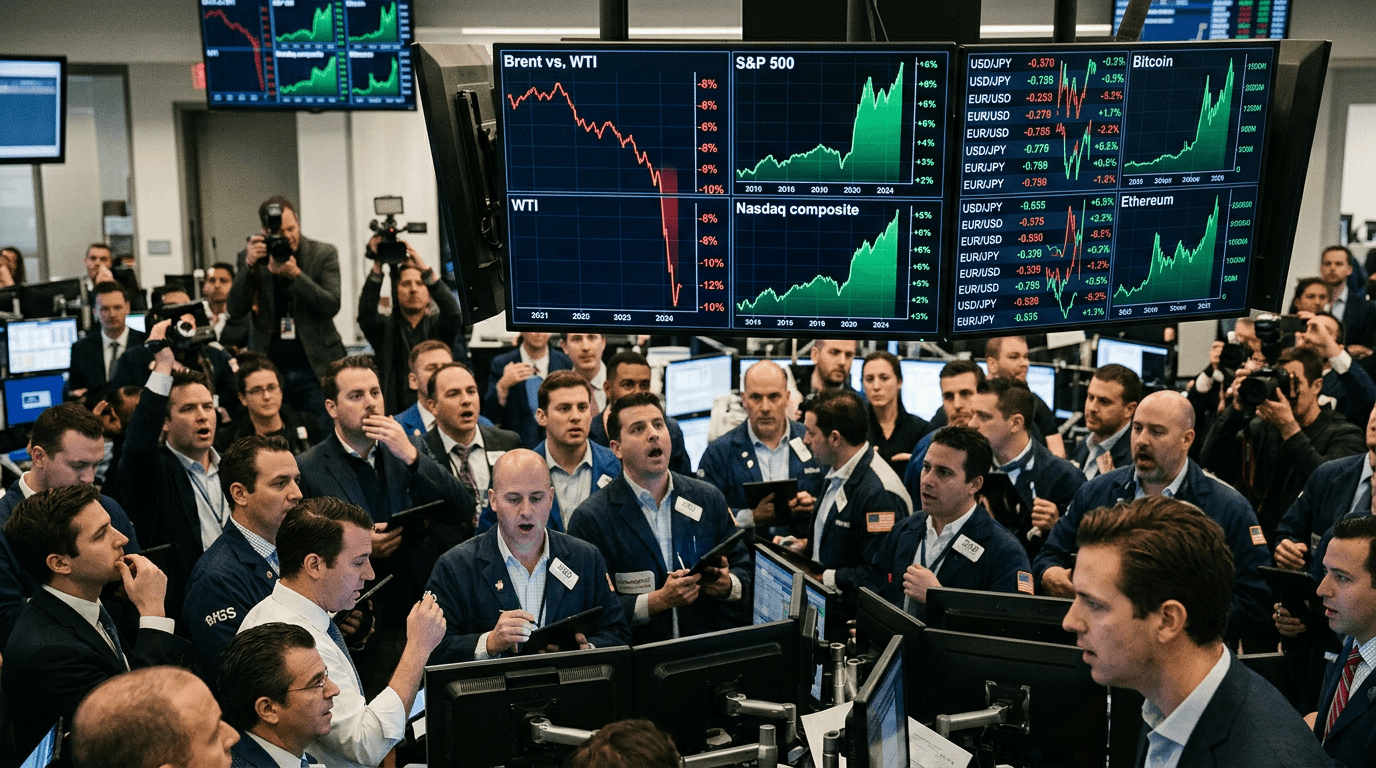
Markets woke up to a rare kind of geopolitical headline: instead of war escalation, a peace memorandum between the US and Iran. The immediate reaction was violent across asset classes—oil sold off, Asian equities ripped to new highs, higher‑beta currencies and major cryptocurrencies surged, while traditional safe havens lost ground as traders rapidly repriced global risk, inflation, and growth scenarios.[1][3][8][9]
What Happened: From War Risk To Peace Dividend
After months of conflict and disrupted flows through the Strait of Hormuz, Washington and Tehran agreed to a memorandum of understanding (MoU) that lays out a pathway to a formal peace deal.[1][2][3] The framework includes an extended ceasefire, steps toward reopening key shipping lanes, and a timetable for further negotiations on sanctions and nuclear issues.[1][2]
Markets care because Hormuz is one of the world’s most critical energy chokepoints. When it was effectively shut, the war “premium” in crude prices and inflation expectations rose sharply. With the MoU in place and a formal signing expected in Switzerland, markets are now pricing in a lower probability of major supply disruption and a reduced risk of an inflation shock.[1][2][3][8]
This swing in perceived tail risks—from “war and energy crunch” to “ceasefire and normalization”—is what shifted the narrative from risk‑off to risk‑on in a matter of hours.
Why Oil Dropped: Unwinding The War Premium
Oil was the most obvious casualty of the peace headlines. Brent and WTI quickly gave back a chunk of their recent war‑risk gains as traders marked down the probability of prolonged supply disruptions and a structurally tighter market.[3][8][10]
For months, crude prices had embedded a war premium: - Disrupted shipping through the Strait of Hormuz - Concerns that Iranian exports would remain constrained - Fears of a broader regional conflict pulling in other producers
The MoU does not magically fix physical supply, but it changes expectations. The prospect of reopening Hormuz and relaxing some restrictions on Iranian exports, even incrementally, signals potential future supply relief.[1][2][8] This is enough for speculative longs to take profit and for hedgers (airlines, transport, energy‑intensive industries) to scale back aggressive upside protection.
In macro terms, lower oil prices translate into: - Reduced perceived inflation risk, especially headline CPI - Less pressure on central banks to stay ultra‑hawkish - A slightly more supportive backdrop for growth‑sensitive assets
That is why you often see the “textbook” pattern after such a headline: oil down, inflation expectations softer, bond yields edging lower, and risk assets higher.[2][3]
Risk-on Rally In Equities, Fx And Crypto
Equities responded in classic risk‑on fashion. Asian markets led the charge, with indices like Japan’s Nikkei and Korea’s KOSPI pushing to record highs as investors rotated into cyclicals and high‑growth names that benefit most from lower input costs and reduced geopolitical uncertainty.[3][8] Asia tech shares, in particular, jumped sharply—double‑digit intraday moves—reflecting their leveraged exposure to global growth and risk sentiment.
US equity futures followed suit, with broad indices like the S&P 500 higher and high‑beta segments such as the Nasdaq 100 and small‑caps outperforming as traders embraced the “peace dividend” narrative.[1][3] Investors extrapolated lower energy costs, more predictable global trade flows, and the removal of one major macro overhang.
In FX, the pattern was equally clear. The US dollar and classic safe‑haven currencies like the Japanese yen and Swiss franc lost ground as the market backed away from worst‑case scenarios and unwound defensive positioning.[8][9] Higher‑beta currencies—such as the Australian and New Zealand dollars and select emerging‑market FX—benefited from the improved risk tone and the prospect of stronger global demand.
Crypto behaved like what it increasingly is in macro terms: a high‑beta, sentiment‑sensitive asset class. Major cryptocurrencies that had been treading water on war concerns and tightening liquidity snapped higher as volatility repriced and traders re‑embraced risk. The shift away from crisis hedging toward growth and innovation narratives tends to favor digital assets, especially when real yields stop grinding higher and energy‑driven inflation fears ease.
The through‑line across all these moves: the market is rapidly repricing downside tails—fewer scenarios involving energy shock, stagflation, and severe risk aversion; more scenarios involving continued expansion and benign inflation.
Key Lessons For Traders: How Geopolitics Flows Into Prices
This episode is a live case study in how a single geopolitical headline can cascade through markets:
1. Geopolitics → Commodities Conflict in an energy chokepoint adds a war premium to crude; peace progress removes it. That directly impacts inflation expectations and sector earnings (energy vs transportation, manufacturing, consumer).
2. Commodities → Rates and Inflation Pricing Lower oil reduces perceived inflation risk, which can pull down inflation breakevens and, sometimes, nominal yields. This affects rate‑sensitive assets, from growth stocks to housing proxies.
3. Rates and Inflation → Equities, FX, Crypto As inflation and growth tails soften, investors rotate from safe havens into risk assets. High‑beta equities, pro‑cyclical currencies, and crypto tend to benefit; safe havens and defensive sectors lag.
4. Positioning and Liquidity Matter The speed and magnitude of these moves are amplified by existing positioning. When markets are heavily hedged for war, even partial peace news can trigger sharp squeezes as traders rush to close protection and re‑add risk.
For active traders, the takeaway is not to chase every headline, but to understand the transmission channels and know in advance how you expect different assets to react. That’s your playbook.
Using Simulated Trading To Build Your Event Playbook
A peace MoU of this scale is not an everyday event—but news shocks of various magnitudes hit markets constantly. The edge comes from preparation, not prediction.
In a simulated trading environment, you can:
- Practice reaction, not prediction Build rules for what you do when volatility spikes on geopolitical headlines—how you adjust position size, where you set stops, and which assets you prioritize.
- Test cross‑asset hypotheses For example: “If crude drops 5% on peace news, how do I expect high‑beta FX, bank stocks, and crypto to respond over the next 24–72 hours?” You can test these relationships without risking real capital.
- Refine risk management under stress Sharp, news‑driven moves expose weaknesses in sizing, leverage, and correlation assumptions. SimFi lets you experience that stress in a controlled environment and refine your approach before the next real‑world shock.
- Build scenario trees The MoU is only a step; it could progress to a durable peace—or unravel. Simulated trading lets you build and rehearse scenarios for both outcomes: deeper peace dividend vs renewed conflict and re‑pricing of war risk.
For all the excitement, remember that this is still an MoU, not a fully implemented final deal.[1][2] Implementation risk is real: logistics of reopening shipping lanes, sequencing of sanctions relief, and domestic politics on both sides can all inject fresh volatility. Markets will trade the milestones—signing ceremonies, progress reports, and any sign of backtracking.
For traders and investors, the opportunity lies in combining a clear macro framework with disciplined execution. Understand why oil, equities, FX, and crypto are moving the way they are; then use structured practice—whether in live or simulated markets—to turn that understanding into a robust, repeatable process.