
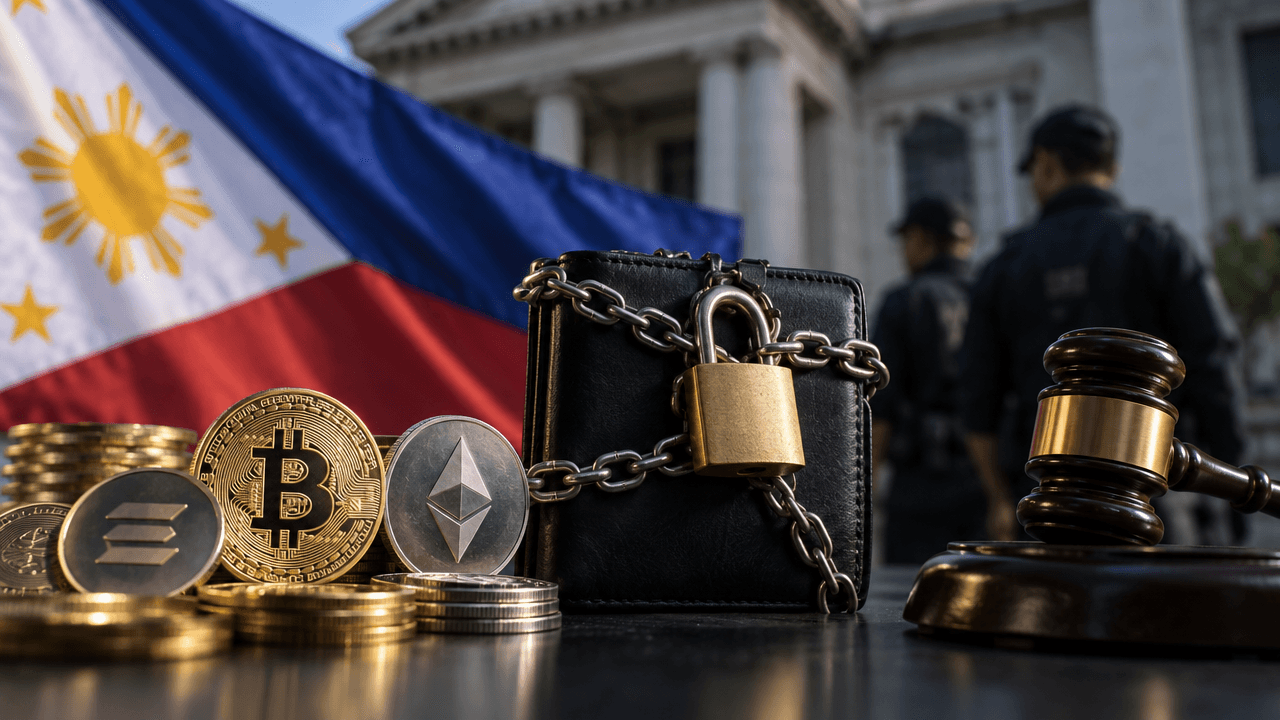
Philippine regulators have moved decisively against alleged corruption involving digital assets, freezing 25 crypto wallets and 86 bank accounts tied to a “prominent lawmaker” under investigation for plunder in flood‑control projects.[2][3][7][15] In total, 116 assets are covered by the order, underscoring how closely authorities are now scrutinizing the link between public‑sector corruption and crypto‑enabled money flows.[1][2][7][15] While the freeze does not amount to a conviction, it sends a clear signal that regional regulators are willing to move quickly against suspected misuse of virtual assets, with implications for compliance, trading behavior and market sentiment across Asia’s crypto ecosystem.[6][8][10][15]
Market Context: Freeze Order Hits 25 Crypto Wallets
The Court of Appeals issued the freeze order on 21 September after finding probable cause that the assets were related to alleged plunder under the Philippines’ Plunder Law, Republic Act 7080.[2][3][7] The Anti‑Money Laundering Council (AMLC) sought the order as part of a broader probe into anomalous flood‑control projects, in which funds from public contracts are suspected of being diverted and laundered through layered financial channels.[2][5][9][15] The case centers on an unnamed lawmaker, a corporation and several associated individuals and entities, all of whom allegedly lacked legitimate income streams sufficient to justify the volume of their investments and asset holdings.[5][7][11]
The composition of the frozen assets illustrates how traditional finance and crypto rails intersect in suspected corruption schemes.[2][4][7] The court’s order covers 86 bank accounts, four investment accounts, one insurance policy and 25 virtual‑asset wallets, reflecting a mix of conventional financial instruments and digital asset infrastructure.[2][3][7][11] Authorities say funds were routed through multiple virtual‑asset service providers and wallets, then distributed among various recipients and channels to make tracing more difficult.[8][10][11][12] For traders, this reinforces a key reality: enforcement risk is no longer confined to banks and cash‑based transactions; crypto venues and wallets are firmly in scope.
What The Freeze Order Actually Does
A freeze order in the Philippine context is an interim measure designed to preserve property suspected of being linked to unlawful activity, preventing it from being withdrawn, transferred or otherwise disposed of while an investigation unfolds.[2][3][6] Under Philippine law, such an order initially runs for 20 days, but courts may extend it up to six months to give authorities time to analyze transaction patterns and build a case.[6] Crucially, a freeze order is not a finding of guilt and does not equate to asset forfeiture; rather, it is a temporary, preventive tool that keeps funds in place so they can be scrutinized.[6][8][10]
For market participants, this distinction matters but does not eliminate risk. Even without a conviction, counterparties whose assets are frozen can face severe operational disruption, reputational damage and banking‑relationship strain.[2][5][13] Service providers involved in the flows—whether banks, brokerages or virtual‑asset platforms—may come under pressure to review their controls, report suspicious activity and exit certain relationships.[8][11][12] Traders should understand that once authorities establish probable cause, the threshold to immobilize assets is lower than the threshold to convict, and regulators are increasingly willing to act at the freeze‑order stage.
Ripple Effects On Regional Crypto And Simfi Markets
The incident feeds into a broader global narrative: regulators in emerging markets are treating crypto not only as a speculative asset class, but also as a potential channel for large‑scale corruption and money laundering.[8][10][11] When a high‑profile case connects virtual‑asset wallets to alleged plunder of public funds, it bolsters political support for tighter oversight, stronger know‑your‑customer (KYC) rules and stricter licensing of local exchanges and service providers.[2][4][7][11] Neighboring jurisdictions watch these developments closely, and regional compliance standards often converge upward over time.
For traders using SimFi platforms like E8 Markets, these real‑world events are valuable stress‑test scenarios rather than immediate capital risks. Simulated environments allow traders to model how sudden enforcement actions and negative regulatory headlines can impact liquidity, volatility and cross‑exchange spreads. A freeze targeting specific wallets or accounts can, in live markets, trigger temporary dislocations, widen bid‑ask spreads and deepen the discount on tokens perceived as regulatory targets. Practicing how to manage positions and risk limits during such events in a simulated setting helps traders prepare for similar shocks in live trading.
Risk Management Lessons For Traders
Three practical lessons stand out from the Philippine freeze order. First, counterparty risk extends beyond exchanges to include the broader ecosystem of brokers, liquidity providers and funds that may be entangled—directly or indirectly—with regulatory investigations. If a key counterparty’s accounts are frozen, access to liquidity can dry up quickly even if the underlying tokens remain tradable. Second, compliance risk is now a market variable: changes in enforcement intensity can move prices, especially in tokens closely associated with certain jurisdictions or platforms.
Third, information flow matters. The Philippine case became public through official AMLC statements and local media coverage outlining the scope of the freeze and the suspected laundering patterns.[2][5][7][13] Traders who monitor regulatory news alongside price feeds can react more rationally than those who rely solely on social‑media sentiment. In practice, that means incorporating regulatory event tracking into trading plans, defining rules for how to adjust exposure when new enforcement actions hit, and documenting scenarios in which standing aside is safer than chasing volatility.
What To Watch Next
Going forward, several variables will determine how market‑moving this case becomes. The immediate question is whether the freeze order leads to formal charges and eventual convictions, or remains an interim measure that expires without asset forfeiture.[6][8][10] The duration and scope of any extensions to the initial 20‑day freeze will signal how confident authorities are in their evidence.[6] At the regulatory level, the key issue is whether this case prompts new guidance, stricter rules or additional oversight for virtual‑asset service providers in the Philippines and potentially across ASEAN.[2][4][7][11]
For traders and SimFi users, the takeaway is clear: enforcement risk around crypto is rising, but it is also increasingly predictable in its triggers and mechanics. Understanding how freeze orders work, how investigators trace funds through wallets and bank accounts, and how regulators communicate their actions equips traders to respond with discipline rather than panic. Using simulated platforms to rehearse responses to regulatory shocks—adjusting position sizes, diversifying counterparties, and defining stop‑trading thresholds—turns headline risk into a training opportunity. In an environment where compliance and markets are tightly intertwined, preparation is a durable edge.