
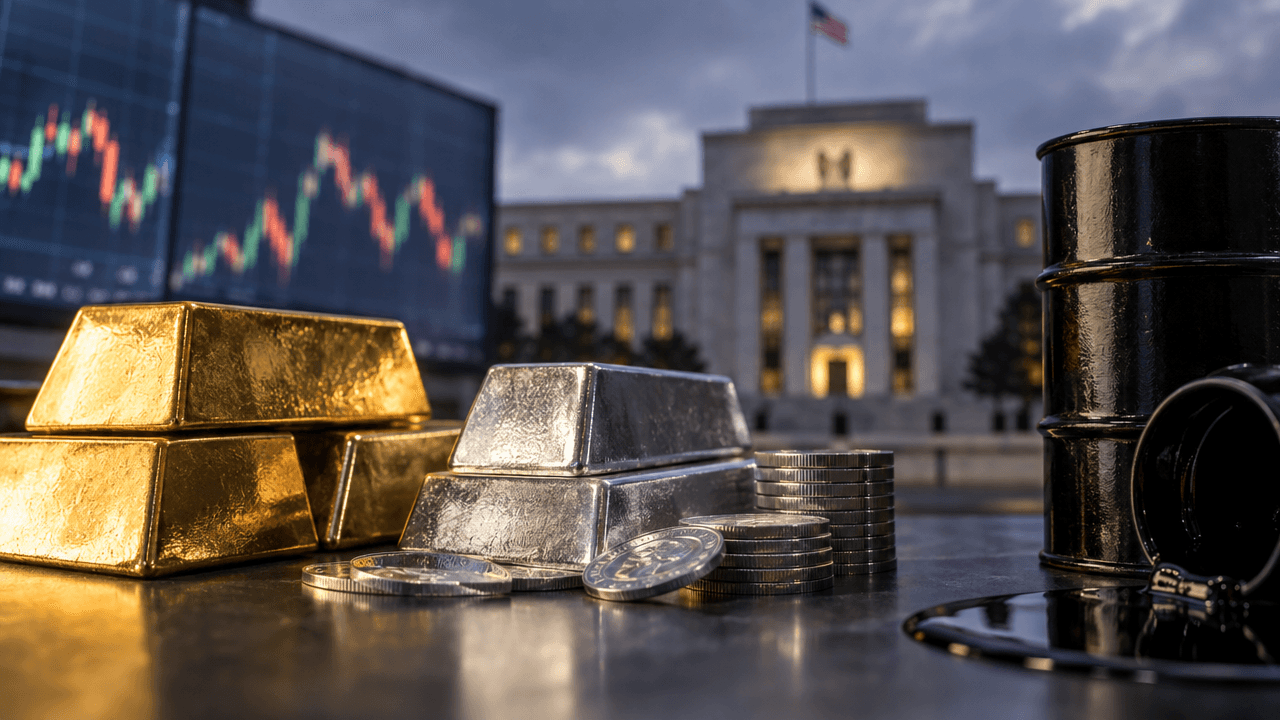
Markets are entering the latest Federal Reserve meeting with a distinctly defensive stance, and nowhere is that more visible than in precious metals and energy prices[9][10][14]. Gold and silver are catching a bid as classic hedges against policy missteps, while Brent crude trades above the psychological $100 mark and has recently pushed past $108 per barrel, rekindling inflation fears and complicating the Fed’s calculus[9][10][14]. For traders, these cross-asset moves are more than headlines—they are real-time signals about risk sentiment, inflation expectations, and the path of interest rates.
Fed Jitters And Precious Metals
In periods of policy uncertainty, gold and silver tend to become voting machines on how confident investors are in central banks[5][10][13]. Ahead of the upcoming US Fed decision, gold and silver prices on India’s MCX have firmed, with silver showing a comparatively stronger tone as traders hedge interest-rate and currency risks[10][11][15]. Internationally, spot gold has oscillated around multi-month ranges, rising on days when the dollar softens and rate hike bets fade, but slipping when inflation data or Fed commentary reassert “higher for longer” narratives[9][12][14].
These moves reflect a familiar dynamic: gold as a hedge against both financial volatility and the potential erosion of real purchasing power, silver amplifying that behavior with higher beta to growth and industrial demand[5][10]. When traders anticipate a hawkish surprise—strong inflation prints, firm labor data, or a Fed that pushes back on easing hopes—precious metals often correct lower as real yields climb[4][9][14]. Conversely, any hint of dovishness or policy misstep that might allow inflation to re-accelerate tends to pull capital back into safe-haven metals[5][12].
Key takeaway: treat gold and silver as live “sentiment gauges” around Fed decisions, not static safe havens. Their response will depend on whether the market interprets the Fed as credibly restraining inflation or falling behind the curve.
Energy Prices Reignite Inflation Fears
Energy is the other side of this story. Brent crude’s push above $108 per barrel reflects persistent supply concerns, geopolitical tensions, and a market unwilling to price a quick return to pre-shock levels[9][14]. Oil is the most visible inflation input for households and businesses, and its rally has repeatedly reignited fears that headline inflation could re-accelerate just as the Fed attempts to guide the economy toward a soft landing[9][12][13].
Recent episodes have shown that spikes in oil prices can overshadow otherwise benign inflation data, forcing traders to reassess how “transitory” disinflation really is[9][14]. Higher fuel and transportation costs feed through to broader price levels, prompting markets to increase the odds of additional rate hikes or a longer plateau at restrictive settings[9][12]. That, in turn, pressures rate-sensitive assets—equities, long-duration bonds, and even metals—creating a complex push-pull between gold’s role as an inflation hedge and its sensitivity to real yields[5][9][14].
Key takeaway: track oil and the Fed together. A crude rally into a policy meeting raises the bar for dovish surprises and increases the odds that the Fed will lean hawkish or at least reaffirm a cautious stance.
Futures Curves Signal Longer-lived Pressure
The impact of Fed jitters and energy prices is visible not just in spot markets, but across the futures curves for both metals and crude[5][9][12]. In oil, sustained strength at the front of the curve—where near-dated contracts trade at a premium to longer-dated ones—often indicates worries about short-term supply or geopolitical risks, reinforcing the idea of near-term inflation pressure[9][12]. When the curve flattens or slips into contango, it can signal that markets expect current tightness to ease, reducing inflation risks over the medium term[5][12].
In precious metals, upward pressure on near-term futures alongside higher implied volatility tends to occur when traders are actively hedging event risk around major data releases or policy meetings[4][10][13]. If the Fed is perceived as staying ahead of inflation, the curve can flatten as market participants expect less need for aggressive hedging, with longer-dated contracts reflecting more stable real-rate expectations[5][6]. Academic research suggests that the direct impact of pure monetary shocks on commodity prices has moderated compared with pre-crisis periods, but policy surprises still matter when they interact with inflation and growth narratives[6].
Key takeaway: don’t stare only at spot prices. Curve shape, volatility structures, and term spreads offer more nuanced information about how deeply markets believe current inflation and policy risks will persist.
Practical Playbook For Commodity Traders
For active traders, the current backdrop calls for a structured approach rather than reactive bets. One framework is to separate trades into three themes: inflation hedging, policy surprise positioning, and relative-value opportunities between metals and energy.
Inflation hedging might involve strategic long exposure in gold or diversified commodity indices when oil rallies look durable and real yields appear capped[5][9][12]. Policy surprise positioning involves using options around Fed meetings to express views on volatility—buying calls on gold or crude if you expect a dovish turn that could weaken the dollar, or puts if you anticipate hawkish language that lifts real yields and pressures commodities[4][9][13]. Relative-value trading looks at the historical relationship between gold and oil: when oil rallies sharply while gold lags, it may signal either a lagged catch-up in metals or an overdone move in energy, depending on the macro backdrop[5][9][12].
Risk management is critical. High-impact events like Fed decisions can produce sharp intraday swings, whipsawing unhedged positions. Position sizing, clear stop levels, and an understanding of margin requirements across MCX, global metals exchanges, and energy futures are essential to navigate these conditions without over-leverage[10][11][15].
Key takeaway: convert macro views into clearly defined trade structures, and always pair directional ideas with robust risk controls.
Simulated Finance: Stress-testing Your Strategy
Simulated Finance (SimFi) environments offer a powerful way to rehearse strategies for exactly this type of cross-asset scenario. When MCX gold and silver move in anticipation of a Fed outcome and Brent trades north of $108, simulated markets can replicate historical episodes with similar conditions—oil spikes, policy uncertainty, and shifting inflation expectations[9][10][14]. Traders can test how different portfolios behave when gold rallies but then corrects on a hawkish surprise, or when oil jumps again after a supposedly “dovish” meeting that inadvertently weakens the currency and re-stokes inflation risks[5][9][12].
In a SimFi setup, you can run playbooks such as: long gold versus short equity going into the meeting; long crude with a protective put spread; or a calendar spread on metals futures to express views on how quickly policy clarity will normalize volatility[4][5][10]. Because capital risk is removed, you can stress-test reactions to extreme scenarios—a sharper-than-expected rate hike, a sudden drop in oil, or an unexpected geopolitical shock—that would be challenging to explore with live exposure[6][9][12].
Key takeaway: use simulation to turn the current Fed-and-energy narrative into a learning environment. The goal is not to predict every move, but to build muscle memory for how to respond when correlations break, volatility spikes, or the Fed delivers a surprise.