
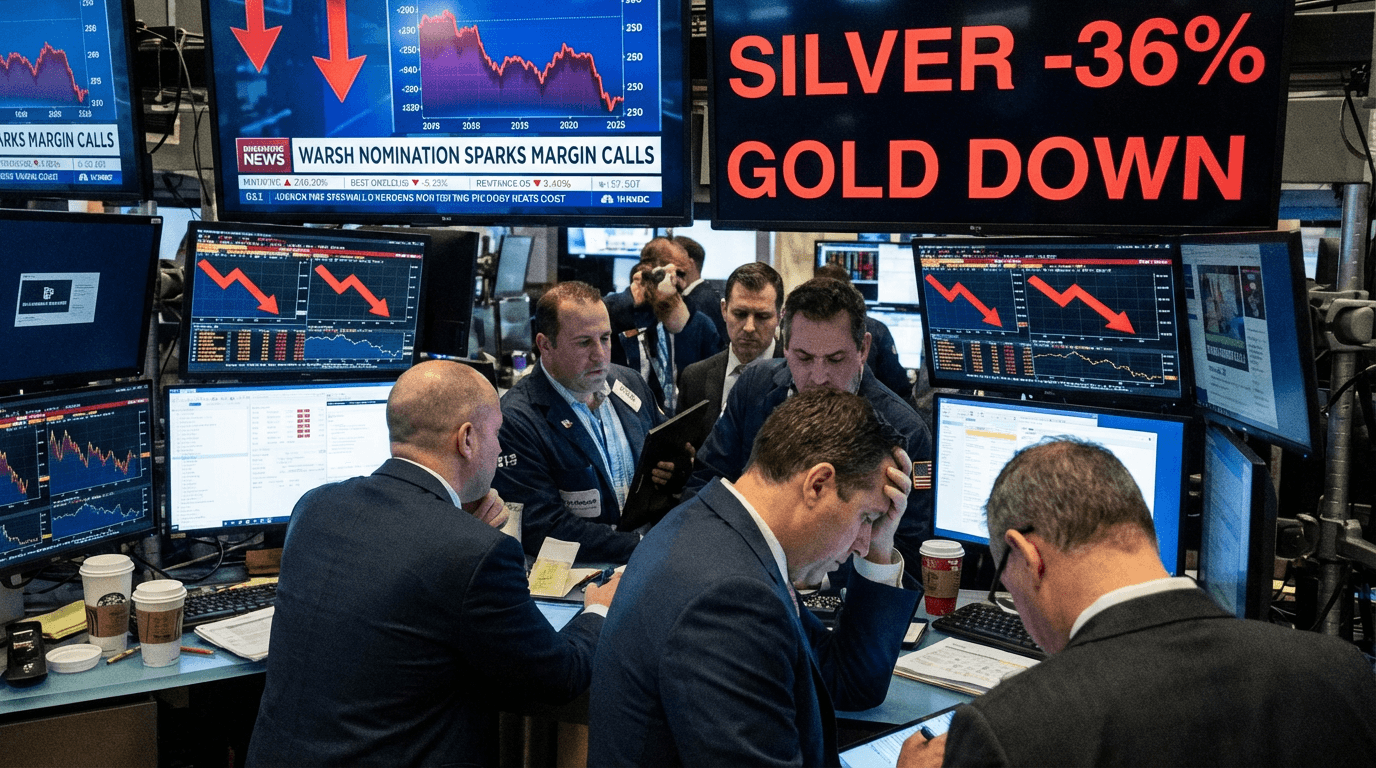
The precious metals market experienced one of the most catastrophic sell-offs in modern financial history on January 29-30, 2026, with gold and silver suffering devastating losses that wiped out trillions in paper value and left traders questioning the fundamental structure of commodity markets. What started as a coordinated unwinding of crowded trades escalated into a systemic event that exposed deep structural vulnerabilities in how precious metals are traded, priced, and regulated. For traders and investors, understanding what happened—and why—is critical to navigating the volatile regime ahead.
What Happened: The Numbers Tell A Brutal Story
The scale of the destruction was staggering. Gold plunged $500 in just 60 minutes, dropping from $5,600 to $5,100, representing a 9% crash in a single hour. Silver fared even worse, collapsing $13 from $121 to $108—an 11% decline in the same timeframe. By Monday morning, silver had fallen further to around $77 an ounce, marking the largest single-day decline since the Hunt Brothers crisis of 1980. Gold stabilized around $4,700 but remained under pressure. In total, approximately $5.9 trillion in paper value was erased in what market observers are calling the "30-Minute Crime Scene."
This collapse followed an extraordinary January rally where silver surged 65% and gold climbed 30%, creating an environment ripe for mean reversion and forced liquidations. The sharp reversal wasn't a gradual correction but a violent, algorithmic unwinding that caught leveraged traders off-guard and triggered cascading margin calls throughout the system.
The Technical Breakdown: When Structure Becomes Fragile
What made this crash particularly severe wasn't just the initial selling—it was the mechanical reinforcement that followed. The CME Group announced an emergency 36% margin hike effective February 2, 2026, a move that had immediate and devastating consequences. Traders holding leveraged positions were suddenly required to post significantly more capital. Those who couldn't meet the new margin requirements were automatically liquidated, forcing them to sell at precisely the worst moment.
This created a vicious cycle: margin hike announcement triggered selling, selling caused prices to drop further, and each price decline triggered additional margin calls, forcing more selling. The system had been mathematically engineered to be fragile, and when the first major shock hit Friday afternoon, there was insufficient liquidity to absorb the impact. Prices collapsed not because fundamentals changed dramatically but because the market structure itself became a "kill switch" for leveraged participants.
Perhaps most troubling for long-term investors was the exposure of a massive divergence between paper and physical prices. While futures contracts plunged, physical silver dealers found themselves unable to source inventory at anywhere near the published prices. Retail investors who owned physical silver bars discovered their holdings were worth 30% less on paper than the previous day—not because the metal disappeared but because paper contracts with no physical backing had collapsed. This separation between the abstract price in futures markets and the concrete reality of physical possession has become a defining characteristic of the new market regime.
Why The Fed Decision Triggered The Cascade
The immediate catalyst for the sell-off was Donald Trump's nomination of Kevin Warsh to lead the Federal Reserve. Warsh is perceived as hawkish on monetary policy and supportive of shrinking the Fed's balance sheet—positions that directly threaten the assumptions underlying the precious metals bull market. Throughout 2024 and into 2025, investors had accumulated massive long positions betting on currency debasement, central bank money printing, and dollar weakness. Warsh's nomination signaled a potential shift toward tighter monetary policy and a stronger dollar.
As the dollar strengthened following the announcement, precious metals—which are priced in dollars and therefore negatively correlated with dollar strength—suffered sharp declines. The strength of the dollar INDEX, or DXY, acts as a powerful negative multiplier for commodities. When the DXY rises, gold and silver typically fall. This relationship became brutally apparent as the Warsh trade unfolded and the dollar surged.
Additionally, weaker economic data from China, which consumes substantial quantities of industrial metals alongside precious metals, added to selling pressure and reinforced bearish sentiment across commodity markets.
Separating Signal From Noise
For traders and investors, the key question is whether this represents a trend reversal or a violent correction within a continuing bull market. The underlying fundamentals that supported the January rally remain largely intact—central banks continue accumulating gold, geopolitical tensions persist, and sovereign debt remains at unsustainable levels. However, the technical damage is real, leverage has been purged, and the market structure has fundamentally changed with higher margins and tighter risk management.
The historic crash of January 30th serves as a stark reminder that precious metals markets, despite their reputation as safe havens, are subject to violent technical corrections when leverage unwinds and structural vulnerabilities are exposed. Understanding both the fundamental case for owning precious metals and the mechanical risks of how they trade is now essential for anyone with exposure to this asset class.