
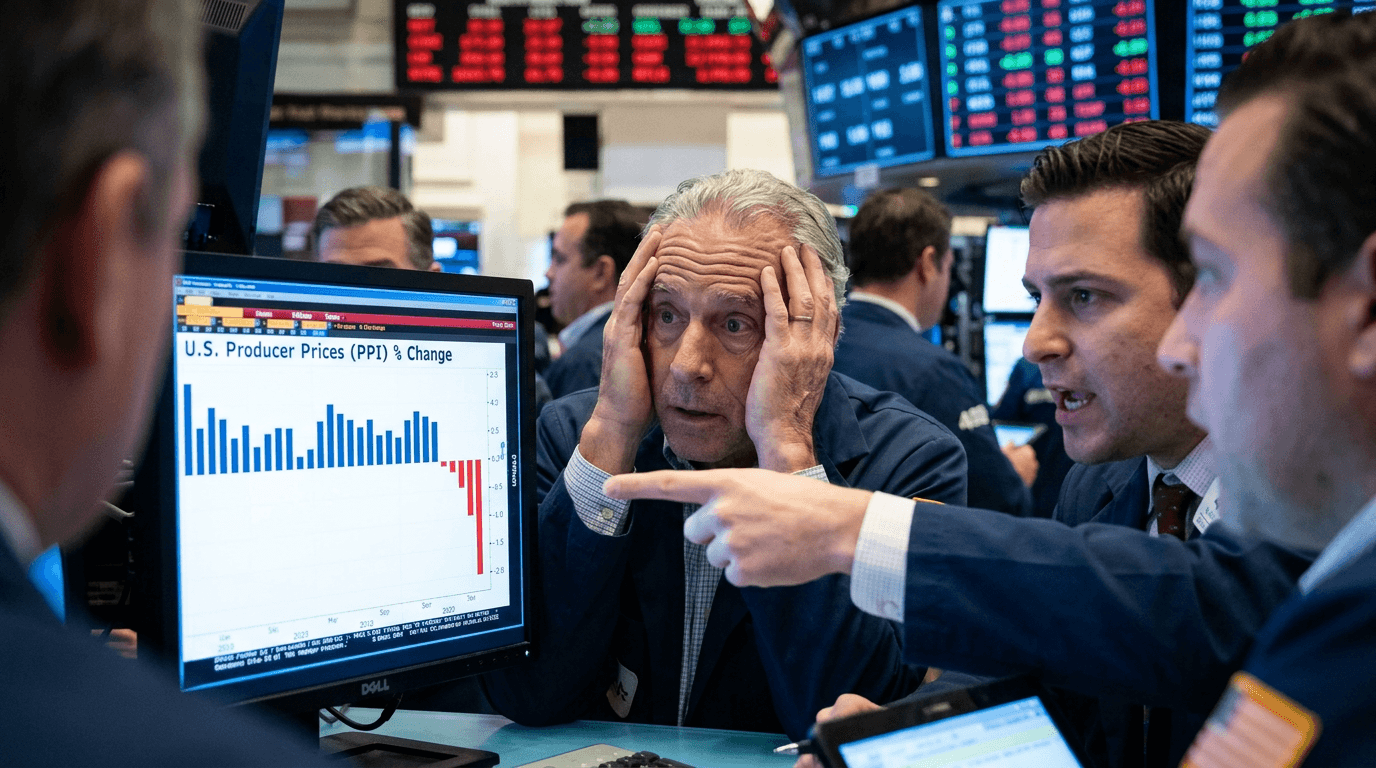
U.S. producer prices just delivered the kind of surprise markets notice: a 0.4% month‑on‑month decline in the Producer Price Index (PPI) for final demand, versus expectations for an increase. That downside shock to wholesale inflation quickly fed into rates and FX pricing, nudging traders toward a more dovish path for Federal Reserve policy over the coming months as near‑term inflation pressures were marked down in interest‑rate futures.
What The Ppi Data Is Telling Us
The Producer Price Index tracks the average change in prices received by domestic producers for their output, essentially measuring inflation pressures earlier in the production pipeline before they reach consumers.[4] It covers a broad range of goods and services, from raw materials and intermediate inputs to final‑demand products sold to businesses and governments.[4]
A 0.4% month‑on‑month drop in PPI is meaningful because markets had positioned for a modest increase, consistent with a narrative of sticky inflation. Instead, the data hinted at softening pricing power for producers, suggesting that some cost pressures may be easing or that firms are finding it harder to pass on higher costs to customers.
This kind of downside surprise is especially important when it comes on the heels of mixed or only slowly improving inflation data elsewhere. It adds another piece of evidence that upstream price pressures may be cooling, potentially feeding through to consumer price inflation in the months ahead.
Investors also pay close attention to “core” producer prices, which strip out volatile food and energy components. If both headline and core PPI are soft, the signal that underlying inflation momentum is slowing becomes more convincing. If only the headline is weak while core remains firm, markets may treat the move more cautiously, viewing it as noise driven by a few categories such as energy or commodities.
Why Producer Prices Matter For The Fed
The Federal Reserve’s mandate is centered on maximum employment and stable prices, with the latter increasingly interpreted through 2% inflation over time. While the Fed’s formal inflation target is based on personal consumption expenditures (PCE) prices, it looks at a wide dashboard of indicators, including the PPI, to understand where inflation is likely heading.
Producer prices matter because they are part of the “pipeline” for consumer inflation. If input and wholesale prices are consistently rising, they tend to filter into consumer prices with a lag. Conversely, declining or subdued producer prices reduce the pressure on firms to raise end‑user prices, lowering the risk of persistent inflation.
When PPI prints significantly below expectations, it gives doves on the Federal Open Market Committee more cover to argue that policy can remain accommodative or that rate cuts can be delivered sooner without jeopardizing the inflation outlook. It also reduces the urgency for hawks to push for tighter policy, at least in the near term.
That is exactly why this downside surprise nudged policy expectations in a more dovish direction. Traders in interest‑rate futures and swap markets modestly increased pricing for future Fed easing, effectively saying: “If upstream inflation pressures are easing faster than thought, the Fed has a bit more room to consider cutting later.”
Market Reaction: Dollar, Yields, And Risk Assets
A softer‑than‑expected PPI print typically triggers a familiar pattern across macro markets:
Short‑term interest rates: Yields on Treasury bills and short‑dated notes often dip as traders price in a slightly lower expected path for the Fed funds rate. In futures markets, contracts tied to the policy rate may show higher probabilities of cuts or a steeper path of easing.
Longer‑term yields: At the long end of the curve, yields can also fall as inflation risk premia decline. However, the move is sometimes less pronounced if growth expectations remain solid; in that case, curves may steepen as the front end rallies more than the back end.
U.S. dollar: A more dovish Fed path tends to weigh on the dollar, especially against currencies whose central banks are perceived as more hawkish or less likely to cut. FX markets often re‑price rate differentials quickly after surprises in U.S. inflation data.
Risk assets: Equities and credit often respond positively to lower inflation pressures and lower expected rates. Growth stocks and duration‑sensitive sectors, such as technology, can be particular beneficiaries when yields fall on a dovish shift in expectations.
In the latest move, that is exactly what played out: traders dialed back near‑term inflation concerns, nudged up the odds of future easing, and adjusted positions across Treasuries, the dollar, and equity indices accordingly.
What This Means For Traders And Simulated Finance
For traders, both in live markets and in SimFi environments, a print like this is a textbook example of how a single macro release can reprice the entire curve of expectations.
In practical terms
- Macro calendars matter: Knowing when PPI, CPI, PCE, and jobs data are due is as important as any technical indicator. The biggest intraday moves frequently cluster around these releases.
- Consensus versus surprise: Markets care less about the absolute level of the data and more about the gap versus expectations. A negative 0.4% PPI print is impactful precisely because traders were positioned for an increase.
- Narrative shifts: Each data point either reinforces or challenges the prevailing macro narrative. Recently, the narrative has been about persistent inflation and a cautious Fed. A downside PPI surprise pushes against that, even if only modestly.
- Cross‑asset linkages: Learning to map “lower inflation surprise” into “lower front‑end yields,” “softer dollar,” and “stronger risk assets” is core to macro trading. Simulated trading environments allow you to practice these reaction functions without capital at risk.
In a SimFi setting, you can re‑create the past 24–48 hours of market action: how Treasury yields moved after the release, how the dollar reacted against major pairs, and how equity indices repriced. Doing this repeatedly around key data helps you build an internal playbook for future events.
Key Takeaways For Your Playbook
For traders looking to turn this news into an edge, a few key lessons stand out:
First, treat PPI as an early warning system rather than a standalone signal. It is one piece of the inflation mosaic, best interpreted alongside consumer prices, wage data, and inflation expectations.
Second, focus on the surprise element. Build a habit of comparing the actual print to consensus expectations and thinking through how that gap should affect the Fed path. Even a modest shift in cut probabilities can move rates, FX, and equity indices in a meaningful way.
Third, be nimble but disciplined around data releases. Volatility spikes offer opportunity, but they also punish emotional decisions. Pre‑defined scenarios (“If PPI is 0.3 percentage points below consensus, I expect X, Y, Z reactions”) can help you respond faster and more consistently.
Finally, use simulated environments to pressure‑test your macro strategy. Practicing how you would trade a dovish inflation surprise—without the psychological weight of real capital—can sharpen your execution so that, when it matters, you are reacting with a plan instead of a guess.