
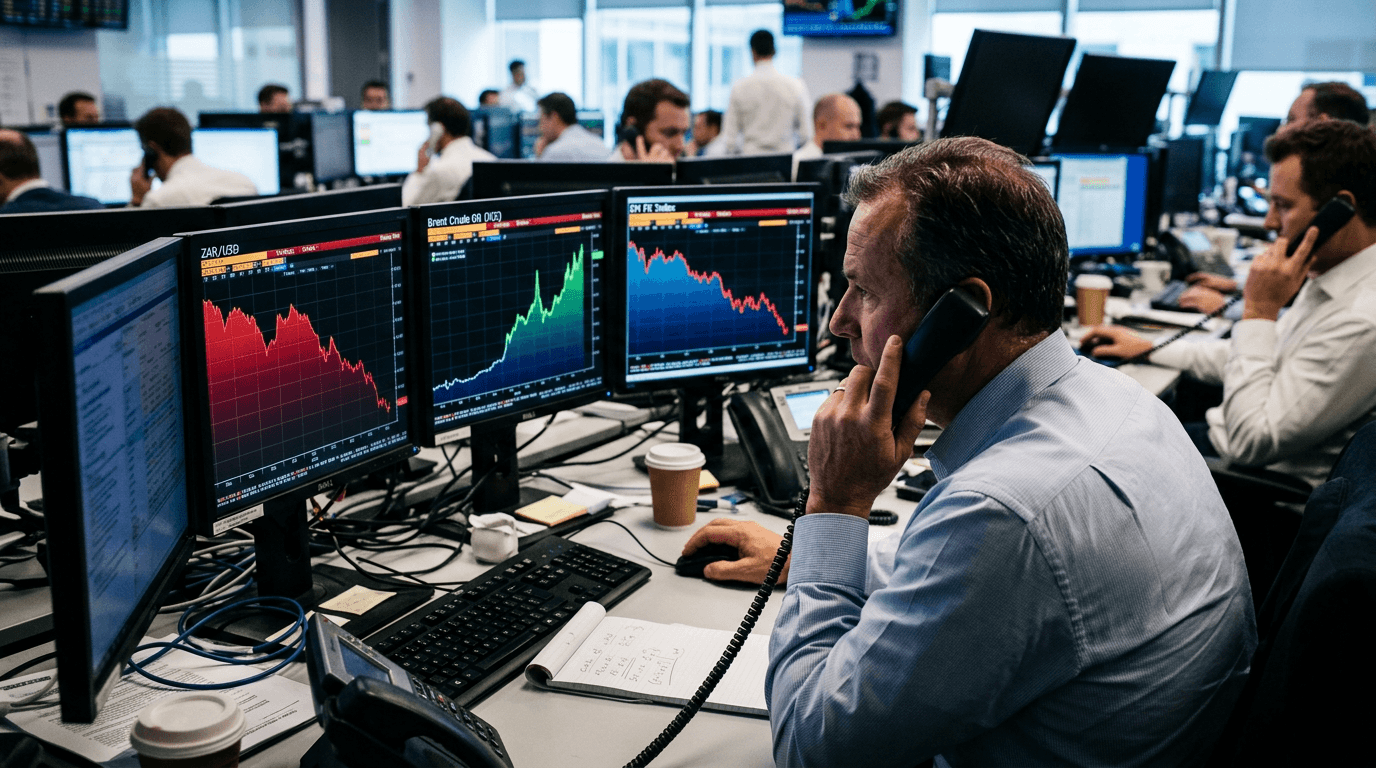
South Africa’s rand has slipped to a one‑week low against the dollar as renewed tensions in the Middle East push investors out of risk assets and into traditional safe havens.[2][15] The move mirrors a broader wave of risk aversion that has hit emerging‑market currencies, equity futures, and bond futures as traders reassess geopolitical risk and reprice the cost of holding higher‑yielding assets.[2][8] For traders, the latest sell‑off is a timely reminder of how quickly geopolitical shocks can ripple through FX and cross‑asset markets.
Market Reaction: Rand And Risk Assets Under Pressure
The rand weakened to around the mid‑16s against the dollar, marking its softest level in roughly a week as the greenback held near recent highs.[2][15] Heightened confrontation involving Iran, the United States, and regional allies has reignited concerns about supply disruptions and broader instability across the Middle East.[2][10] Oil prices jumped more than 2% following fresh military action and renewed sanctions on Iranian crude, amplifying the risk‑off tone across global markets.[2][10] In this environment, the dollar drew a stronger safe‑haven bid, while higher‑beta currencies such as the rand bore the brunt of risk reduction.[2][8]
The impact has not been limited to currencies. Emerging‑market equity and bond futures also came under pressure as investors trimmed exposure to riskier assets in favour of dollar‑denominated and other defensive holdings.[2][4] South African government bonds saw yields push higher during earlier phases of the conflict as investors demanded greater compensation for risk, a classic sign of a flight to safety.[4] This cross‑asset repricing underscores how geopolitical stress quickly becomes a macro theme, affecting everything from FX to fixed income and commodities.[8][10]
Why Geopolitics Hits The Rand So Hard
The rand is widely viewed as a high‑beta proxy for emerging‑market sentiment, which means it tends to move more than peers when global risk appetite swings.[4][15] Analysts note that since hostilities in the Middle East intensified, the rand has underperformed as investors reassessed the outlook for global growth, inflation, and interest rates.[10][12] Over recent weeks the currency has posted cumulative weekly declines as the conflict has persisted, illustrating how sustained geopolitical risk can keep pressure on EM FX beyond the initial headline shock.[10][15]
Oil is a crucial channel for South Africa. The country is a net importer of energy, so a sharp rise in crude prices raises input costs, squeezes real incomes, and complicates the inflation outlook.[10][15] As oil has surged on fears of disrupted supply, markets have begun to question whether the South African Reserve Bank can comfortably deliver the rate cuts that were previously expected, given the risk of higher imported inflation.[10][15] Research houses have cautioned that as long as Middle East tensions and oil market volatility remain elevated, emerging‑market currencies such as the rand are likely to lag developed‑market counterparts, particularly against the U.S. dollar.[10][13]
There is also a terms‑of‑trade angle. Episodes of geopolitical stress have not only lifted oil but also generated volatility in metals prices, undermining one of the rand’s traditional supports via South Africa’s exports of precious and base metals.[12][15] When the dollar strengthens on safe‑haven demand at the same time that export prices wobble, the rand faces a “double squeeze” from weaker capital flows and a softer current‑account backdrop.[12]
WHAT THIS MEANS FOR EMERGING‑MARKET TRADERS
For active traders, the latest rand move is a textbook case of a global risk‑off shock: geopolitical escalation, a jump in oil, a stronger dollar, and broad weakness in high‑yielding EM assets.[2][8] Correlations across emerging‑market currencies tend to rise in these episodes, which is why the sell‑off has extended beyond the rand to other EM FX, equity, and bond markets.[2][8] Traders who were positioned for carry—borrowing in low‑yield currencies to buy higher‑yielders like the rand—have been particularly exposed as volatility picked up and funding conditions tightened.[10][12]
In practice, this environment often brings wider bid‑ask spreads, faster intraday swings, and a greater risk of gaps around news headlines. Overnight geopolitical developments can translate into abrupt moves at the FX open, challenging tight stops and oversized positions. The key lesson is that macro event risk is not an abstract concept: it directly affects P&L, margin, and the behaviour of correlated assets.
A pragmatic approach for EM FX and index traders in this setting includes:
1) Closely monitoring geopolitical timelines alongside economic calendars, especially when tensions are already elevated.
2) Tracking key macro proxies such as the dollar index, front‑month oil futures, and global volatility indices as early warning signals of shifting risk appetite.
3) Scaling position sizes and leverage to reflect higher volatility and the potential for out‑of‑hours price gaps.
4) Stress‑testing portfolios for scenarios where the dollar strengthens further, oil remains elevated, and EM risk premia widen.
Using Simulated Finance To Build Geopolitical Playbooks
Geopolitical shocks like the current Middle East flare‑up are hard to trade because they are unpredictable, fast‑moving, and narrative‑driven. That is precisely where simulated finance (SimFi) can add value. In a simulated environment, traders can replay historical periods of stress—such as previous episodes of Iran‑related tensions—and explore how rand, oil, gold, EM indices, and U.S. yields interacted without putting real capital at risk.
SimFi platforms allow traders to test how different position sizes, hedging strategies, or diversification choices would have performed during prior risk‑off waves. For example, a trader can compare outcomes from running an unhedged long‑rand position versus hedging with dollar exposure, gold, or a global equity index during a Middle East shock. This kind of sandbox testing helps refine rules for when to reduce risk, when to rotate into defensives, and how to avoid forced liquidations during volatility spikes.
Crucially, simulated trading also builds emotional discipline. Experiencing steep, but virtual, drawdowns during volatile geopolitical episodes can highlight weaknesses in a strategy—such as placing stops too close to market noise or concentrating risk in a single theme—and encourage more robust risk management before those weaknesses are tested with live capital.
Key Practical Takeaways
The rand’s drop to a one‑week low is a reminder that geopolitical risk can challenge even well‑thought‑out macro views when positioning is crowded and volatility is repricing.[2][15]
For traders and investors, several practical takeaways emerge:
1) Treat geopolitical risk as a core macro driver, not a side story. If tensions escalate, assume it will affect FX, commodities, and rates together.
2) Recognise the rand’s role as a high‑beta EM proxy. When global risk aversion rises, the rand is likely to move more sharply than many peers.[4][15]
3) Watch oil as closely as the currency chart. For South Africa, higher crude prices are both an inflation shock and a growth headwind, with direct implications for monetary policy expectations.[10][15]
4) Align leverage and time horizon with the news cycle. Short‑term traders should be wary of holding large positions through weekends or key geopolitical events when headline risk is highest.
5) Use simulated trading to rehearse responses to shock events. Having a pre‑tested playbook for risk‑off scenarios can make the difference between forced exits and controlled adjustments.
As Middle East tensions and the associated oil shock continue to evolve, the rand’s path will likely hinge on the interplay between geopolitics, the dollar’s safe‑haven appeal, and expectations around South African monetary policy.[8][10][12] For now, the message from markets is clear: when uncertainty rises and risk assets sell off, currencies like the rand sit on the front line—and traders need to have their risk management frameworks ready.