
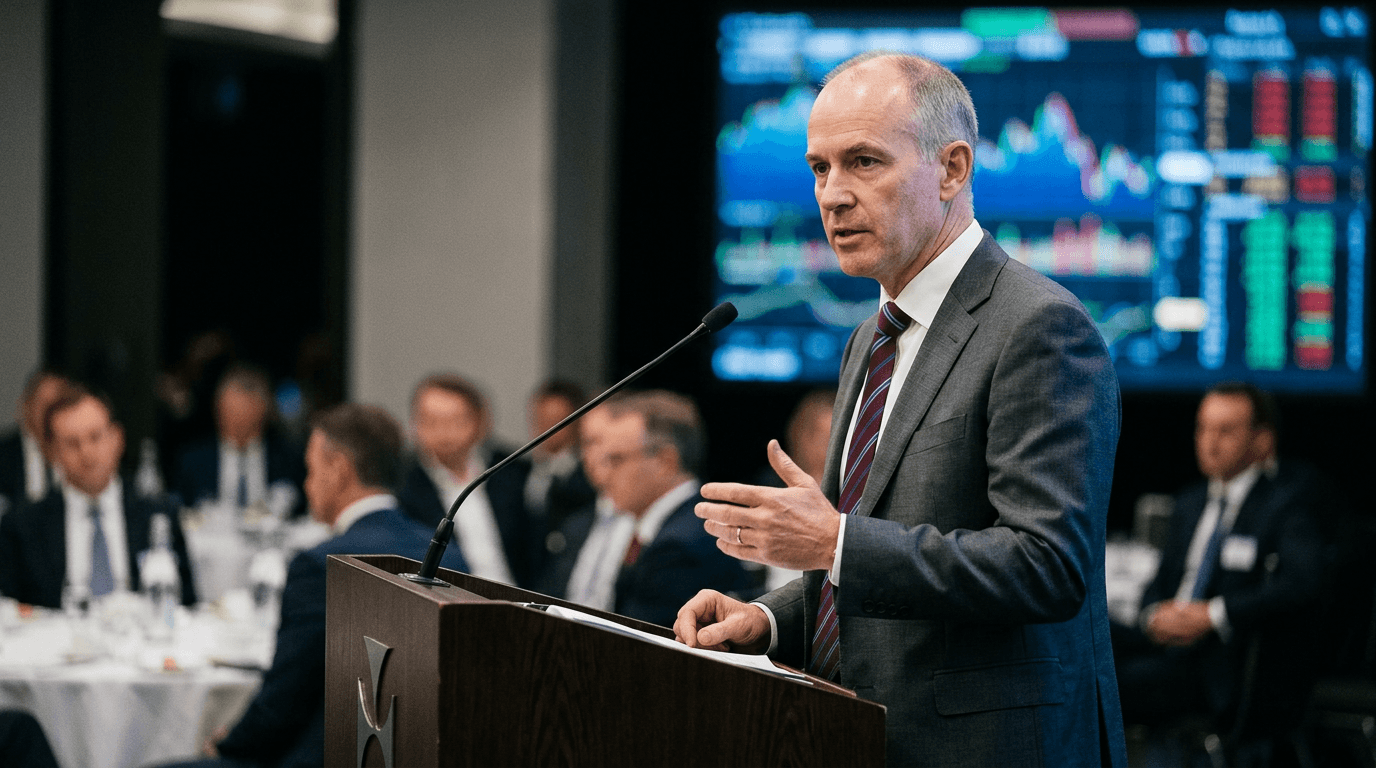
Andrew Hauser’s latest remarks have injected fresh energy into the Australian dollar and local rates markets, as traders reassess how far the Reserve Bank of Australia (RBA) is willing to go if inflation proves stubborn. His message is clear: if price pressures stay “too high” and show signs of becoming entrenched, more rate hikes are firmly on the table.[2][4][9] That prospect supports the AUD, but also raises questions about domestic growth and risk assets, making this a pivotal moment for macro-focused traders and SimFi participants.[2][11][13]
MARKETS FOCUS ON HAUSER’S HAWKISH SIGNAL
Hauser has repeatedly described high inflation as a central banker’s “nightmare” and warned that the board does not yet have high confidence that policy is restrictive enough to bring inflation back to the 2–3% target range.[1][2][11] His comments follow a period where headline inflation is above the RBA’s comfort zone and underlying inflation has stayed above 3%, with forecasts showing trimmed-mean inflation likely to remain elevated into mid-2027.[6][10][13]
These remarks reinforce a tightening bias: the RBA is prepared to “do what is needed” to return inflation to target, including raising rates again if the data suggest price pressures are becoming persistent rather than transitory.[4][5][9] For traders, that shifts the distribution of future policy moves toward more hikes or a longer period of restrictive settings, even if the pace of changes remains measured.
The tone matters as much as the explicit guidance. Hauser has emphasized that inflation “cannot be allowed to persist” at high levels, linking renewed price strength to rising demand against supply constraints in the economy.[9][11] In practice, this keeps the RBA’s reaction function sensitive to upside inflation surprises and firm wage or demand data, a key consideration for anyone trading interest rate expectations or macro-sensitive assets.
Why Sticky Inflation Worries The Rba
Hauser’s focus on “sticky” inflation is rooted in the RBA’s experience with price shocks and the risk of stagflation—a mix of high inflation and weakening growth that he has labeled a “nightmare” scenario.[1][11] Recent rises in fuel and raw material costs, driven in part by conflict in the Middle East and broader energy market disruptions, are expected to push headline inflation toward a peak near 4.8% in mid-2026.[1][2][13]
The RBA’s May Statement on Monetary Policy projects trimmed-mean inflation staying above 3% until around mid-2027, reflecting faster-than-usual pass-through of fuel-related cost increases amid capacity pressures in the economy.[13] This suggests the bank sees not just one-off price spikes but underlying inflation dynamics that could prove hard to tame if expectations become unanchored.
Hauser has underscored that current inflation readings above 3% are “too high” and that strong credit growth indicates rates may not yet be restrictive enough.[5][6][10] At the same time, he stresses the RBA looks one to two years ahead rather than reacting to single data prints, highlighting a strategy aimed at guiding inflation back to target over time while avoiding unnecessary volatility in activity.[6][10][15]
Implications For Aud And Rates Markets
The prospect of additional rate hikes or an extended period of restrictive policy is generally supportive for the Australian dollar, especially relative to peers where central banks are closer to paused or easing cycles.[2][4][11] Higher expected yields in Australia improve the currency’s carry appeal and can attract capital flows into local bonds, particularly at the front end of the curve.
Hauser’s hawkish tone has already lifted attention on AUD as traders price in a higher terminal rate or a slower path to future easing.[2][9][11] Interest rate futures and swap markets tend to react by pushing implied policy rates higher and flattening or inverting curves if growth concerns intensify alongside tightening expectations.
However, tighter policy is a double-edged sword for domestic assets. More hikes increase funding costs, pressure highly leveraged households and businesses, and can weigh on growth-sensitive sectors such as housing, consumer discretionary, and small-cap equities.[1][6][11] For equity traders, that means separating sectors that can pass on higher costs (for example, energy or some exporters) from those more exposed to weaker domestic demand and higher borrowing costs.
Impact On Australian Economy And Risk Assets
Hauser has warned that the income shock from higher oil prices and the broader inflation challenge could lead to a tougher period ahead, including the risk of higher unemployment as policy tightens.[1][2][11] That trade-off—between restraining inflation and safeguarding employment—is at the heart of current RBA deliberations.
Rising rates tend to slow credit growth, cool housing markets, and dampen discretionary spending, which can help bring inflation down but also raises the probability of slower GDP growth or even a mild contraction.[5][6][13] If inflation remains sticky despite tighter policy, the RBA may feel forced to push rates further into restrictive territory, increasing the downside risks for cyclical assets and domestically focused companies.
For bond markets, persistent inflation and a hawkish RBA bias can keep short-dated yields elevated while leaving longer maturities influenced by growth expectations and global risk sentiment.[2][9][13] Periods where inflation surprises on the upside and Hauser reiterates the willingness to act are likely to be accompanied by rising volatility in rates, FX, and equity markets, creating opportunities but also amplifying risk.
How Traders And Simfi Participants Can Respond
For traders on SimFi platforms and in live markets, Hauser’s comments offer a blueprint for scenario analysis and strategy planning. A “sticky inflation, more hikes” scenario suggests several practical angles:
1. Monitor inflation, wages, and fuel price data closely, treating upside surprises as catalysts for repricing RBA expectations and AUD strength.[9][13][15]
2. Consider the relative value of AUD against currencies where central banks are more dovish or closer to cutting, focusing on carry and rate differentials while managing risk around major policy events.[2][4][11]
3. Use simulated environments to test how portfolios respond to shifts in the yield curve—such as front-end rate spikes or curve flattening—and adjust sector exposure accordingly toward more resilient, cash-generative businesses.[6][10][13]
4. Explore hedging strategies for growth-sensitive assets, including duration management in bond portfolios and diversified sector positioning in equity baskets, particularly in scenarios where unemployment rises as policy tightens.[1][6][11]
By practicing these scenarios in a simulated setting, traders can build a playbook for real-world volatility, learning how macro speeches and policy signals translate into market moves across FX, rates, and equities.
Conclusion
Andrew Hauser’s warning that more rate hikes are possible if inflation stays sticky underscores the RBA’s determination to bring price growth back to its 2–3% target, even at the cost of slower growth and higher unemployment.[2][4][11] For markets, this reinforces a hawkish bias that supports the Australian dollar and keeps local rates elevated, while increasing pressure on growth-sensitive domestic assets.[2][9][13]
Traders who understand the links between policy language, inflation dynamics, and asset prices will be better positioned to navigate this environment, whether in live markets or in SimFi platforms that allow disciplined testing of macro scenarios. The key is to treat Hauser’s signals not as isolated remarks, but as part of a broader tightening narrative that will continue to shape Australian markets as long as inflation remains “too high” and uncomfortably sticky.[1][5][9]