
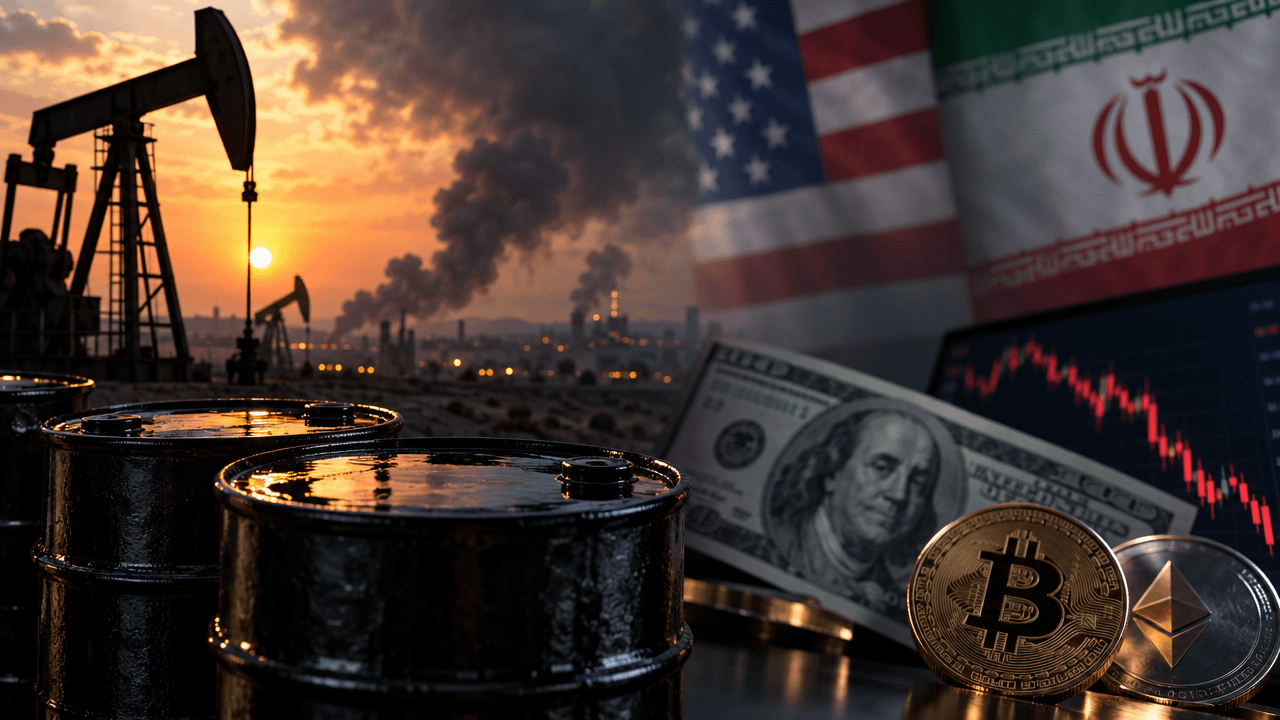
Oil’s surge back above $105 a barrel has turned a simmering geopolitical story into a broad market event, forcing traders to reassess risk, inflation, and liquidity across asset classes. President Trump’s rejection of Iran’s seven-day ceasefire proposal has kept tensions around the Strait of Hormuz elevated, transforming a diplomatic setback into a catalyst for volatility in oil, bonds, equities, crypto and currencies.
MARKETS REACT TO U.S–IRAN STANDOFF
The U.S.–Iran standoff is not just a regional conflict headline; it is directly tied to the flow of energy through one of the world’s most critical chokepoints, the Strait of Hormuz. When traders hear “ceasefire rejected” and “Hormuz still at risk,” they immediately price in higher odds of supply disruption and risk premia across energy markets.
Brent crude spiking above $105 reflects more than near-term supply fears. It signals a repricing of geopolitical risk across time horizons. Markets are effectively assigning a higher probability that elevated tensions will persist, that shipping routes could be disrupted again, and that insurance, logistics, and production costs will rise. All of this feeds into higher expected energy prices and, by extension, higher inflation expectations.
In this type of environment, risk sentiment tends to pivot quickly. Investors rotate out of non-yielding, speculative assets and into instruments perceived as safer or offering more predictable cash flows. That rotation is now visible across equities, crypto, and parts of the bond market.
OIL ABOVE $105: WHY IT MATTERS
An oil price move through the $105 level is psychologically and fundamentally important. Psychologically, three-digit crude prices are a red flag for consumers, policymakers, and asset allocators who remember prior inflation spikes and growth scares. Fundamentally, oil is an input into everything from transportation to manufacturing, so sustained high prices can tighten margins and pressure economic activity.
Higher oil acts like a tax on energy-importing economies. Households face higher fuel and heating costs, while companies see shipping and production expenses climb. That can either compress profits or force firms to pass costs on through higher prices, reinforcing inflation dynamics. For central banks already wary of sticky inflation, renewed energy price pressure can delay rate cuts or even revive hawkish rhetoric.
For traders, the key takeaway is that oil above $105 is not just a commodity story; it is a macro regime signal. It raises the probability of: - Stronger headline inflation prints over the coming months - Central banks keeping rates higher for longer - Increasing dispersion between energy-linked sectors and more rate-sensitive, growth-oriented names
Pressure On Risk Assets And Crypto
While energy-linked futures and oil-sensitive equities have benefited from the move, non-yielding and high-beta assets have come under pressure. Bitcoin, growth stocks, and speculative tech often trade as “liquidity proxies,” thriving when real rates are falling and risk appetite is strong. In an environment of rising yields and geopolitical uncertainty, that narrative flips.
As bond yields push higher, the opportunity cost of holding assets that do not generate income increases. Investors can now earn more on cash-like instruments and short-duration bonds, making it less attractive to hold bitcoin or long-duration growth equities purely for capital appreciation. When the risk-free rate rises, discount rates used in valuation models go up, compressing the present value of distant cash flows.
For crypto traders, the lesson is that macro still dominates. Narrative-driven rallies struggle to persist when real yields are rising and geopolitical risks are unresolved. For equity traders, particularly in high-multiple sectors, this is a reminder that sensitivity to rates and inflation must be part of any risk management framework.
Bond Yields, The Dollar, And Policy Expectations
The same dynamics that push oil higher are now pulling bond yields up and supporting the dollar. Rising inflation expectations and term premia mean investors demand higher yields to hold longer-dated government bonds. At the same time, elevated geopolitical risk can reinforce demand for dollar-denominated assets, especially when the U.S. is perceived as relatively insulated compared with energy-dependent economies.
A stronger dollar further tightens financial conditions. It can weigh on emerging markets, commodity importers, and corporates with dollar liabilities, while helping U.S. consumers to some extent by making imported goods cheaper. However, when the driver of dollar strength is risk aversion and higher yields rather than robust global growth, risk assets tend to struggle.
For traders, several practical implications stand out: - Duration risk matters: Portfolios heavily exposed to long-dated bonds or long-duration growth equities will feel more pressure as yields rise. - FX spillovers: Currency pairs linked to energy importers may weaken, while petro-currencies and the dollar gain relative strength. - Policy path: Even if central banks do not hike, they may signal a slower easing path, affecting rate futures and curve trades.
Practical Takeaways For Traders And Simfi Users
In a SimFi environment, episodes like this are ideal for stress-testing strategies and building macro awareness without real capital at risk. U.S.–Iran tensions and the move in oil above $105 provide a live case study in how geopolitics, commodities, rates, and risk assets interact.
Here are actionable ways to use this regime shift
1. Run scenario analyses Simulate portfolios under: - Sustained oil above $105 - A further spike toward $120 - A fast mean reversion back below $95
Observe how P&L, margin usage, and drawdowns change across equities, crypto, FX, and bond proxies. This helps identify hidden concentrations and sensitivity to energy and rates.
2. Practice cross-asset rotation Use a simulated account to test shifting exposure from: - Non-yielding assets into short-duration, rate-sensitive instruments - Broad indices into energy-linked sectors - Single-name high-beta tech into more defensive, cash-generative companies
Track how these rotations perform as oil and yields move, refining your playbook for future real-world episodes.
3. Refine risk management rules High-volatility macro events are where risk rules are either validated or exposed. In simulation: - Test tighter position limits when key macro thresholds (like $100 or $105 Brent) are breached - Implement volatility-based sizing so positions automatically scale down as average true range or implied vol rises - Explore conditional hedging, such as adding downside index exposure or FX hedges when geopolitical risk spikes
4. Link macro triggers to trading plans Convert qualitative events into quantitative triggers. For example: - “If Brent closes above $105 for three consecutive sessions, reduce net long exposure to high-beta equities by 20%” - “If 10-year yields rise more than 25 basis points in a week, reassess leverage and tighten stop losses”
By embedding clear macro triggers, you move from reactive trading to structured, rule-based decision-making.
Conclusion
The latest U.S.–Iran flare-up and the push in oil above $105 are a reminder that geopolitical risk can rapidly shift the macro landscape. Energy prices, bond yields, the dollar, and risk assets are all responding to the same underlying shock: rising uncertainty around supply, inflation, and policy. For traders, the goal is not to predict every headline, but to understand the transmission channels and build robust strategies that can adapt.
Whether trading live markets or practicing in a simulated environment, this episode underscores the value of cross-asset thinking, disciplined risk management, and clearly defined macro triggers. Oil above $105 is more than a number on a screen; it is a signal that the balance between growth, inflation, and risk appetite is shifting—and your trading framework needs to keep pace.