
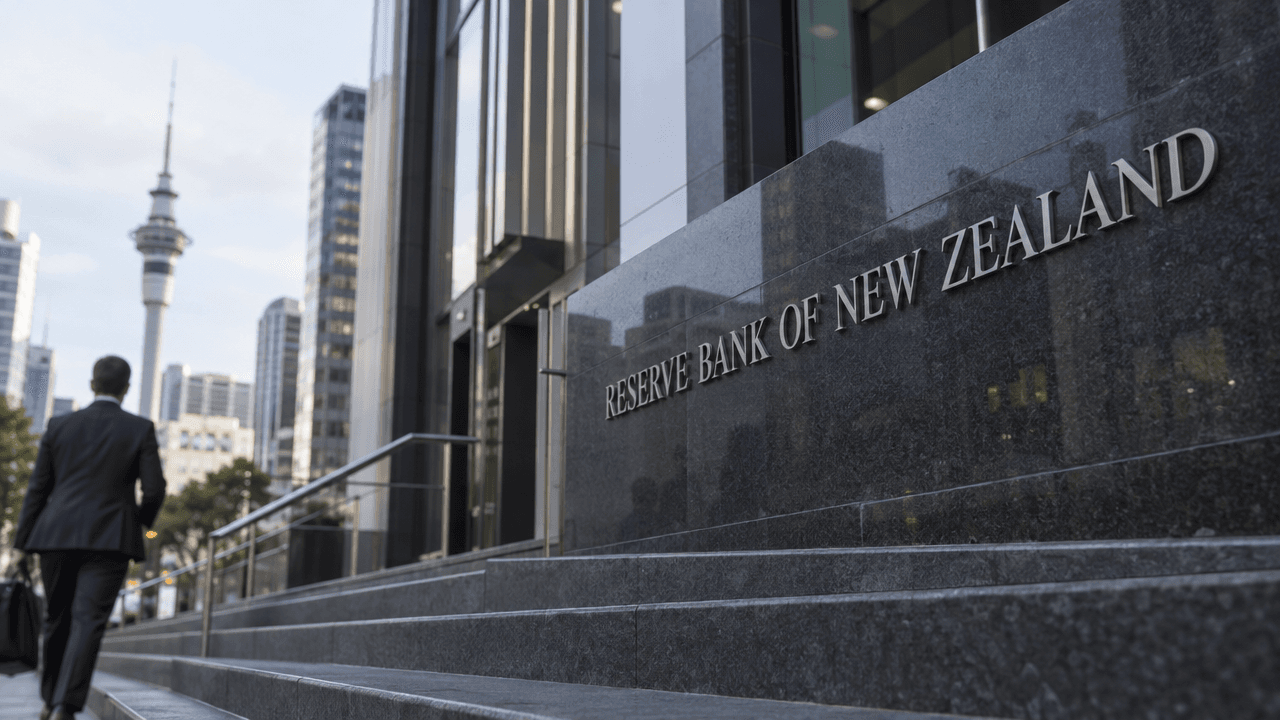
The Reserve Bank of New Zealand is widely expected to raise its Official Cash Rate by 25 basis points to 3% on October 28, marking its third consecutive increase. The decision would confirm that policymakers are responding to persistent inflation pressures, higher energy costs and a weaker New Zealand dollar. However, because financial markets have largely anticipated the move, the announcement itself may be less important than what the RBNZ says about the months ahead.
Markets and economists have moved firmly toward a rate increase. The NZIER Monetary Policy Shadow Board reported that most members supported lifting the OCR from 2.75% to 3%, while major New Zealand banks have also forecast a 25-basis-point hike. [1] The probability of an October increase has risen sharply in interest-rate markets, with pricing at one point indicating an expectation above 80%. [6]
For traders, this creates a familiar central-bank setup: when an interest-rate decision is already priced in, the direction of the currency and bond market depends heavily on the accompanying guidance.
Why The Rbnz Is Expected To Tighten
The RBNZ’s challenge is that inflation remains uncomfortably high even as economic conditions are not uniformly strong. Recent pressure has come from higher fuel prices and a softer New Zealand dollar, both of which can increase the domestic cost of imported goods. A weaker currency also raises the price of imported energy, food and manufactured products, potentially making inflation more persistent.
New Zealand’s quarterly inflation rate reportedly came in below some forecasts but remained too high for policymakers to ignore. Analysts have warned that inflation could move above 4% in the fourth quarter and remain outside the RBNZ’s 1% to 3% target range for longer than previously expected. [12]
A 25-basis-point increase would take the OCR to 3%, its highest level in a year. [2] It would also represent a shift away from the earlier expectation that the central bank might pause. RBNZ Chief Economist Paul Conway has indicated that the decision was not entirely predetermined, but the balance of market expectations has moved decisively toward a hike. [9]
The central bank must therefore balance two risks. Moving too slowly could allow inflation expectations to become entrenched. Moving too aggressively could weaken demand, increase borrowing costs and place additional pressure on households with floating or refinancing mortgages.
Guidance Will Matter More Than The Hike
The most important question is whether the RBNZ signals that additional increases are likely. A routine hike to 3%, followed by cautious language, could disappoint traders who have already priced a longer tightening cycle. By contrast, a clear warning that inflation risks require further action could support the New Zealand dollar and push local interest-rate futures lower.
Several banks expect the OCR to rise beyond 3%. ASB economists have forecast additional 25-basis-point increases in December and February, producing a possible peak of 3.5%. [5] Other forecasts are more cautious, highlighting the uncertainty around the terminal rate and the sensitivity of future decisions to inflation, employment and economic growth.
The absence of a new full set of forecasts may make the tone of the statement and any press conference especially important. Without a fresh projected interest-rate path, traders will examine the RBNZ’s description of inflation, domestic demand and the balance of risks.
A hawkish message would likely include language suggesting that policy must remain restrictive for an extended period or that further tightening may be necessary. A less forceful message could emphasize that the central bank will assess incoming data before deciding whether to continue raising rates.
What It Means For The New Zealand Dollar
The New Zealand dollar has already benefited from expectations of a rate increase. When investors believe New Zealand interest rates will rise relative to those in other major economies, New Zealand dollar assets can become more attractive. This can encourage demand for the currency, particularly when global risk sentiment is supportive.
Yet a widely expected hike can produce a “buy the rumor, sell the fact” reaction. Traders who purchased the kiwi ahead of the announcement may close positions after the decision if the RBNZ fails to deliver a stronger-than-expected outlook.
Market commentary has emphasized that the New Zealand dollar may need hawkish guidance to extend its gains. A signal of more tightening could lift expected returns on New Zealand dollar deposits and bonds, while cautious guidance could prompt an unwinding of recent positions. [15]
The reaction may be especially visible in NZD/USD and AUD/NZD. NZD/USD will also depend on the US dollar, global risk appetite and US interest-rate expectations. AUD/NZD could offer a more focused expression of relative central-bank policy, particularly if traders see the RBNZ as more aggressive than the Reserve Bank of Australia.
Trading The Policy Decision
SimFi traders should avoid treating the expected hike as a guaranteed one-way opportunity. The headline decision is only one part of the event. The statement, policy language, market pricing and subsequent price action all matter.
Before the announcement, traders can identify three scenarios. In the first, the RBNZ raises rates and signals further hikes. This would generally be the most supportive outcome for the kiwi. In the second, the bank hikes but adopts a cautious tone. That could create a volatile or initially bullish reaction followed by a reversal. In the third, the RBNZ unexpectedly holds rates. Because markets have placed a high probability on an increase, a surprise hold could trigger a sharp decline in the New Zealand dollar and a rally in rate futures.
Risk management is essential. Central-bank announcements can produce rapid spreads, slippage and reversals. Traders should reduce position size, avoid placing stops too close to current prices and define the maximum acceptable loss before entering. Waiting for the first reaction to settle can be more effective than attempting to predict every second of the release.
Key Takeaways
The expected move to 3% is significant, but it is largely priced into markets. The RBNZ’s guidance on future tightening is likely to determine the next sustained move in the New Zealand dollar and local rate futures.
The central bank’s policy path will depend on whether inflation remains above target, how energy prices evolve and whether the weaker kiwi continues to add imported inflation. Traders should focus not only on the rate decision but also on the language used to describe these risks.
For SimFi participants, the event offers a valuable lesson in macro trading: market prices reflect expectations before the news arrives. The greatest opportunity often comes from the difference between what traders anticipated and what policymakers actually communicate.