
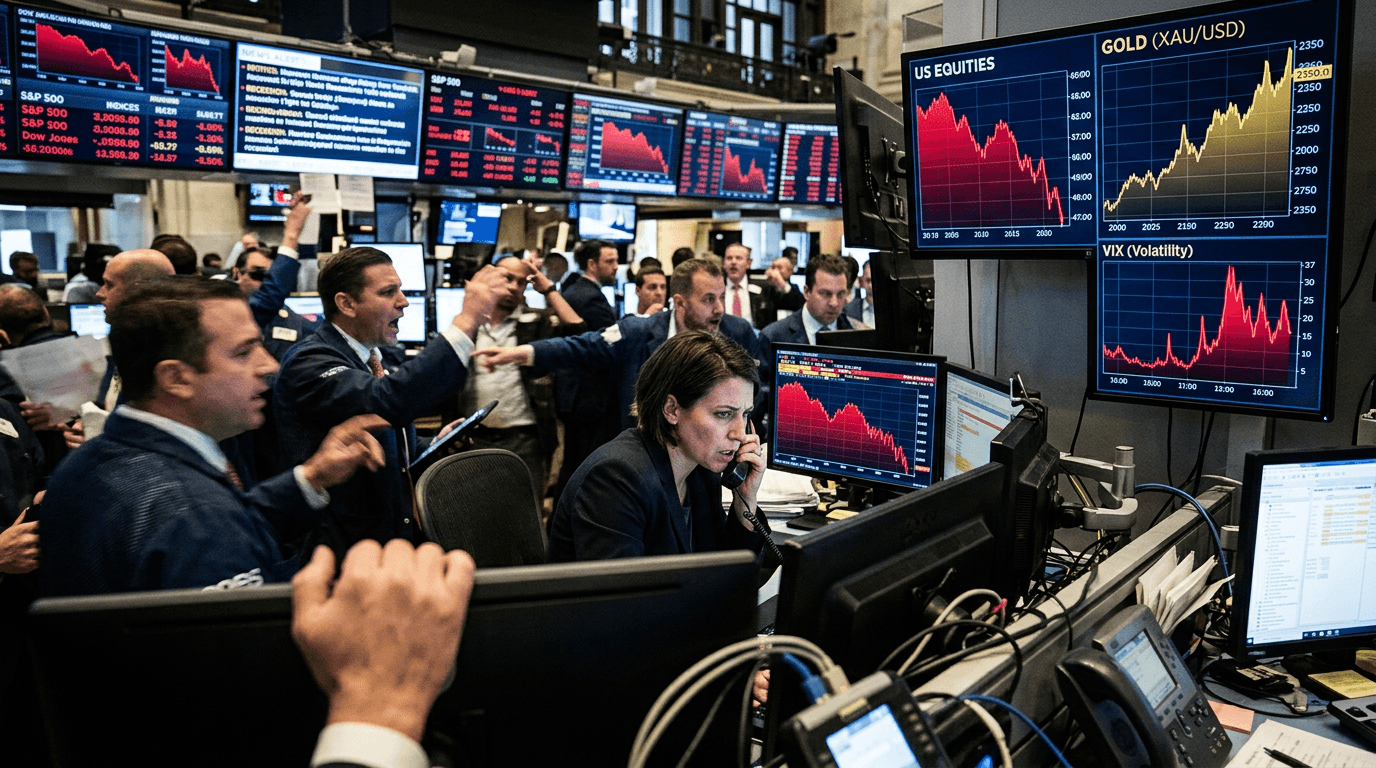
US equities have slipped into a risk-off mood as investors digest weaker macro data and renewed geopolitical tension, and the rotation has been swift: flows have moved out of growth-sensitive stocks and into traditional havens like gold, high-quality government bonds, and the US dollar. The result is tighter financial conditions at the margin, more pressure on emerging market currencies, and a noticeable pickup in volatility across equity, rates, and FX futures. For traders, this is less a surprise and more a textbook example of how quickly sentiment can flip.
RISK-OFF IS BACK: WHAT’S DRIVING THE MOVE
“Risk-off” describes periods when investors’ tolerance for risk falls sharply and capital rotates out of equities, high-yield credit, and cyclical assets into perceived safe havens.[3] In this latest episode, the trigger has been a combination of softer economic data and rising geopolitical risk, which together have revived fears that the next move in the cycle could be toward recession rather than reacceleration.
As growth expectations adjust lower, equity indices that had been pricing a relatively benign macro backdrop suddenly look vulnerable. Financial conditions – the overall “ease” of borrowing and funding in the economy – tighten as credit spreads widen, equity prices fall, and the dollar strengthens. That, in turn, adds pressure on more fragile parts of the market, notably emerging market currencies and dollar-funded carry trades, further reinforcing the risk-off loop.[3]
This feedback mechanism is why risk-off episodes can feel so sharp. Position unwinds in index futures, rates futures, and FX futures lift volatility across asset classes simultaneously, even if the fundamental data have not changed dramatically week to week. For traders using leverage, these shifts in volatility and correlation matter as much as the direction of prices.
Why Gold Is Holding Firm
Against this backdrop, gold’s resilience stands out. Historically, gold has tended to hold its value or even post gains during periods of market stress, owing to its role as a crisis hedge and its low correlation to both stocks and bonds.[1] During major equity drawdowns and systemic shocks, gold has often outperformed traditional asset classes, helping reduce overall portfolio losses when risk assets come under pressure.[1]
Several factors support gold in a risk-off, recession-focused environment. First, when growth expectations fall, markets often start to price a lower path for real interest rates over time, which is supportive for a non-yielding asset like gold. Second, heightened geopolitical risk increases demand for stores of value that sit outside the financial system, a role gold has played for decades.[1]
Third, gold’s diversification benefits become more visible precisely when they are most needed. Because it has exhibited minimal long-term correlation with major equity and bond indices, a modest allocation can help smooth portfolio returns and cushion drawdowns.[1] In the current episode, that’s exactly what investors appear to be seeking: a liquid hedge that can offset equity volatility without relying solely on government bonds, which themselves can behave unpredictably when inflation and policy uncertainty are in play.
Recession Risk Back In Focus
The latest market move is less about a single data release and more about a narrative shift: from “soft landing” toward “late-cycle vulnerability.” Research on previous expansions highlights that recession risk tends to rise as imbalances build – from elevated corporate debt levels to tight labor markets and a central bank leaning toward restrictive policy.[2] When those late-cycle markers flash amber or red, investors become more sensitive to downside surprises in the data.[2]
Yield curves, credit spreads, and business surveys are watched closely for confirmation. Historically, inverted yield curves – where short-term rates exceed long-term ones – have often preceded recessions by 9–18 months.[2] While no single indicator is perfect, a cluster of weakening signals can shift investor psychology quickly, making markets more reactive to even modest disappointments in jobs, manufacturing, or consumer data.
This backdrop helps explain why US stocks can sell off even if the data still show positive growth: markets discount the future, not the present. When traders decide that the balance of risks has tilted toward slower growth or outright contraction, they demand a higher risk premium for holding equities and other cyclical assets, pushing prices lower and volatility higher.
What This Means For Active Traders
For active traders, a risk-off, recession-focused tape requires a different playbook from a bullish, low-volatility environment. Several practical implications stand out.
First, correlations tend to rise in stress episodes. Stocks that previously offered diversification may start moving together, reducing the benefits of simple sector rotation. Hedging strategies using index futures, options, or exposure to havens like gold become more relevant, but they also need to be sized carefully given increased volatility.
Second, position sizing and leverage management are critical. With volatility elevated across equity, rates, and FX futures, the same nominal position can carry much higher risk than it did a few weeks earlier. Risk parameters that worked in a calm tape may be too loose in a risk-off regime.
Third, scenario planning becomes more valuable. Traders can map out “what if” paths – a shallow slowdown, a full recession, or a quick stabilization in data – and consider how each might impact equities, gold, yields, and currencies. Using a simulated environment to test these scenarios can help refine entries, exits, and hedges without exposing real capital to the full force of market swings.
Finally, it is important to distinguish between a cyclical scare and a true systemic crisis. Not every risk-off episode turns into 2008. Being disciplined about using data – earnings revisions, credit conditions, and leading indicators – helps avoid overreacting to volatility while still respecting the risks on the table.
Conclusion: Opportunity In Volatility
A risk-off turn in US equities, firmer gold prices, and rising cross-asset volatility are all signals that investors are repricing growth and recession risk, not random noise. The rotation into havens and the tightening of financial conditions reflect a market that is once again paying close attention to the cycle, policy, and geopolitics – and demanding more compensation to hold risky assets.
For traders and investors, the key is adaptation. Understanding how risk-on/risk-off dynamics work, why gold can act as a stabilizer, and how recession risks filter through markets can turn a turbulent tape into a more structured opportunity set. With robust risk management, thoughtful hedging, and disciplined scenario analysis, this kind of environment can reward preparation as much as prediction.