
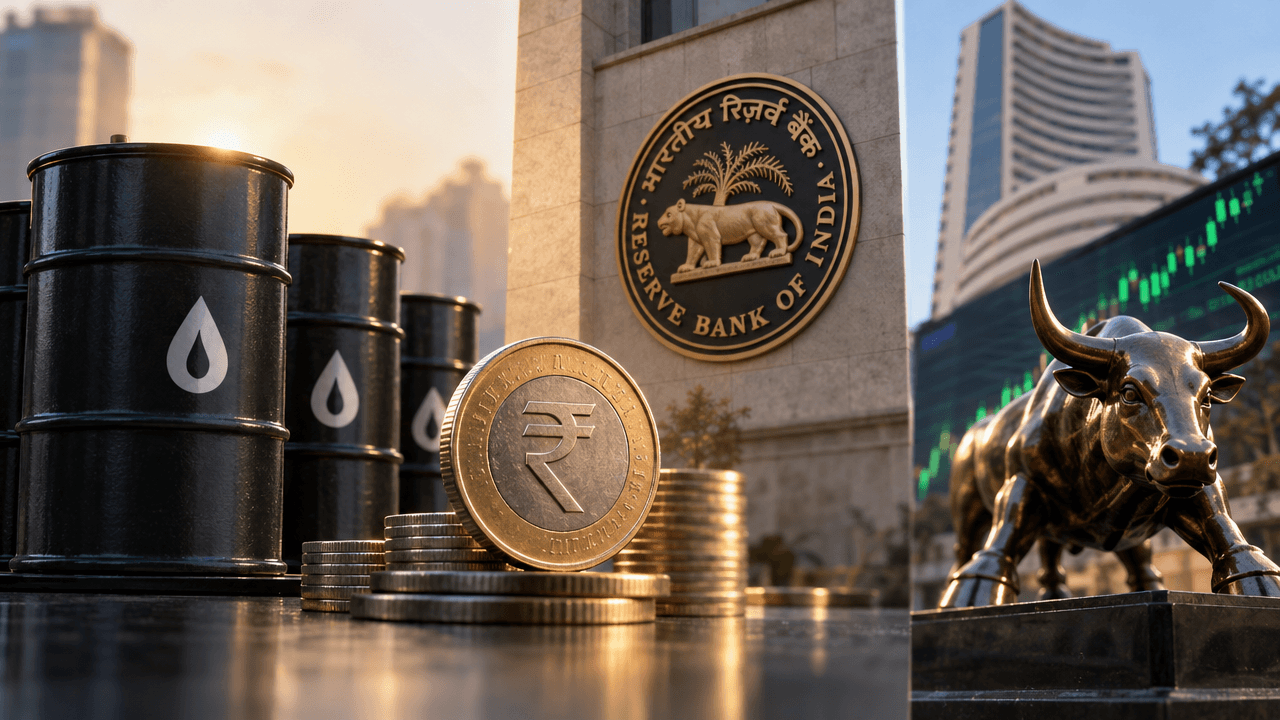
The rupee’s latest firming streak is a textbook example of how macro drivers like oil prices, central bank activity, and equity sentiment can quickly reshape currency dynamics. As crude benchmarks edge lower and domestic stocks recover, the near-term pressure on India’s balance of payments and inflation outlook has eased, giving the rupee room to breathe and stabilise against the dollar.[1][2][3]
Current Market Snapshot
In recent sessions, the rupee has rebounded from multi-week lows to trade around 95.7 per dollar, reversing part of the weakness seen when oil briefly surged above the USD 100 mark.[1][3][12] Softer crude prices, with Brent hovering near USD 103–104 per barrel and posting modest daily declines, have been a key tailwind for the currency.[1][2] At the same time, benchmark indices like the Sensex and Nifty have moved higher, reinforcing a more constructive tone in local risk assets.[1][2]
Behind the scenes, traders continue to point to dollar selling by the Reserve Bank of India (RBI) as an important stabilising force, particularly after previous bouts of volatility when oil spiked and the rupee flirted with record lows.[7][12] This pattern of selective intervention has helped cap sharp downside moves, smoothing market conditions for both corporates and portfolio investors.[7][12] In combination, the easing in energy costs and firmer domestic equities have shifted sentiment from defensive to cautiously optimistic across the FX and equity complex.[1][2][3]
Why Lower Oil Prices Support The Rupee
For an oil-importing economy like India, currency performance and crude prices are tightly linked. When Brent or WTI push higher, the import bill rises, widening the trade deficit and increasing demand for dollars as refiners and corporates hedge their exposure.[8][12] This additional dollar demand typically weighs on the rupee, as seen recently when elevated crude above USD 106 per barrel coincided with the currency slipping to four‑month lows near 95.9 per dollar.[8]
When oil prices ease, the reverse occurs: import costs fall, the trade deficit outlook improves, and demand for dollars from energy importers moderates, reducing immediate pressure on the rupee.[1][2][3] Lower fuel costs also help anchor inflation expectations, which can influence how aggressively the RBI needs to respond with monetary policy and intervention in the FX market.[12] As that policy uncertainty diminishes, the rupee can stabilise and occasionally outperform regional peers, particularly during phases when India’s growth story remains intact.[3]
For traders, this oil–FX linkage is a crucial macro relationship to monitor in both live and simulated environments. A persistent downtrend in crude, even if modest, often translates into a more favourable backdrop for INR, especially if accompanied by steady capital inflows and supportive equity performance.[1][2][3] Scenario analysis around different oil paths—sharp declines, range‑bound moves, or renewed spikes—can help refine currency and equity strategies.
Rupee Strength And Local Equity Sentiment
The current move in the rupee is closely tied to an improvement in local equity sentiment, with key indices posting moderate gains as investors respond to lower energy costs and resilient corporate earnings.[1][2][14] A firmer currency reduces imported inflation, stabilises input costs, and can improve visibility on margins for sectors such as manufacturing, autos, and consumer discretionary.[14] This macro backdrop supports equity valuations and often encourages domestic and foreign investors to add risk selectively.[1][2][14]
Foreign portfolio flows are particularly sensitive to currency trajectories. When the rupee is under heavy pressure, overseas investors face compounded losses from both asset prices and FX translation, which can trigger outflows.[6][12] Conversely, when the rupee shows signs of stabilising or strengthening, inflows linked to events like major IPOs and index rebalancing tend to pick up, further supporting the currency.[3] This positive feedback loop—stronger rupee, firmer equities, better flows—is evident in the current market tone.[1][2][3]
For market participants, the practical takeaway is that currency and equity views should not be formed in isolation. Aligning INR expectations with sectoral equity outlooks can create more coherent strategies, whether one is trading index futures, sector baskets, or cross‑asset themes such as “oil relief” beneficiaries.
Broader Asia Fx And Global Context
The rupee’s recent firming is also part of a broader shift in Asia FX sentiment, as oil‑sensitive currencies benefit from lower energy costs and reduced geopolitical risk premia.[5][14] When crude backs away from recent peaks, regional importers collectively see less strain on current accounts, narrowing the perceived vulnerability that often drives speculative pressure in FX markets.[5] In this environment, currencies with credible policy frameworks and deep local markets—such as INR—can act as relative safe havens within the emerging‑market complex.[3][7]
Global factors still matter. Expectations around U.S. rate decisions, shifts in risk appetite, and changes in geopolitical tensions can quickly overshadow the relief from lower oil.[5][12] Recent episodes, where surging crude and Fed hike worries pushed the rupee to its weakest levels in more than a month, underline how fast sentiment can pivot.[12] Traders should therefore treat the current firming as a tactical move, not a guarantee of one‑way appreciation.
For Asia‑focused strategies, the key is to map how INR behaves relative to peers during both stress and relief phases. Back‑testing these regimes can improve hedging frameworks for portfolios exposed to multiple regional currencies and commodities.
Conclusion And Trading Takeaways
The rupee’s latest gains, supported by easing oil prices, RBI dollar sales, and improving local equities, highlight how quickly macro conditions can turn from headwind to tailwind for currency markets.[1][2][3][7] For traders and SimFi participants, this is an opportunity to deepen understanding of the oil–FX–equity nexus rather than simply reacting to price moves.
Three practical takeaways stand out. First, track oil benchmarks alongside USD/INR; persistent shifts in crude often signal upcoming pressure or relief for the rupee. Second, watch the interaction between RBI actions, bond yields, and equity flows, as these channels frequently amplify or dampen currency trends.[7][12] Third, use simulated environments to stress‑test portfolios under alternative scenarios—renewed oil spikes, global risk‑off episodes, or sustained energy softness—and refine hedging and position‑sizing accordingly.
While the current backdrop favours a more stable rupee, the path ahead will be shaped by how long oil remains contained, how global central banks navigate the next leg of policy, and whether domestic growth and earnings stay resilient.[3][5][14] Investors who integrate these moving pieces into a structured framework will be better positioned to navigate both the present firming phase and the inevitable future bouts of volatility.