
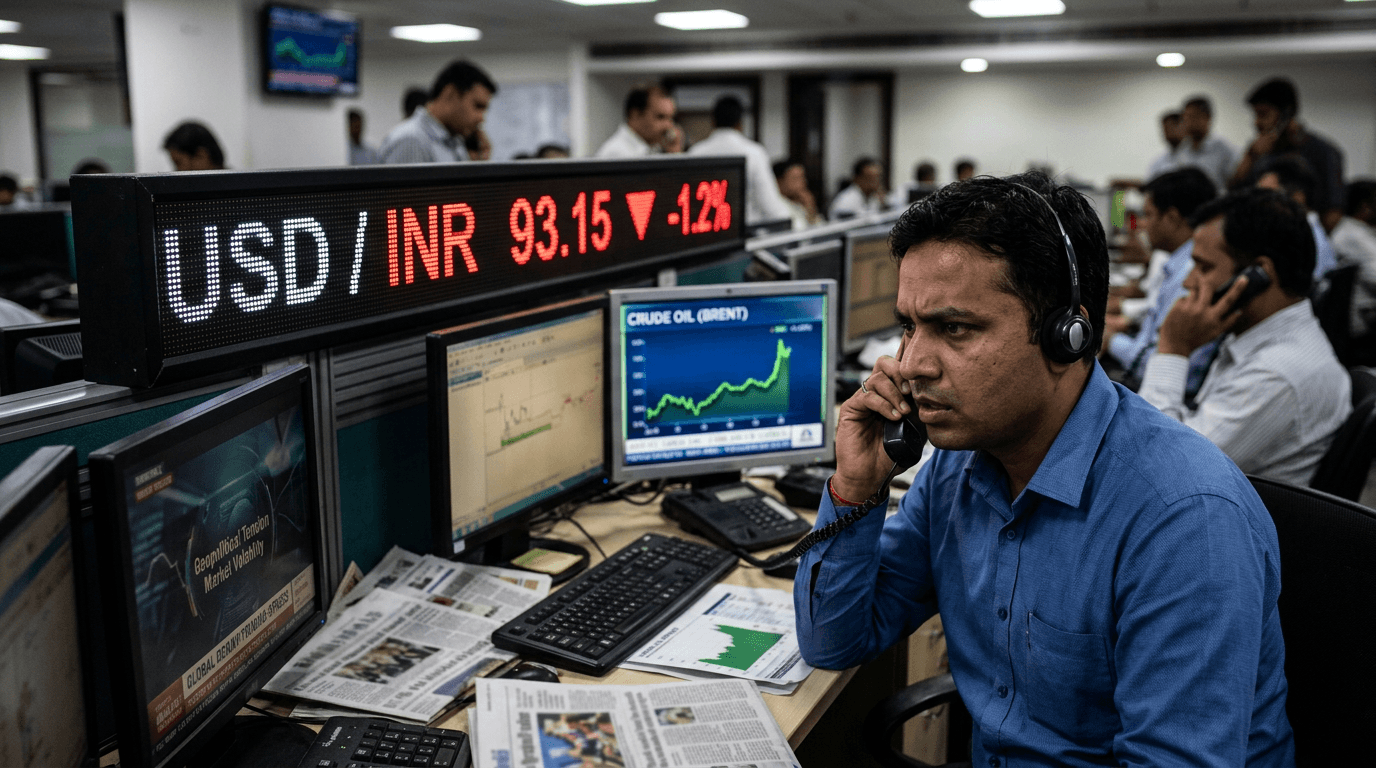
Rupee's Record Low: Geopolitical Tensions Expose Emerging Market Fragility
The Indian rupee has plunged into uncharted waters, breaching the 93 per dollar mark for the first time on March 20, 2026. This historic low is not merely a currency anomaly; it highlights the vulnerability of emerging economies when global crises intertwine with domestic economic strains. For traders and investors in Indian markets, deciphering the forces behind this unprecedented move is crucial for risk management amidst an increasingly unstable environment.
The Perfect Storm: Geopolitics Meets Economics
The rupee's descent isn't the result of a single shock but a confluence of critical forces. The primary trigger is the escalating conflict in West Asia, particularly the tensions in the Strait of Hormuz involving the United States and Iran. This geopolitical hotspot has propelled crude oil prices upward, with Brent crude soaring to $106.90 per barrel and India's crude basket reaching a staggering $114.08 per barrel in March, far surpassing the Reserve Bank of India's fiscal assumption of $70 per barrel.
India's heavy reliance on energy imports, exceeding 80 percent of its needs, makes it acutely vulnerable to these shocks. Each dollar increase in oil prices directly inflates import costs, exerting immediate pressure on the currency. As importers scramble for dollars to cover costly energy supplies, the rupee faces intensified selling pressure. Concurrently, the US dollar has strengthened, with the dollar index climbing to 100.25, presenting a dual challenge for emerging market currencies like the rupee.
Yet, the narrative extends further. Foreign institutional investors, already cautious of emerging market risks, have accelerated their withdrawals. March 2026 witnessed approximately $9.83 billion in net outflows from Indian financial markets—the largest monthly retreat since October 2024. As global uncertainty peaks, risk-averse capital seeks refuge in the US dollar, exacerbating the downward pressure on the rupee even as domestic conditions worsen.
Equity Markets Amplify the Crisis
The currency crisis has reverberated through India's stock markets with alarming intensity. The Sensex and Nifty plummeted to 21-month lows as investors reevaluated valuations amid rising inflation risks and currency headwinds. Although both indices rebounded on March 20 to close at 75,167.91 and 23,313.65 respectively, the recovery offers only temporary respite in an ongoing deteriorating environment.
This equity market fragility creates a negative feedback loop for the currency. As Indian asset values decline, international investor confidence erodes, prompting further capital outflows and increased pressure on the rupee. The rupee has depreciated 3.6 percent against the dollar year-to-date and 2.4 percent since the West Asia conflict erupted on February 28. For portfolio managers with rupee-denominated investments, currency losses compound with equity losses—a brutal combination.
The RBI's Intervention: A Losing Battle?
The Reserve Bank of India has not remained passive. The central bank has engaged in substantial interventions, primarily selling dollars from its foreign exchange reserves to prop up the rupee. Market estimates suggest the RBI has executed approximately $100 billion in net forward dollar sales through onshore and offshore markets via forward contracts and swaps. Despite this significant effort, stability remains elusive.
By March 7, the RBI's foreign exchange reserves had depleted by $11.68 billion, reflecting the cost of intervention. A treasury advisor encapsulated the precarious situation: "The rupee looks vulnerable with the RBI the only one protecting it from further fall by selling dollars." This raises critical concerns—if the RBI is the sole support for the currency, how sustainable is this defense? Ongoing reserve depletion questions the central bank's ability to maintain interventions indefinitely while managing domestic monetary policy.
The RBI faces a painful policy dilemma. The rupee's weakness will inevitably drive inflation as import costs surge, yet raising interest rates could further accelerate capital outflows. Rate hikes may be necessary to curb price pressures, but they risk triggering additional currency weakness—a lose-lose scenario for policymakers.
Implications for Traders and Investors
For those trading or investing in Indian markets, several crucial insights emerge. First, currency risk is now paramount. The rupee's volatility means even profitable equity positions can be undermined by exchange rate losses. Hedging currency exposure is no longer optional but essential for serious market participants.
Second, geopolitical risk premiums have widened significantly. Monitoring and anticipating developments in the Middle East have become as vital as tracking earnings reports. The rupee's plunge illustrates how external shocks can overwhelm technical indicators and sentiment-based analysis.
Third, the RBI's intervention capacity, though substantial, is finite. If geopolitical tensions persist, sustained capital outflows could exhaust central bank resources, necessitating a more drastic adjustment. Timing becomes critical—early positioning ahead of potential further depreciation could yield rewards.
The rupee's record low is a stark reminder that emerging market currencies are susceptible to compound shocks. Geopolitical crises, commodity volatility, and capital flight can converge with devastating speed. Navigating this environment demands vigilance, hedging discipline, and a readiness to adjust strategies as circumstances evolve.
News Impact Score: 8