
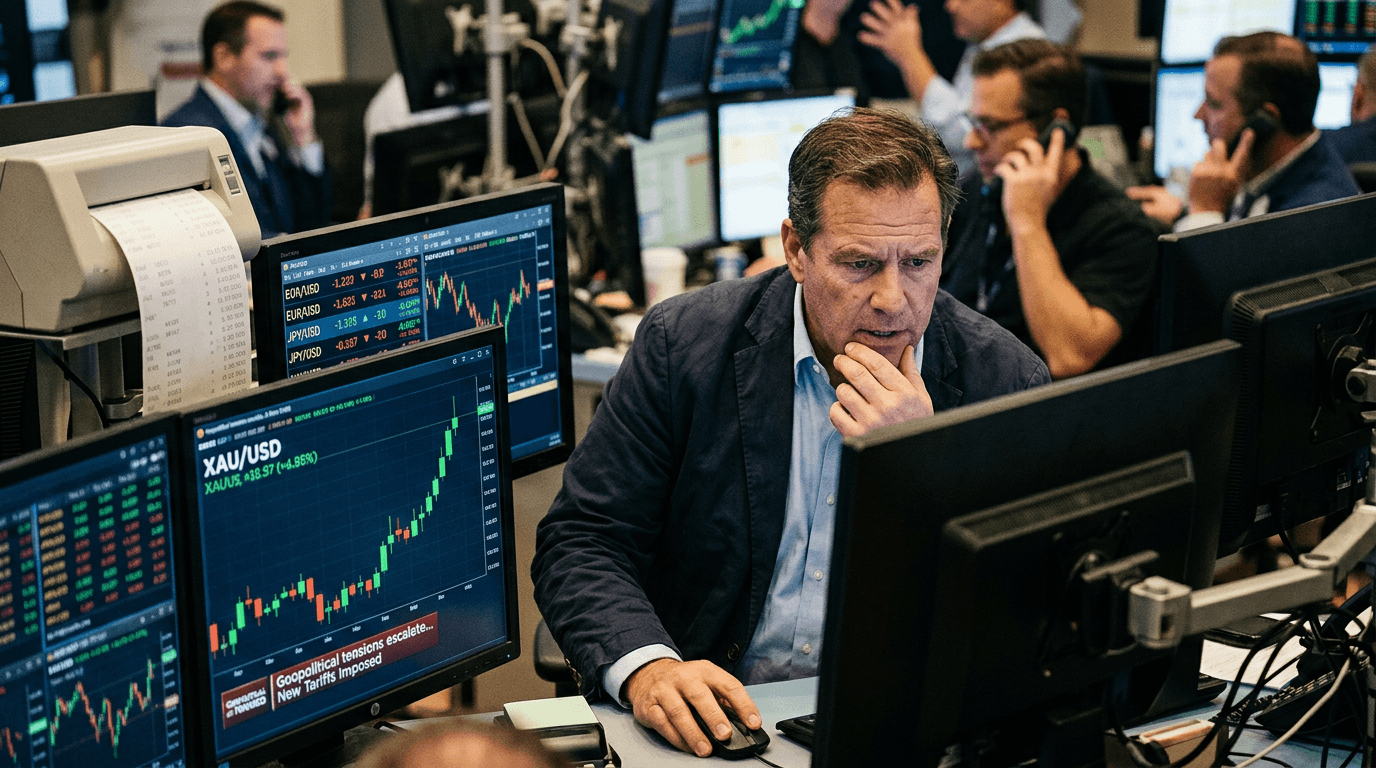
Gold has clawed back its prior-session losses as safe-haven demand returns, with investors reacting to a fresh mix of geopolitical tensions and new US–China tariff headlines. The rebound in XAU/USD is being reinforced by lower real yields and a broader bid for defensive assets, while risk-sensitive FX pairs and commodity currencies are adjusting to a more cautious market mood.
Safe-haven Flows Return To Gold
Gold’s renewed strength fits neatly into a pattern markets have seen repeatedly over the past two years: whenever geopolitical risk and policy uncertainty spike, investors reach for traditional safety valves.
In recent episodes, gold has surged to record highs as geopolitical tensions intensified and investors worried about tariff-driven inflation, slower growth, and a weaker US dollar.[1][3] As a non‑yielding, globally recognized store of value, gold tends to outperform when confidence in fiat currencies, trade relationships, or the macro outlook is under pressure.[1][2]
This latest move reflects that same instinct. Higher tariffs raise fears of supply‑chain disruptions and cost‑push inflation, while geopolitical strains increase the perceived probability of tail‑risk events. In that environment, a modest pullback in gold can look more like an opportunity than a trend reversal, especially for investors who missed earlier rallies.
The key point: when the newsflow clusters around conflict, sanctions, or trade wars, gold’s “insurance” role comes back into focus. Even modest escalations can generate disproportionate price responses if markets were previously complacent.
WHY GEOPOLITICS AND TARIFFS MATTER FOR XAU/USD
Geopolitics and tariffs influence gold through several interconnected channels:
First, they affect growth expectations. Trade barriers and political shocks can dampen global demand, disrupt investment, and tighten financial conditions. That tends to push investors toward defensive positioning, benefitting gold alongside other safe assets like US Treasuries and the Swiss franc.
Second, they shape inflation dynamics. Tariffs are, in effect, taxes on imports; they often filter through into higher prices for consumers and businesses. Markets then reassess inflation expectations and the likely reaction from central banks. Gold has historically benefited when investors fear that inflation could rise faster than nominal interest rates, eroding real purchasing power.[1][4]
Third, geopolitics and tariffs can weigh on major currencies. If policy uncertainty undermines confidence in the US dollar, euro, or other reserve currencies, gold often becomes the “neutral” alternative. Recent years have seen gold outpace major currencies and risk assets as global uncertainty mounted, with spot prices rising roughly 50% in 2025 alone amid economic and geopolitical stresses.[2]
Finally, structural demand reinforces these cyclical drivers. Central banks, particularly in emerging markets, have been accumulating gold reserves to diversify away from concentrated currency exposure and geopolitical risk.[1][2] When news headlines turn risk‑averse, this underlying bid makes it easier for gold to pivot higher and stay supported.
The Real Yield Channel: Why Bond Markets Matter
The latest safe‑haven bid in gold is closely tied to a move lower in real yields—the return on government bonds after adjusting for inflation. This relationship is crucial for traders to understand.
Gold does not pay interest or dividends. Its “opportunity cost” is therefore measured against what an investor could earn in safe bonds. When real yields fall—because nominal yields drop, inflation expectations rise, or both—the relative disadvantage of holding gold diminishes. That is precisely the environment in which gold has historically performed best.[2][4]
Recent episodes have shown how this works in practice. As global uncertainty mounted and central banks shifted toward easier policy, real yields compressed, helping fuel one of gold’s strongest rallies in decades.[2][4] Analysts noted that gold was being pulled between inflation fears and safe‑haven flows, creating a fragile balance: hawkish policy and higher real yields capped gains, while each bout of geopolitical stress unleashed renewed demand.[4]
Today’s backdrop echoes that dynamic. Tariff headlines and geopolitical tensions are supporting inflation expectations and safe‑haven buying, nudging real yields lower and underpinning XAU/USD. If bond markets start to price in slower growth or earlier rate cuts, that could extend the tailwind. Conversely, a sharp rebound in real yields would be an early warning that gold’s momentum might stall.
For traders, it is not enough to watch the gold chart in isolation. Monitoring breakeven inflation, inflation‑linked bonds, and nominal yields provides critical context for understanding whether the macro environment is becoming more or less supportive for bullion.
Ripple Effects Across Fx And Commodity Currencies
Gold’s safe‑haven rally rarely happens in a vacuum; it typically comes with clear patterns in foreign exchange markets.
Risk‑off episodes tend to favor currencies like the Japanese yen and Swiss franc, while pressuring high‑beta and commodity‑linked currencies such as the Australian dollar, New Zealand dollar, and some emerging‑market units. Tariffs and geopolitical risks are especially negative for export‑oriented economies and those deeply embedded in global manufacturing and commodity supply chains.
This creates interesting cross‑currents:
- Currencies of gold‑producing countries (such as AUD) can face conflicting forces—support from higher gold prices but pressure from broader risk aversion and trade uncertainty.
- Asian and EM currencies tied to global trade often weaken when US–China tariff tensions resurface, even if their direct exposure is limited, because investors de‑risk regionally rather than selectively.
- The US dollar can either strengthen as a defensive asset or weaken if markets anticipate easier Federal Reserve policy in response to tighter financial conditions and weaker growth.[2][5]
For FX and CFD traders, understanding that a safe‑haven bid in gold often signals a broader “risk‑off” regime can help align strategies across multiple instruments, not just XAU/USD.
How Traders Can Navigate The Current Gold Backdrop
In a market driven by geopolitical and tariff headlines, a disciplined framework becomes essential.
First, map the narrative. Identify the key risk drivers—trade measures, sanctions, military developments—and consider how they influence growth, inflation, and policy expectations. This helps distinguish between short‑lived headline spikes and genuinely regime‑changing events.
Second, connect gold to real yields. Track moves in major government bond markets and inflation expectations. If gold is rallying alongside falling real yields, the move has stronger macro backing than a purely sentiment‑driven spike.
Third, respect volatility. Geopolitically driven markets can gap on unexpected news, making position sizing and risk limits crucial. Using predefined stop levels, avoiding over‑leverage, and diversifying across instruments can reduce the impact of sharp reversals.
Fourth, think in scenarios rather than forecasts. Build simple “if–then” maps: if tariffs escalate further, then real yields might fall and gold could outperform risk assets; if tensions de‑escalate and economic data hold up, then safe‑haven demand may fade and cyclical assets could regain leadership.
Simulated trading environments can be particularly useful in this kind of regime, allowing traders to test how their strategies perform when gold and FX markets react to sudden increases in geopolitical risk, without putting real capital at risk.
Conclusion
The latest rebound in gold underscores its enduring role as a barometer of global anxiety. Rising geopolitical and tariff risks are once again pushing investors toward perceived safety, pressuring real yields and supporting XAU/USD while reshaping flows across FX and commodity currencies.
For traders, the opportunity lies not just in calling the next move in gold, but in understanding the macro mechanics behind it—how newsflow feeds into inflation expectations, policy paths, bond markets, and, ultimately, cross‑asset correlations. In a world where headlines can shift sentiment in minutes, those who can connect these dots will be better equipped to navigate both the turbulence and the opportunity that safe‑haven markets present.