
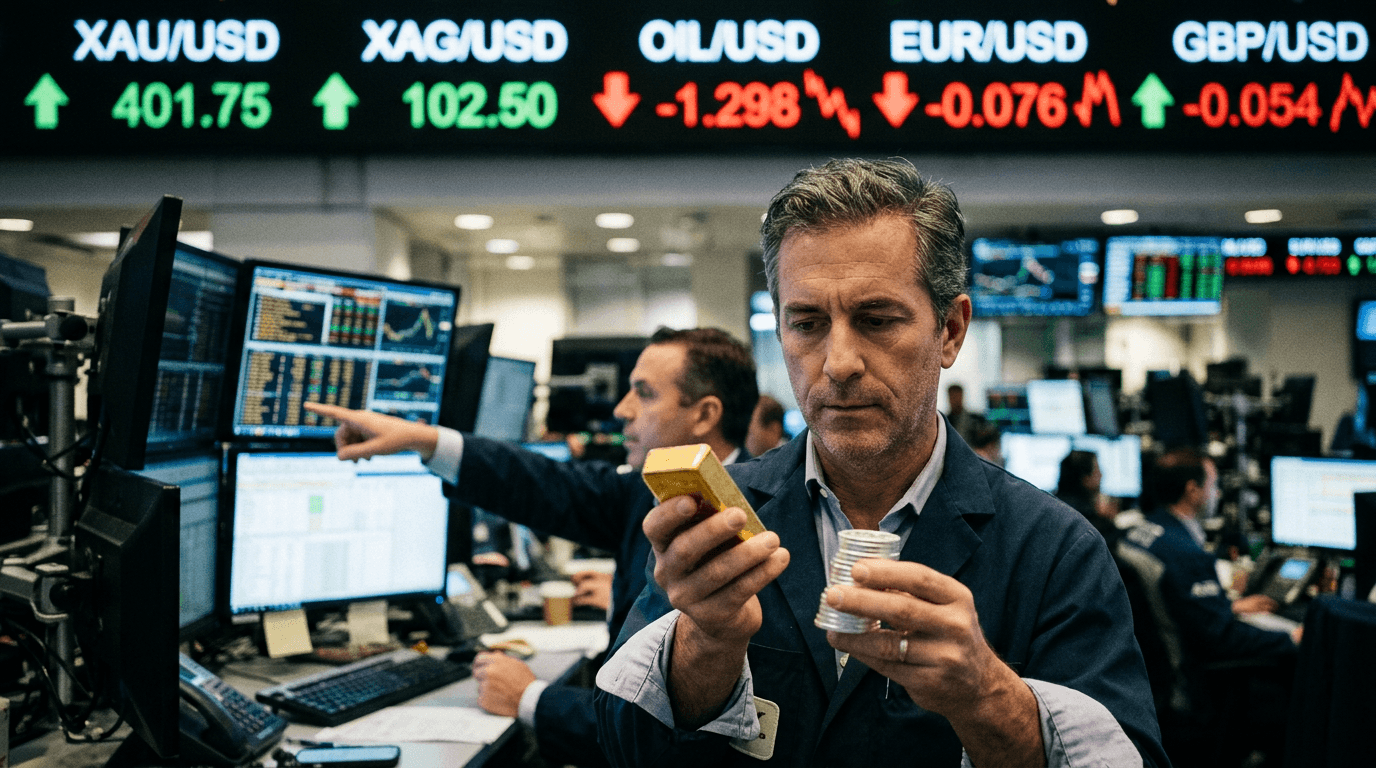
Safe-haven flows have returned to centre stage, lifting precious metals and reshaping moves in major currencies as the Middle East war disrupts global energy routes and reignites inflation fears. Silver has surged above $84 and gold remains firm as the U.S. dollar’s recent rally pauses, while WTI crude oil’s rebound above $79 is feeding directly into rate expectations and volatility across commodity-linked FX and bond markets.
Safe-haven Bid In Precious Metals
The most immediate market response to the widening conflict has been a renewed bid for traditional safe-haven assets, especially gold and silver.[3][6] Gold, already up strongly this year on a mix of geopolitical tension and macro uncertainty, is drawing fresh inflows as traders hedge the risk that the Middle East war broadens or persists.[3][4] Silver has moved even more aggressively, spiking above $84 per ounce as investors seek both a defensive asset and exposure to a metal with industrial links that could also benefit from supply disruptions and reflation themes.[3][6]
Safe-haven demand is being amplified by a temporary pause in the U.S. dollar’s advance.[4][6] When the dollar steps back from recent highs, gold becomes cheaper for non‑U.S. buyers, making it easier for global investors to add to positions.[3] That combination—geopolitical stress plus a softer dollar—creates a powerful tailwind for precious metals.
For traders, it is important to recognise what this move in metals is really pricing in: not just immediate headlines, but a higher probability of prolonged uncertainty. Gold tends to respond to the trajectory of risk more than single events. Sustained conflict, questions around energy security, and shifting expectations for central bank policy all feed into the narrative that supports elevated gold and silver prices.
Energy Disruption And The Inflation Story
At the same time, the conflict is disrupting energy flows out of the Middle East, pushing WTI crude back above $79 after recent softness. Oil is the transmission channel from geopolitical risk into everyday economic reality. Any sustained rise in crude prices can lift headline inflation, squeeze consumers, and complicate central bank plans to cut rates.
Higher oil prices affect inflation in several ways
- Directly, through fuel and transportation costs.
- Indirectly, as businesses pass on higher input costs.
- Via expectations, as households and markets anticipate higher future price levels.
That last point—expectations—is critical for rates markets. When traders start to price in stickier inflation, they tend to push out the timing and scale of future rate cuts. We have already seen bond and futures curves react to the combination of rising energy prices and geopolitical risk, with inflation-sensitive instruments such as breakeven inflation rates and short-dated rate futures repricing to reflect a more cautious view on policy easing.
For macro‑focused traders, this creates a complex backdrop: growth risks from higher energy costs versus inflation risks that limit dovish central bank responses. The result is often more volatility and less clear trend, particularly in rates and risk assets.
Fx Market Reaction: Commodity Currencies Vs Safe Havens
Foreign exchange markets sit at the crossroads of these moves in metals and energy. On one side, you have commodity-linked currencies such as the Canadian dollar (CAD) and Norwegian krone (NOK), which typically benefit from higher oil prices. On the other, you have classic safe-haven currencies like the U.S. dollar, Japanese yen (JPY), and Swiss franc (CHF), which tend to strengthen when geopolitical uncertainty rises.[7]
The current episode is nuanced
- CAD and NOK can see support from higher crude, since their economies and export revenues are closely tied to energy.
- However, if war-related risk aversion intensifies, broad “risk‑off” flows can weigh on cyclical and commodity FX, even when underlying commodities are strong.
- The U.S. dollar, while pausing from recent highs in this particular move, remains a key global safe haven, often strengthening in times of stress and affecting gold’s performance for non‑dollar investors.[7]
This tug-of-war creates a more complex trading environment for FX:
- Commodity FX is pulled higher by improving terms of trade (stronger oil) but pushed lower by risk‑off sentiment.
- Safe-haven FX gains when risk aversion dominates, but can lose ground when focus shifts back to carry trades and growth.
For traders, the key is to distinguish between oil-driven moves in CAD and NOK and risk-driven moves across the broader FX complex. Pair selection becomes critical: CAD vs USD may behave differently from CAD vs JPY, depending on whether oil or risk sentiment is the dominant driver in the short term.
Bonds, Rates, And Futures: Pricing Geopolitical Risk
The combination of safe-haven buying in metals and rising energy prices is playing out visibly in rates and futures markets. On the one hand, higher inflation risks argue for more cautious central banks and fewer rate cuts. On the other, elevated geopolitical risk and potential growth headwinds from higher energy costs support demand for safe assets like government bonds.
This tension can manifest as
- Flatter or more volatile yield curves, as traders debate the balance of inflation versus growth.
- Moves in inflation-linked bonds and breakeven rates as markets update their view on energy-driven price pressures.
- Repositioning in interest rate futures as the probability distribution for future policy decisions shifts.
For traders in a simulated environment, watching how bond yields react to each new headline can be particularly instructive. Sudden shifts in the expected path of rates often precede larger moves in FX and equities, making rates markets a leading indicator of changing macro narratives.
Practical Takeaways For Traders And Simfi Participants
This environment—safe-haven metals bid, energy disruption, and shifting FX—is a textbook example of how geopolitics can cascade through asset classes. Whether trading live markets or simulated finance (SimFi), there are several practical lessons:
1. Follow the chain of transmission War risk → energy flows → oil prices → inflation expectations → rate expectations → FX and risk assets. Mapping this chain helps explain price action and avoid being surprised by cross‑asset moves.
2. Watch correlations, but don’t assume they are static Gold usually rises when the dollar falls, yet both can act as safe havens depending on the shock.[3][7] Oil strength typically supports CAD and NOK, but risk‑off can override that. In stressed markets, relationships can change quickly.
3. Focus on relative moves, not just absolute prices Gold and silver can be at historically high levels, but what matters for trading is the rate of change and the drivers behind those moves.[3][6] Similarly, an oil bounce from $70 to above $79 can be more significant than the absolute price if it shifts inflation and rate expectations.
4. Use simulated trading to test scenarios In a SimFi environment, traders can build and test strategies around these themes: long gold vs short high‑beta equities in a risk‑off scenario, long CAD vs JPY in an oil‑up, risk‑on scenario, or curve trades that express views on central bank reactions to energy‑driven inflation. Because the risk is simulated, it is an ideal way to learn how geopolitics, commodities, FX, and rates interact.
As the Middle East war continues to disrupt energy flows, markets are likely to remain sensitive to new developments. Precious metals will reflect the ebb and flow of safe‑haven demand, commodity-linked FX will trade the balance between oil strength and global risk sentiment, and rates markets will keep repricing the path of inflation and policy. For traders, the opportunity lies in understanding those linkages—and using them to build coherent, risk‑aware strategies in both live and simulated markets.