
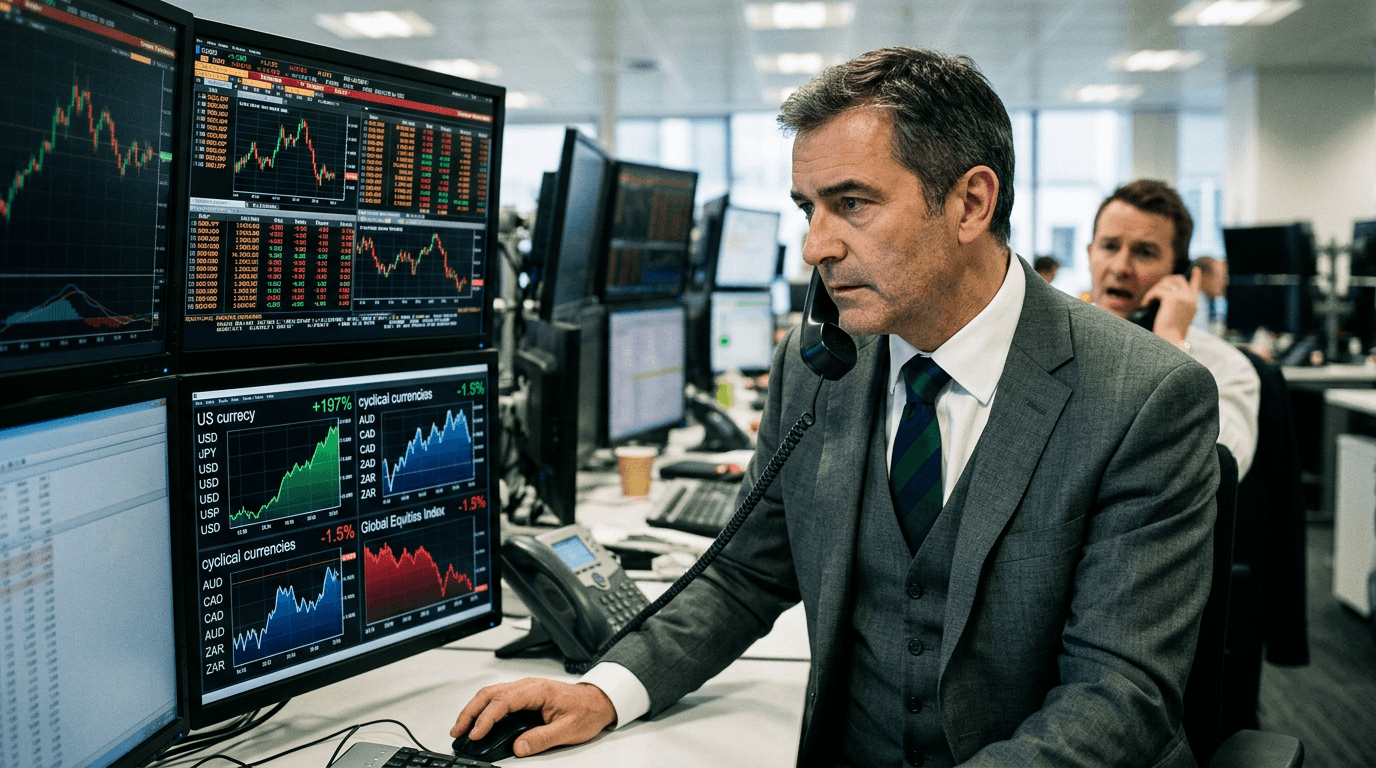
Markets have been reminded once again that geopolitics and trade policy can move prices just as forcefully as economic data. A fresh bout of tension in the Middle East, combined with renewed US–China tariff rhetoric, has triggered a classic “risk-off” reaction: global stock futures are under pressure, cyclical currencies are struggling, and safe-haven assets like the US dollar and US Treasuries are attracting strong inflows.[1][5] For traders, understanding why this happens is essential to navigating the volatility rather than being blindsided by it.
WHAT ARE SAFE-HAVEN FLOWS – AND WHY DO THEY MATTER?
Safe-haven flows describe the shift of capital into assets perceived as more stable and liquid when uncertainty spikes. In practice, this often means money moving out of equities, high-yield credit, and emerging-market currencies, and into US dollars, US Treasuries, and other perceived “quality” assets.[1][4][5]
The US dollar occupies a unique position in this landscape. It is the world’s primary reserve and invoicing currency, involved in roughly half of all global trade invoices and a dominant share of international funding.[2][5] That structural demand gives investors confidence that, in a crisis, they can always find a buyer for dollars and dollar assets.
Other traditional safe havens also play a role. Gold tends to attract flows when investors worry about both geopolitical risk and inflation, while currencies like the Japanese yen and Swiss franc see demand during periods of global stress.[4] Government bonds from highly rated issuers, especially US Treasuries, are another pillar of the safety trade.[4]
Key takeaway: When headlines signal rising risk, expect a broad “flight to quality” that boosts the dollar and Treasuries while pressuring equities, high-yield credit, and cyclical FX.
Why The Dollar Rises When Risk Rises
The dollar’s safe-haven strength is not just psychological; it is rooted in deep market structure. The size of the US economy, the depth and liquidity of its bond market, and the central role of the dollar in trade and funding all reinforce its status.[2][5] During periods of stress, global institutions often need more dollars to service dollar liabilities or meet margin calls, which can amplify demand for the currency.[7]
Monetary policy adds another layer. When the Federal Reserve is comparatively hawkish or offers higher real yields than other major central banks, the dollar gains an additional yield advantage on top of its safe-haven appeal.[1] This has been visible in recent years, where a combination of elevated US yields and geopolitical tensions has propelled the dollar to new highs on broad indices.[1]
However, there is a tension: aggressive tariff policies or trade wars can, over time, raise questions about the sustainability of the dollar’s dominance, by encouraging some countries to diversify away.[2][7] For now, most research suggests that any erosion of the dollar’s safe-haven status is a slow-burning story rather than an immediate threat, given its entrenched role in trade and finance.[2][5]
Key takeaway: In the short to medium term, higher US yields and the dollar’s central role in global finance tend to overpower concerns about tariffs and keep the greenback in demand when risk aversion rises.
GEOPOLITICS + TARIFFS: A POWERFUL MIX FOR VOLATILITY
Geopolitical shocks in the Middle East affect markets through several channels. They raise uncertainty about energy supply, potentially pushing oil prices higher, which can squeeze growth and corporate margins while feeding inflation risk. That combination often leads investors to de-risk their portfolios, hitting equities and cyclical assets while boosting safe havens like the dollar and Treasuries.[1][5]
At the same time, renewed US–China tariff rhetoric revives memories of the previous trade war, when tit-for-tat tariffs and policy uncertainty triggered surges in volatility across equities, bonds, and FX.[3][6] Scenario analysis of tariff shocks shows that higher trade barriers can weigh on global growth and corporate earnings, while also shifting inflation and interest rate expectations – a recipe for broad cross-asset repricing.[3][6]
Past episodes show that trade tensions can spill into dollar-funding markets, raising stress indicators and reinforcing demand for the US currency as institutions scramble for liquidity.[3][7] Even if long-term questions arise about the dollar’s role, in the heat of the moment, it is still the first place investors go when they seek safety.[2][5][7]
In such risk-off phases, cyclical and commodity-linked currencies like the Australian dollar, New Zealand dollar, Canadian dollar, and many emerging-market currencies tend to underperform, while defensive currencies and the dollar outperform.[1][4][5]
Key takeaway: When geopolitical tension and tariff headlines hit at the same time, they can create a potent cocktail that boosts the dollar and Treasuries while disproportionately hurting cyclical currencies and global stock indices.
Practical Implications For Active Traders
For traders in a SimFi environment or live markets, these moves are not abstract theory; they translate directly into intraday and multi-day opportunities and risks. Several practical steps can help you navigate this type of regime more effectively.
First, pay attention to cross-asset correlations. In risk-off episodes driven by geopolitics or tariffs, the dollar index often trades inversely with major equity benchmarks, while US Treasury futures tend to rise alongside the dollar.[1][3][5] Watching how DXY behaves relative to S&P 500 or Nasdaq futures, for example, can provide confirmation that a risk-off move is gaining traction.
Second, put event risk front and center in your strategy. Key dates such as diplomatic summits, tariff announcement deadlines, or major policy speeches can act as catalysts for sharp repricing. During these windows, spreads can widen and liquidity can thin, increasing both opportunity and risk.[3][6] Having a plan for position sizing, stop-loss placement, and potential gap moves is essential.
Third, remember that safe-haven flows can be fast and self-reinforcing but also prone to sharp reversals when news improves. Headlines signaling de-escalation, cease-fire talks, or a softer tone on tariffs can unwind positions quickly, leading to a weaker dollar and a rebound in risk assets. Flexibility and frequent reassessment of the news flow are critical.
Key takeaway: Treat geopolitical and tariff headlines as recurring volatility events. Use them to shape your risk management, timing, and cross-asset monitoring rather than trading single markets in isolation.
Positioning When Safe-haven Flows Dominate
When safe-haven demand is in control, the trading playbook often looks different from a calm, carry-friendly environment. Momentum and breakout strategies in the dollar and Treasuries can work better than mean reversion, as markets can trend further than fundamentals alone might suggest.[1][6]
Scenario work is particularly valuable. For example, you can map out what your positions might do under: (1) escalation in Middle East tensions with higher oil prices and stronger USD; (2) an intensification of US–China tariff threats, leading to weaker global equities and stronger dollar; (3) a surprise de-escalation that triggers a relief rally in risk assets and a pullback in the dollar.[3][6][7] Running these scenarios in a simulated environment helps you understand potential drawdowns before real capital is on the line.
Diversification across asset classes and time frames also matters. Research on safe havens highlights that relying on a single “safe” asset can be risky; instead, combining exposures to currencies, bonds, and real assets like gold can provide more robust protection across different types of shocks.[4][5] For traders, that may mean not only trading FX, but also monitoring bond futures, equity indices, and commodities together.
Key takeaway: In a safe-haven-dominated regime, emphasize scenario planning, trend awareness, and cross-asset diversification rather than assuming a quick return to “normal.”