
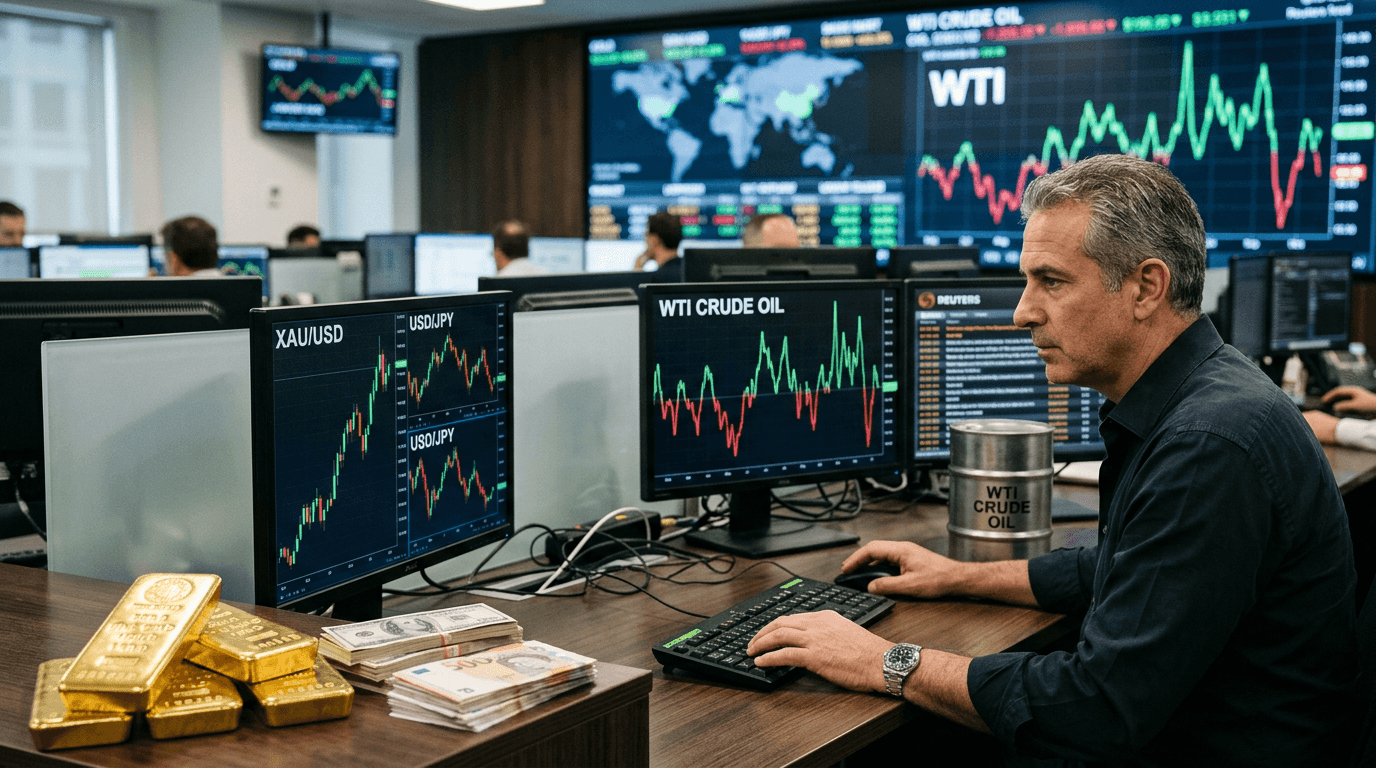
Geopolitical tensions centered on Iran have pushed markets back into a classic risk-off posture, with safe-haven currencies and gold in focus while oil futures swing sharply from one session to the next.[2][5][8][10][19] For traders, this backdrop is not just headline noise—it is a live case study in how geopolitics, commodities, FX, and risk sentiment connect.
Geopolitical Risk And The Safe-haven Playbook
When uncertainty spikes, investors typically rotate out of risk-sensitive assets like equities, high-yield credit, and commodity-linked FX into instruments perceived as more resilient: major reserve currencies, high-grade bonds, and precious metals.[5][8][13][19] Recent Middle East escalation has reinforced this pattern, with capital moving away from volatile growth stories and into safer stores of value.
In episodes of heightened tension between Israel, the U.S., and Iran, gold demand has repeatedly climbed as investors seek protection against both market turbulence and the tail risk of a wider conflict.[9][13][19] At the same time, measures of risk appetite in FX show the dollar, yen, and Swiss franc gaining ground as traders pare back positions in cyclical and emerging-market currencies.[5][8][10]
For traders, the takeaway is that geopolitics tends to compress correlations: risk assets often move lower together, while safe havens move higher together. Recognizing this regime shift early—before price moves become extreme—can be the difference between being positioned with the flows or fighting them.
Safe-haven Fx: Yen, Franc, And The Dollar
Not all safe-haven currencies behave the same way. Research on Middle East volatility shocks shows the Swiss franc (CHF) has delivered some of the most consistent and persistent safe-haven performance, trading closely with gold and credit spreads.[10] During recent flare-ups in US–Iran tensions, CHF strength has aligned with wider risk aversion and widening credit premia, reinforcing its reputation as a “clean” safe haven.[10]
The Japanese yen (JPY) remains a go-to refuge, but its behavior is more conditional.[10] Structural short positioning and domestic political risks can blunt its response, meaning it does not always rally as mechanically as in prior cycles.[10] Meanwhile, the US dollar often benefits on multiple fronts: as a safe haven, as the world’s key funding currency, and—more recently—as a relatively high-yield option versus other majors.[5][10]
Practically, this means:
- Safe-haven strength may show up most clearly in pairs like EUR/CHF, GBP/CHF, and high-beta crosses versus CHF and JPY.[8][10]
- The dollar index (DXY) often firmed in previous Middle East episodes, particularly against commodity and EM currencies, as investors sought liquidity and depth.[5][10]
- Commodity-linked FX such as AUD, CAD, and NOK tend to underperform in risk-off regimes, even when oil prices are rising, because the broader risk aversion outweighs any terms-of-trade boost.[8][10]
For simulated and live trading, monitoring how CHF, JPY, and USD respond around geopolitical headlines offers a practical way to gauge the intensity of risk-off sentiment.
GOLD’S SAFE-HAVEN BID – AND ITS LIMITS
Gold has once again attracted safe-haven flows as the Iran-focused conflict raises fears of broader regional instability and energy disruption.[2][9][13][17][19] In recent episodes, futures prices have tested or exceeded prior records, with analysts speaking of a “risk premium” embedded in gold as investors hedge against geopolitical shock and policy uncertainty.[17][19] Expectations that conflict-related volatility could persist have kept gold supported near elevated levels.[2][9][13][16][19]
However, the story is more nuanced than “tensions up, gold up.” There have been periods during the Middle East war when gold’s traditional safe-haven status was challenged, with prices falling sharply despite escalating headlines.[12][14][15][18][20] Several mechanisms explain this:
- Surging oil prices raise inflation fears, pushing bond yields and the dollar higher and increasing the opportunity cost of holding non-yielding assets like gold.[14][15][18]
- If investors face margin calls or liquidity stress, they may sell gold to raise cash, turning the safe haven into a source of liquidity rather than a refuge.[12][15][20]
- When markets price in higher-for-longer interest rates, gold can suffer even in a geopolitical crisis as real yields become the dominant driver.[14][18][20]
For traders, gold during geopolitical turmoil is a three-variable story: geopolitical risk, real yields, and the dollar. Safe-haven flows can push prices up quickly, but shifts in inflation and rate expectations—or a broad liquidity squeeze—can reverse those gains just as fast. Any strategy in gold should factor in not only the conflict path but also how central bank expectations and dollar dynamics are evolving around it.
Oil Futures: Volatility, Risk Premium, And Macro Spillovers
Oil sits at the heart of the current uncertainty. Tensions involving Iran raise the risk of disruptions in the Strait of Hormuz, a chokepoint through which roughly a fifth of global oil and liquefied natural gas flows.[12] Even partial or threatened disruptions can inject a significant risk premium into crude futures, driving sharp intraday swings as traders reassess supply scenarios.[2][12][14]
This volatility matters far beyond energy markets. Higher and more erratic oil prices feed inflation concerns, complicating central bank policy and lifting rate expectations.[12][14][18] That, in turn, influences FX—supporting the dollar and other relatively high-yield currencies—and can weigh on gold and risk assets as discount rates move higher.[14][15][18][20] Equity futures, especially in energy-intensive sectors, often react quickly as earnings and margin assumptions are repriced.
For traders, oil futures under geopolitical stress become a central macro variable: they affect inflation, rates, FX, metals, and equities simultaneously. Watching how crude trades around key headlines and policy responses can provide early signals for cross-asset shifts.
Practical Takeaways For Traders And Simfi Users
For both simulated and real-money traders, this Middle East backdrop is a live classroom for event-driven markets:
First, think in scenarios, not single forecasts. Map out paths where tensions escalate, stabilize, or de-escalate, and consider how each would affect gold, CHF/JPY/USD, oil, and equity indices.[2][5][8][10][12][13][19] Use those scenarios to test strategies in a simulated environment before committing capital.
Second, focus on correlations and regime changes. In risk-off episodes, safe-haven FX, gold, and high-grade bonds often move together, while risk assets and commodity FX weaken.[5][8][10][13][19] Practice building trades that respect these correlations rather than fighting them.
Third, manage leverage and intraday risk. Oil and gold futures can see wide swings around headlines, with liquidity thinning at times of peak uncertainty.[2][17][19] Tight risk controls—smaller position sizes, clear stop levels, and an understanding of margin dynamics—are essential.
Finally, use simulated trading to refine execution. Geopolitical events compress reaction times; prices can gap on news before you can fully process it. A SimFi platform allows you to rehearse how you respond to surprise headlines, fast-moving spreads, and sudden changes in volatility, so that when similar events occur in live markets, your playbook is already tested.
In many ways, the current Middle East tensions are a stress test of the modern safe-haven framework. Gold, CHF, JPY, USD, and oil are all reacting—but not always in simple, textbook fashion. Traders who learn to read these cross-asset signals, and who practice integrating geopolitics with macro drivers in a disciplined way, will be better positioned for the next bout of volatility, whether in simulated markets or the real thing.