
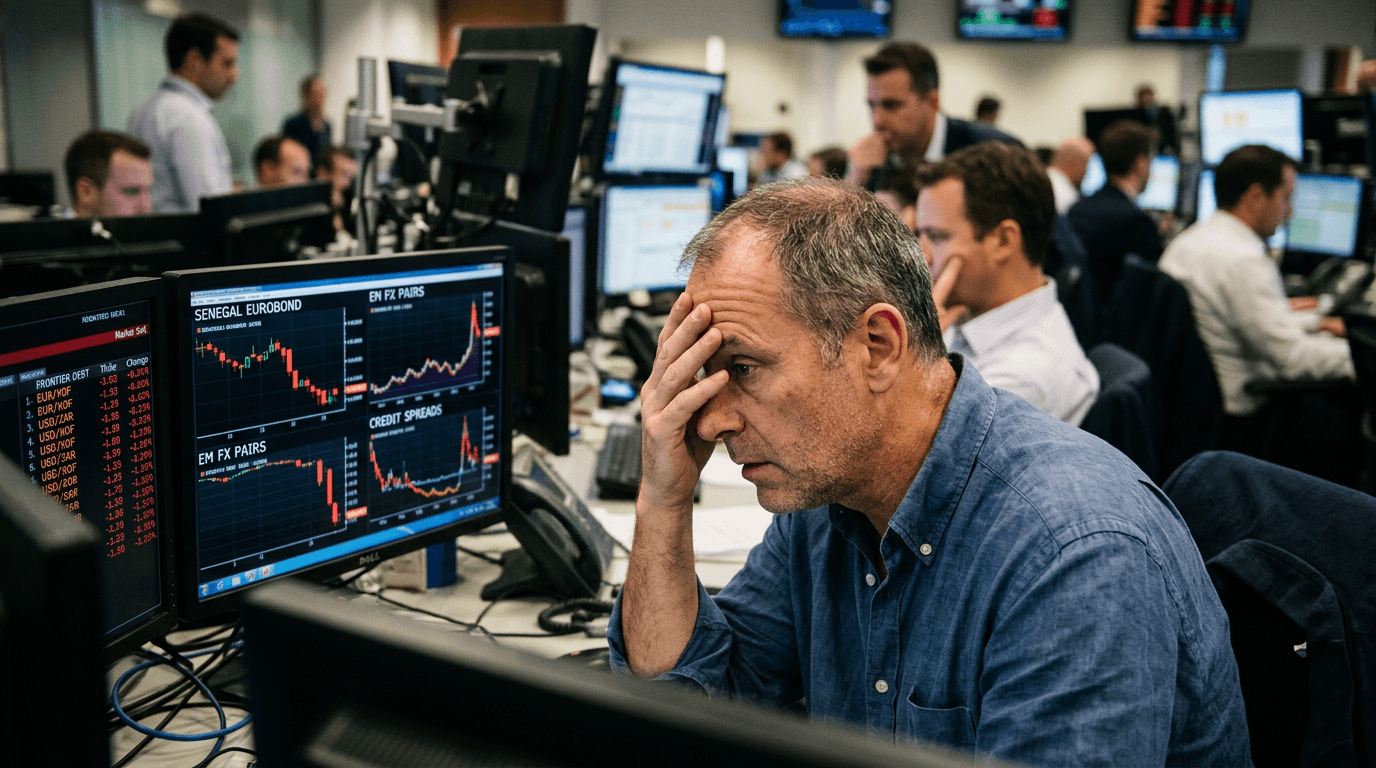
Senegal’s recent bond selloff is more than a country‑specific story; it is a stark reminder of how quickly sentiment can turn against smaller emerging markets when default fears start to build.[1][8] Once a relative outperformer in frontier debt, Senegal has shifted into the “distressed” camp, and that shift is feeding through into EM FX baskets, credit spreads, and risk appetite across high‑yield emerging assets.[1][3][8] For traders and investors, this is a live case study in how sovereign stress can ripple through markets far beyond a single issuer.
SENEGAL’S SLIDE FROM MARKET FAVOURITE TO DISTRESSED CREDITOR
Just a short time ago, Senegal’s eurobonds were trading in the 60–70 cents range, signaling confidence that the country could roll over debt and maintain market access.[1][5][12] The latest moves tell a very different story: several key eurobond lines now trade around 50–58 cents on the euro, levels typically associated with a high probability of default or restructuring.[3][8][9] Yields on benchmark hard‑currency bonds have surged to the low‑20s percent, putting Senegal in the same distressed bracket as names like Lebanon and Venezuela.[13][14]
The drivers of this shift are both fiscal and political. Updated data showed government debt climbing to roughly 119–132% of GDP, far above earlier official estimates and raising doubts about long‑term sustainability.[8][10] The discovery of around $13 billion in previously undisclosed obligations further eroded confidence and led the IMF to suspend its lending program.[11][17] While Senegal recently managed to pay nearly $500 million in due obligations – including about €380 million to eurobond holders – reports suggest it is delaying payments to other creditors and slashing spending, underlining how tight liquidity has become.[11][17]
The market is now fixated on a looming repayment wall: Senegal must honor roughly $1.1 billion in eurobond amortizations between 2026 and 2028, with more than €330 million falling due in March 2026 alone.[8] With some economists arguing that restructuring is “no longer an option, but a strategic necessity,” investors are increasingly pricing in a technical default or negotiated debt overhaul in the near term.[8][9]
WHY SMALLER EM SOVEREIGNS ARE SO EXPOSED TO SHIFTS IN SENTIMENT
Senegal’s story fits into a broader pattern facing smaller emerging and frontier issuers. Over the past decade, many tapped international markets through eurobonds to fund infrastructure and social programs, often at relatively tight spreads.[16][19] The trade worked while global rates were low and liquidity abundant. It becomes far more fragile when refinancing needs peak at the same time as borrowing costs surge.
In sub‑Saharan Africa, 2026 is a particularly challenging year, with multiple sovereigns facing large eurobond maturities and limited room to absorb shocks.[8][16] Earlier debt sustainability analyses from multilateral lenders often classified countries like Senegal as at “moderate” risk of debt distress, but with very little buffer if growth or financing conditions disappointed.[7][15] That buffer has now largely evaporated.
Smaller EM sovereigns tend to be especially vulnerable because:
They rely on a narrow investor base for hard‑currency funding, making them sensitive to even modest outflows.[16] Their domestic capital markets are shallow, limiting the ability to refinance externally issued debt at home. Political instability or policy surprises – such as revelations of hidden debt – quickly translate into sharply higher risk premiums.[10][11][13]
When sentiment shifts, the move is rarely gradual. As seen in Senegal, credit default swap spreads can jump from high‑yield to distressed territory in weeks, and bond prices can fall 20% or more in a short window.[5][8][9] That kind of repricing forces investors to reassess exposures across the entire frontier complex.
Contagion To Em Fx, Credit Spreads And Frontier Debt
The stress in Senegal’s curve is not happening in isolation. Frontier‑market eurobonds and high‑yield EM indices have seen widening spreads as investors demand higher compensation for perceived risk.[1][8][19] Sovereign yield premiums in Senegal are now more than 1,500 basis points above US Treasuries, signalling a market that expects restructuring rather than a smooth rollover.[13]
This repricing spills over into
EM FX baskets: When frontier risk spikes, investors often reduce exposure to smaller EM currencies and rotate into more liquid “core” EM names or developed‑market FX. That can weaken local currencies and tighten domestic financial conditions even before any actual default occurs.[18][19]
EM credit spreads: Index managers and dedicated EM funds may trim positions in higher‑risk credits to manage overall volatility, pushing spreads wider not only for Senegal but for other issuers with similar profiles.
Frontier‑market debt futures and synthetic exposures: In global portfolios and SimFi environments, stress episodes lead to higher implied volatility, wider bid‑ask spreads, and more pronounced moves in high‑beta debt instruments. Senegal’s shift from leader to laggard is a textbook example of how quickly frontier debt can go “risk‑off.”[1][8]
Importantly, this is less about direct fundamental contagion and more about a change in the market’s risk tolerance. Once one frontier issuer moves toward restructuring, investors re‑examine the entire cohort, asking who might be next and repricing accordingly.[16][18]
What Traders And Simfi Participants Should Watch
For active traders and SimFi users, Senegal’s bond stress offers several practical lessons.
First, watch the combination of price, yield, and maturity profile. Bonds trading consistently below 60 cents on the dollar or euro, with double‑digit yields and heavy near‑term amortization needs, are signaling that markets believe restructuring is likely.[3][8][9][13] Simulating scenarios where such issuers either pay, roll over, or restructure can help traders understand the range of outcomes and how portfolios might react.
Second, monitor the policy and IMF narrative closely. The suspension of IMF programs, delays in new agreements, or revelations of hidden liabilities are often the catalysts for sharp market moves.[10][11][17] Conversely, a credible multi‑year program, backed by multilateral financing and domestic reforms, can compress spreads and stabilize FX even in stressed cases.
Third, track cross‑asset signals. Rising CDS spreads, widening hard‑currency bond spreads, weakening local FX, and falling equity valuations in related sectors (banks, utilities, infrastructure) all reinforce the picture of rising sovereign risk.[5][13][18] In SimFi setups, these signals can be turned into stress tests: How would an EM FX basket perform if several frontier names simultaneously moved into distress? How would a high‑yield EM bond portfolio react to a 300–500 basis‑point spread widening?
Navigating The Next Phase Of Em Sovereign Risk
Senegal’s ability to meet recent payments buys some time but does not resolve the underlying issue of an over‑leveraged sovereign facing a steep repayment wall.[11][17] Absent a clear restructuring framework or a robust IMF‑supported plan, markets are likely to keep pricing in a high probability of default, and that perception will continue to weigh on smaller EM credits seen as sharing similar vulnerabilities.[8][9][16]
For investors, the takeaway is not that frontier markets are uninvestable, but that differentiation and risk management are critical. Countries with stronger institutions, diversified financing sources, and credible reform paths may still offer attractive risk‑adjusted returns, even as weaker peers struggle.[16][19] For SimFi users, this environment is an opportunity to explore how sovereign risk cycles unfold, test hedging strategies across FX and credit, and build playbooks for navigating future stress episodes.
Senegal’s bond stress underscores a simple but powerful reality: in smaller emerging markets, sentiment can change fast, and when it does, the impact extends well beyond a single issuer’s balance sheet. Understanding those dynamics, and being able to model them before they hit, is increasingly essential for anyone active in EM and frontier‑market trading.