
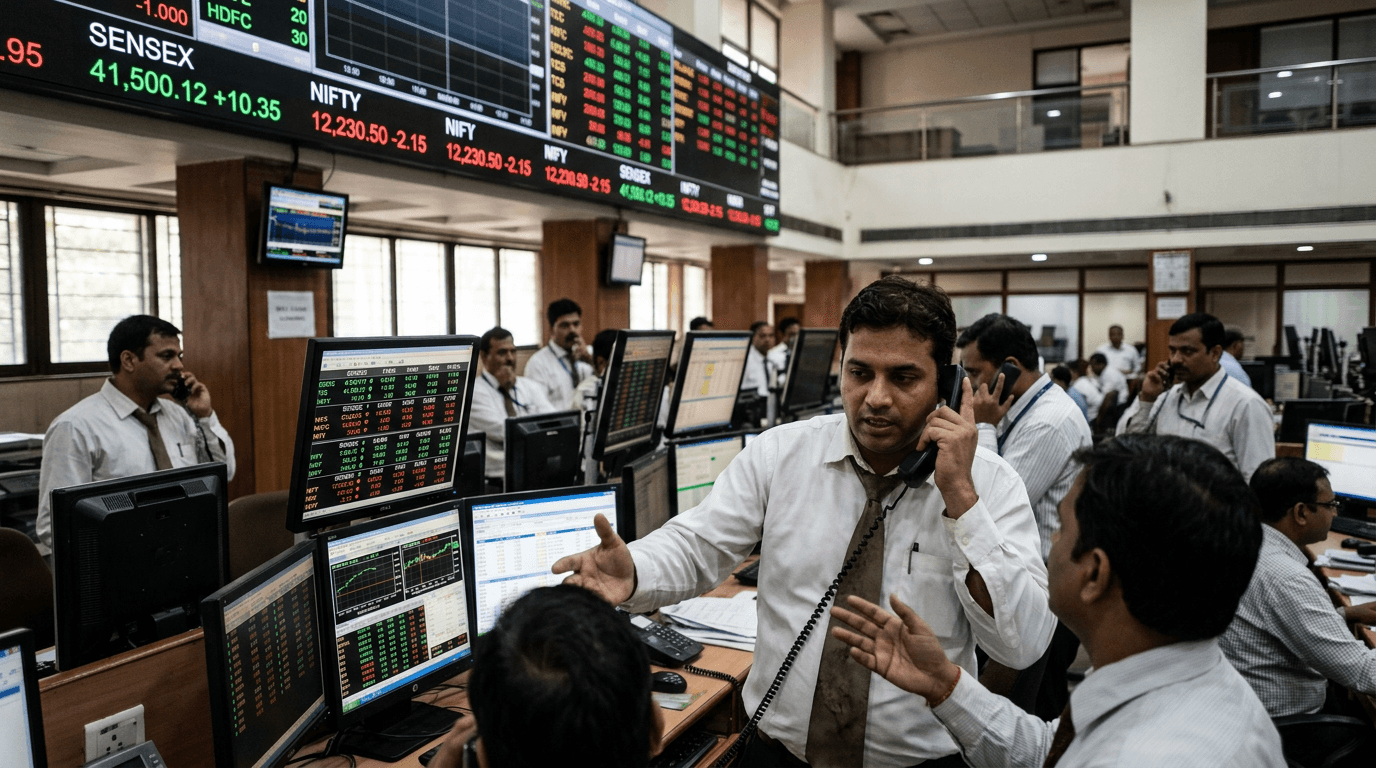
Indian markets opened the week in a curious split-screen: benchmark equities moved in opposite directions while the rupee showed a modest recovery against the dollar. The Sensex slipped, the Nifty edged higher toward the 24,070 region, and the currency firmed by about 5 paise around the 94.35–94.25 band, reflecting a cautious willingness to add risk even as global traders remain fixated on war headlines and dollar strength.
Market Snapshot: Mixed Equities, Firmer Rupee
The divergence between the Sensex and Nifty underlines how index composition matters when geopolitics drive the tape. Large-cap financials, energy, and global-facing cyclicals often dominate the Sensex, making it more sensitive to risk-off flows tied to conflict and oil prices.[10][14][15] The Nifty, with its broader sector mix, can be cushioned by domestic-oriented names such as consumer, IT services, and select industrials that benefit from resilient local demand and stable earnings visibility.[15]
The rupee’s slightly stronger open is notable because it comes after weeks of pressure that pushed the currency to record or near-record lows as the Iran-centered war unfolded.[3][6][13] At various points during the conflict, the rupee has fallen past levels like 92–94 per dollar, with cumulative losses of roughly 3% since hostilities escalated, reflecting a combination of higher oil prices, safe-haven dollar demand, and foreign portfolio outflows.[3][6][14]
In that context, a 5-paise appreciation is not a trend change on its own, but it signals that downside momentum in the currency may be stabilizing. Short-term traders will read this as evidence that some speculative shorts in the rupee are being covered and that the Reserve Bank of India’s smoothing operations are gaining traction in the near term.[3][6][14]
Global War And Dollar Risks
The backdrop to today’s moves is a war that has drawn in the US and Iran and raised the prospect of wider disruption across West Asia. The conflict has already driven a risk-off impulse across global markets, with Asian equities and currencies retreating as investors reassess energy security, growth, and inflation trajectories.[3][10][13] For India, heavily dependent on imported crude, extended hostilities are both a macro and market story: higher oil prices threaten the current account, fiscal math, and inflation path.[3][10][14]
At the same time, the US dollar has enjoyed a powerful safe-haven bid. The dollar index has climbed meaningfully since the war began, putting it on track for one of its strongest monthly advances in about a year as investors rotate into perceived safety.[3][5][10] When the dollar rallies this hard, emerging-market currencies like the rupee typically struggle, particularly if local assets are also seeing foreign selling and domestic risk appetite is fragile.[3][10][14]
How War Risk Translates Into Sensex, Nifty And Rupee
Recent weeks offer a clear illustration of how geopolitical stress flows into Indian asset prices. At several points during the conflict, the Sensex and Nifty have dropped between 1.4% and 2.6% in a single session, wiping out multiple lakh crore of market capitalisation as investors de-risk portfolios and cut leveraged positions.[2][6][13] Weekly losses have been the steepest since early 2025, confirming that this is more than routine volatility.[15]
The rupee has been a parallel casualty. It has repeatedly breached new lows, sliding to levels above 92–94 per dollar as foreign funds trimmed exposure to Indian bonds and equities while oil-linked dollar demand increased.[3][6][13] Market participants now routinely frame the rupee as one of Asia’s weaker performers in this environment, with trading ranges projected in the low-90s versus the dollar if crude remains elevated and war uncertainty persists.[14][15]
These moves are not purely sentiment-driven; they are rooted in the mechanics of macro transmission. Higher oil prices widen the current account deficit, pressure the fiscal position through subsidies or higher borrowing, and complicate inflation management.[3][10][14] In response, the central bank may lean more hawkish or intervene more aggressively in FX markets, which in turn affects bond yields, equity valuations, and the opportunity set for traders.[3][6][10]
WHAT TODAY’S MOVES SIGNAL
Against this backdrop, a day where the Sensex dips, the Nifty edges up, and the rupee opens stronger suggests markets are attempting to find a new equilibrium rather than simply extending panic selling. Domestic institutional investors, retail flows, and systematic strategies often step in when valuations become attractive, helping indices like the Nifty stabilise even as global risk remains elevated.[10][15] Meanwhile, the rupee’s modest recovery indicates that immediate fears about a disorderly slide may be easing, at least temporarily.[3][6][14]
Volatility remains high, however. India’s volatility gauges have recently spiked, and weekly performance across indices has underscored that sentiment can swing quickly as war headlines, oil prices, and dollar moves intersect.[10][15] Traders should therefore treat today’s mixed signals as part of a broader consolidation phase, not as confirmation that war and dollar risks have been fully priced in.
Practical Takeaways For Simulated Traders
For traders using simulated environments such as E8 Markets’ SimFi platform, this backdrop offers a rich learning laboratory. Because capital is not at risk, participants can focus on process and risk management rather than emotional reactions to drawdowns.
1. Study cross-asset linkages Track how moves in crude oil, the dollar index, and US yields line up with daily changes in Sensex, Nifty, and the rupee. This reinforces the habit of looking beyond single charts to understand the macro narrative.[3][5][10]
2. Build and test war-risk scenarios Create model portfolios that are long energy and defensive sectors, short highly leveraged cyclicals, and partially hedged in USDINR. Then backtest how these structures would have behaved during the sharp sell-offs seen since the war began.[2][6][13]
3. Practice FX risk management Use simulated rupee-dollar trades to practise setting stop-losses, position sizing, and hedging around key levels like 92–94 per dollar that have recently been breached.[3][6][14] Focus on how volatility changes as the currency approaches or retreats from those zones.
4. Develop rules for trading high-volatility days Draft a written playbook for days when indices move more than 1.5% and the rupee is swinging by 30–50 paise. Include guidelines on maximum leverage, timeframes, and when to switch from directional trades to mean-reversion or options-based strategies.[2][6][15]
5. Separate structural views from tactical trades Even if the structural view is that India’s growth story remains intact, simulated traders can practise making short-term tactical adjustments—such as cutting beta, rotating into defensives, or increasing cash—when war or dollar shocks hit.[10][13][15]
Conclusion: Navigating A Two-front Market Battle
Indian markets are currently fighting on two fronts: a geopolitical shock that affects energy, growth, and sentiment, and a powerful dollar rally that challenges local currency and asset valuations.[3][5][10] Today’s pattern—Sensex softer, Nifty firmer, rupee slightly stronger—captures the tug-of-war between risk aversion and confidence in domestic fundamentals. For real-money investors, it is a reminder to stay disciplined on asset allocation and hedging. For simulated traders, it is an opportunity to refine playbooks for crisis conditions, deepen understanding of macro transmission, and build habits that will be invaluable when these lessons are eventually applied in live markets.[3][6][13]