
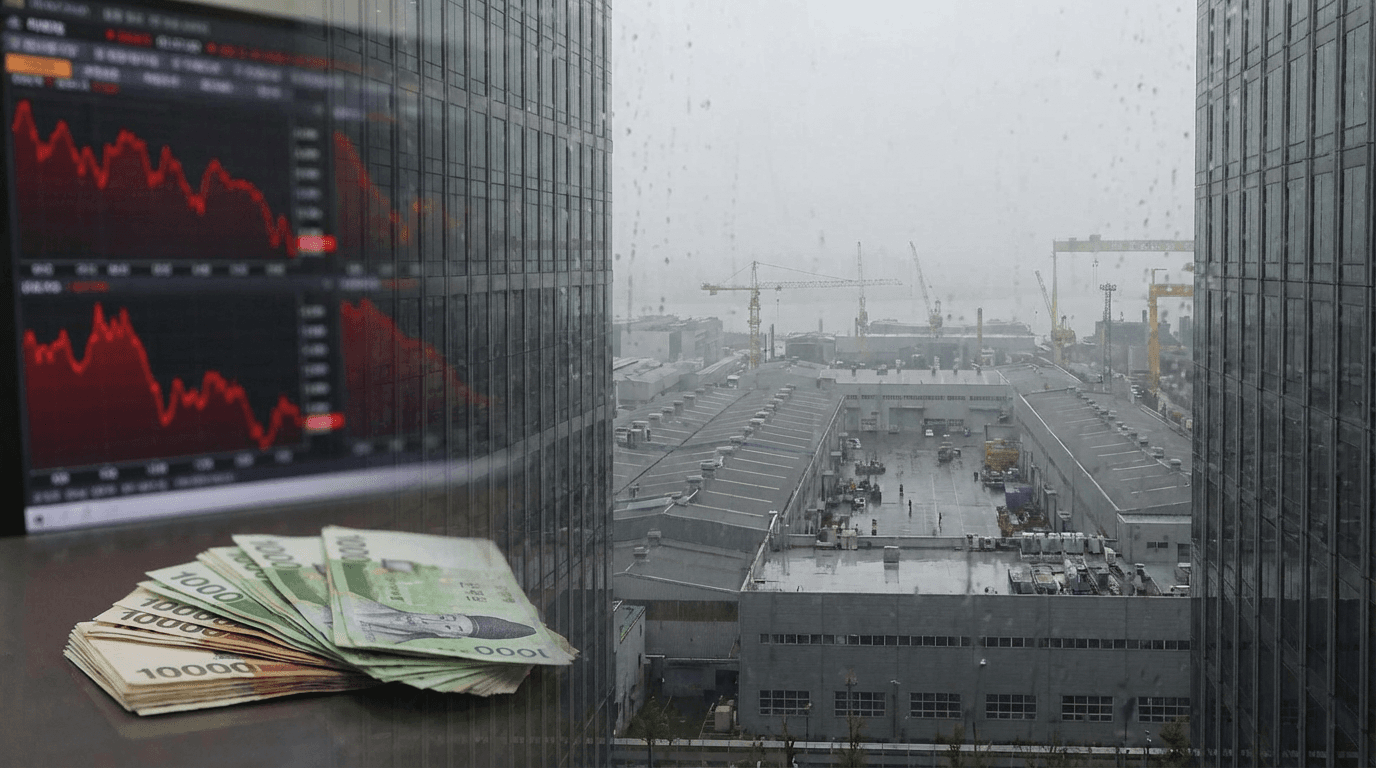
South Korea's industrial output growth hit a five-year low in 2025, expanding just 0.5% year-on-year and sending ripples through Asian currency markets. This slowdown marks the weakest pace since 2020, when the economy contracted amid COVID-19 fallout, and it's now putting pressure on the Korean won and other regional currencies that investors view as proxies for Asian economic health. For traders monitoring forex markets and emerging market currencies, South Korea's industrial weakness represents a critical signal about the broader regional economic trajectory and shifting investor risk sentiment.
The headline numbers paint a concerning picture for Asia's fourth-largest economy. After growth rates consistently above 1% in 2022 through 2024, the deceleration to just 0.5% represents a significant loss of momentum. The slowdown was broad-based across much of the economy, with weak domestic demand cited as the primary culprit. However, the numbers also reveal a bifurcated economy where certain sectors thrived while others struggled, creating a complex backdrop for currency traders assessing regional risk.
What's Behind The Slowdown
The weakness in South Korea's industrial production reflects a confluence of headwinds that extend across multiple economic sectors. Sluggish domestic demand has been the most persistent drag on growth, suggesting that Korean consumers and businesses have grown more cautious about spending and investment. This domestic weakness is particularly notable given that South Korea's economy has traditionally relied heavily on domestic demand alongside export-driven growth.
Beyond domestic factors, global trade uncertainty and inventory normalization have also played roles in tempering industrial activity. The automobile and machinery sectors, which are traditional pillars of South Korean manufacturing, faced disruptions and output stabilization challenges throughout the year. These sectors are not only critical to South Korea's economy but also bellwethers for broader Asian manufacturing health, making their weakness significant for regional currency traders.
Additionally, while the government and central bank implemented various stimulus measures, the effectiveness in spurring industrial production remained limited. This suggests that structural economic challenges may be more persistent than cyclical weakness, which could have longer-term implications for the won's valuation relative to other Asian currencies.
The Forex Implications
For currency traders, South Korea's industrial slowdown directly impacts the Korean won through multiple transmission channels. Weaker economic data typically prompts capital outflows as investors seek safer or higher-yielding alternatives, applying downward pressure on the won. The currency has faced selling pressure as market participants reprice their expectations for South Korean growth and monetary policy divergence relative to other central banks.
The won's weakness has cascading effects across Asian currency markets. As South Korea is a major regional trading hub and economic indicator, won weakness often signals broader economic caution in Asia, leading to softness in other regional currencies including the Australian dollar and currencies of other Asian trading partners. The AUD/USD pair has shown sensitivity to South Korean economic data, as Australia's economy benefits significantly from Asian demand for commodities and manufactured goods.
This dynamic creates a feedback loop: weak Korean industrial output triggers won depreciation, which in turn weighs on other regional currencies as investors adjust their broader Asia exposure. Forex traders have been pricing in these relationships, with recent Asian market opens showing cautious sentiment partially attributable to South Korea's economic data alongside other regional indicators like Japanese jobless rates and production figures.
The Semiconductor Bright Spot
Perhaps the only genuinely bright spot in South Korea's industrial data has been the semiconductor sector, which surged 13.2% year-on-year in 2025. This exceptional performance reflects strong global demand driven by the artificial intelligence boom, with inventory restocking and firmer external demand providing support. Semiconductors essentially prevented the overall industrial production number from being far worse than it was.
For traders, the semiconductor strength matters because it illustrates South Korea's continued competitive advantage in high-tech manufacturing and its exposure to the AI mega-trend. However, semiconductor demand can prove volatile, and this sector's outsized contribution to overall growth also means the economy is heavily dependent on a single industry's fortunes. If chip demand softens, industrial output could deteriorate much more sharply.
What Traders Should Monitor
Going forward, traders should watch several key indicators to assess whether South Korea's slowdown stabilizes or deepens. December data showed a month-on-month rebound of 1.7%, suggesting some stabilization, but the year-on-year comparison remained negative at 0.3%. Monitoring whether this momentum extends into 2026 will be crucial for determining if the slowdown is transitional or structural.
Retail sales showed signs of recovery, rising 0.5% after declining for three consecutive years, which could suggest consumer caution is easing. Facility investment also advanced 1.7%, though construction investment collapsed 16.2%, indicating uneven recovery. These mixed signals suggest the Korean economy is in a delicate rebalancing phase where currency volatility could remain elevated.
For active traders, South Korea's economic data will likely continue influencing won movements and broader Asian currency correlations. Position management around Korean economic releases and close monitoring of semiconductor demand trends should remain priorities for those with regional currency exposure.