
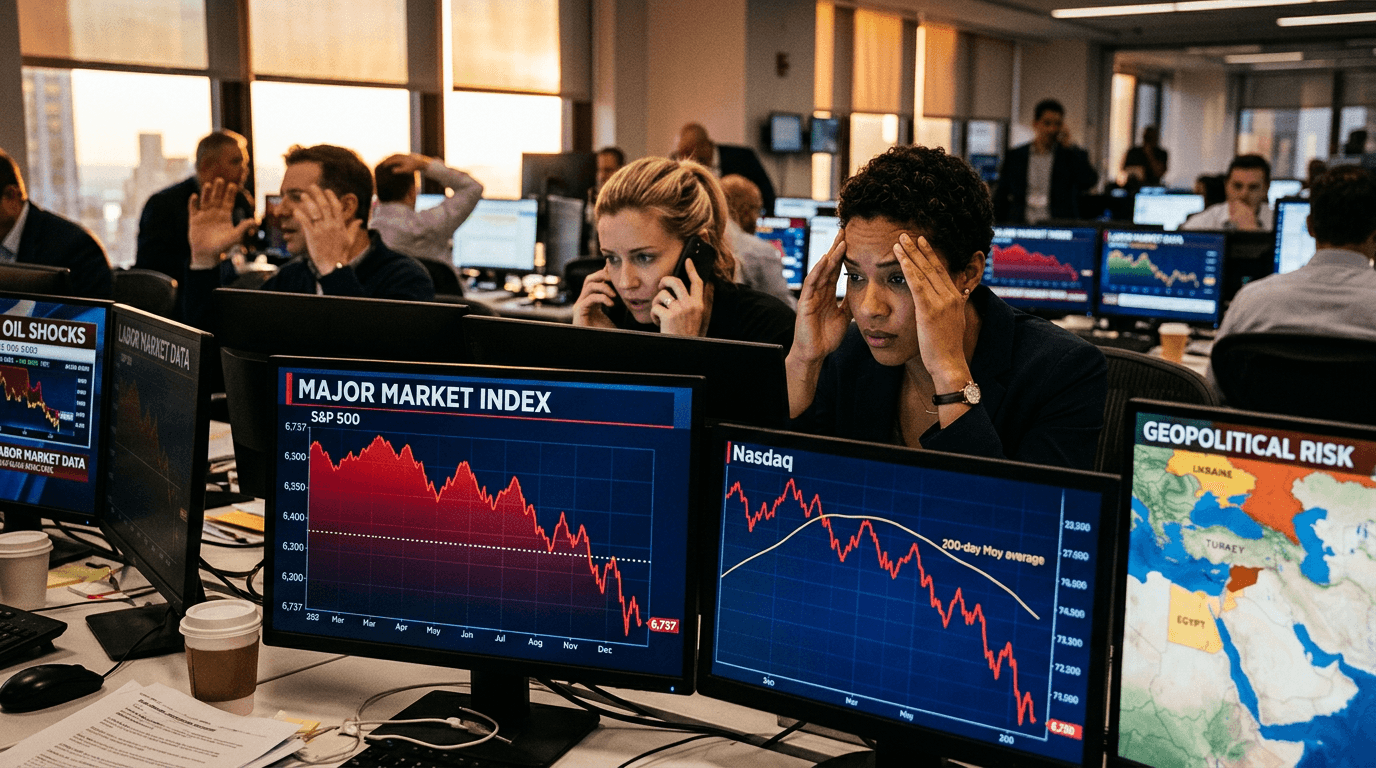
The S&P 500's recent breakdown below the 6,737 support level signals a critical shift in market dynamics as geopolitical tensions and deteriorating economic signals converge to trigger a significant risk-off rotation.[2][3] After weeks of relative stability, equity futures have turned distinctly bearish, with major indices struggling to sustain their earlier gains amid rising oil prices, mounting geopolitical uncertainty, and a troubling pullback in labor market strength. For traders and investors monitoring the broader market structure, the current price action represents a potential inflection point that could reshape portfolio positioning and trading strategies for the weeks ahead.
The S&p 500 Breakdown And Critical Support Levels
The S&P 500 has broken through key technical support at the 6,737 level, a deterioration that moves traders' attention to a cascading series of support zones that could either stabilize the decline or accelerate it further.[1] According to recent technical analysis, if the selling pressure continues beyond 6,775, the next meaningful support lies near 6,720, followed by increasingly important levels at 6,600 and 6,521, which represents November's 2025 low.[4] This structural breakdown matters significantly because it suggests that the recent rally lacked sufficient breadth and conviction to sustain higher prices. The breakdown is particularly meaningful given that the S&P 500 had remained relatively flat through much of early March despite deteriorating market breadth conditions, indicating that the index was held aloft by a narrow subset of mega-cap stocks rather than broad-based participation.[1]
The technical setup suggests traders should be watching for a retest of these broken support levels. A failure to hold above 6,720 would confirm a more serious downtrend and could trigger algorithmic selling that accelerates the decline. Conversely, if buyers step in at these levels with meaningful volume, it could signal the beginning of a stabilization phase. The key remains watching whether each level holds on the first test or breaks through with conviction.
Technology Sector Weakness And The Nasdaq 100 Inflection
While the S&P 500's weakness has been notable, the technology sector's deterioration presents an even more concerning signal for equity market bulls.[1][4] The NASDAQ Composite's breach of its 200-day moving average marks a critical breakdown in what had been one of the market's most resilient segments. Recent trading data indicates that if this key technical defense fails to hold, the next technical target sits around the 23,000 level, contingent on whether the NASDAQ can maintain support at the 24,200 zone.[3]
This development is particularly significant given technology's outsized influence on major indices. Even as the Dow and S&P 500 declined during early March volatility, technology stocks had maintained some relative strength, drawing continued investor interest despite the broader market's risk-off sentiment.[3] That resilience has now broken down, suggesting that even growth-focused traders are reassessing their exposure. The momentum shift in technology matters because it removes one of the few bright spots that could have supported a market rebound.
Geopolitical Uncertainty And Oil Price Shocks
Underlying the technical breakdown is a fundamental shift in the market's risk environment driven by escalating Middle East tensions and climbing energy prices.[2][3] Oil prices have spiked significantly, approaching the $90 level with calls mounting for $100 crude, while some international officials have warned of potential doubling to $150 if the conflict widens.[2] This energy shock directly impacts inflation expectations, corporate profit margins, and global economic growth, creating a toxic cocktail for equities.
The geopolitical backdrop matters because it introduces genuine uncertainty that cannot be easily modeled or priced. Unlike earnings misses or interest rate surprises, geopolitical escalation can move unpredictably, and market participants are rightfully cautious until clarity emerges.[2] The absence of a clear resolution pathway means equity investors face an open-ended tail risk that encourages defensive positioning.
Deteriorating Economic Indicators And Breadth Breakdown
Compounding the technical and geopolitical headwinds is troubling economic data that has emerged in early March. Nonfarm payrolls fell by 92,000 in February, a sharp disappointment against expectations for 50,000 growth and January's gain of 126,000.[2] The unemployment rate also rose to 4.4% from 4.3%, signaling softening labor market conditions. These data points matter for equities because they suggest the economic expansion may be losing momentum precisely when geopolitical risks are accelerating.
Meanwhile, market breadth conditions have deteriorated significantly, with fewer stocks participating in the market's trend even as major indices held their ground.[1] This breadth breakdown is a red flag because it indicates that market strength has become concentrated in a narrowing subset of mega-cap names rather than reflecting broad-based investor enthusiasm. Historically, such divergences precede broader market declines as the lack of participation eventually constrains index performance.
Actionable Takeaways For Traders And Investors
The current market environment requires a recalibration of risk management and positioning strategy. Traders should establish clear stop-loss levels at the identified support zones while maintaining flexibility to take profits on any attempted bounces. For longer-term investors, the elevated volatility and fear indicators suggest maintaining conviction in quality holdings, though selective trimming of extended positions makes tactical sense given the technical breakdown.