
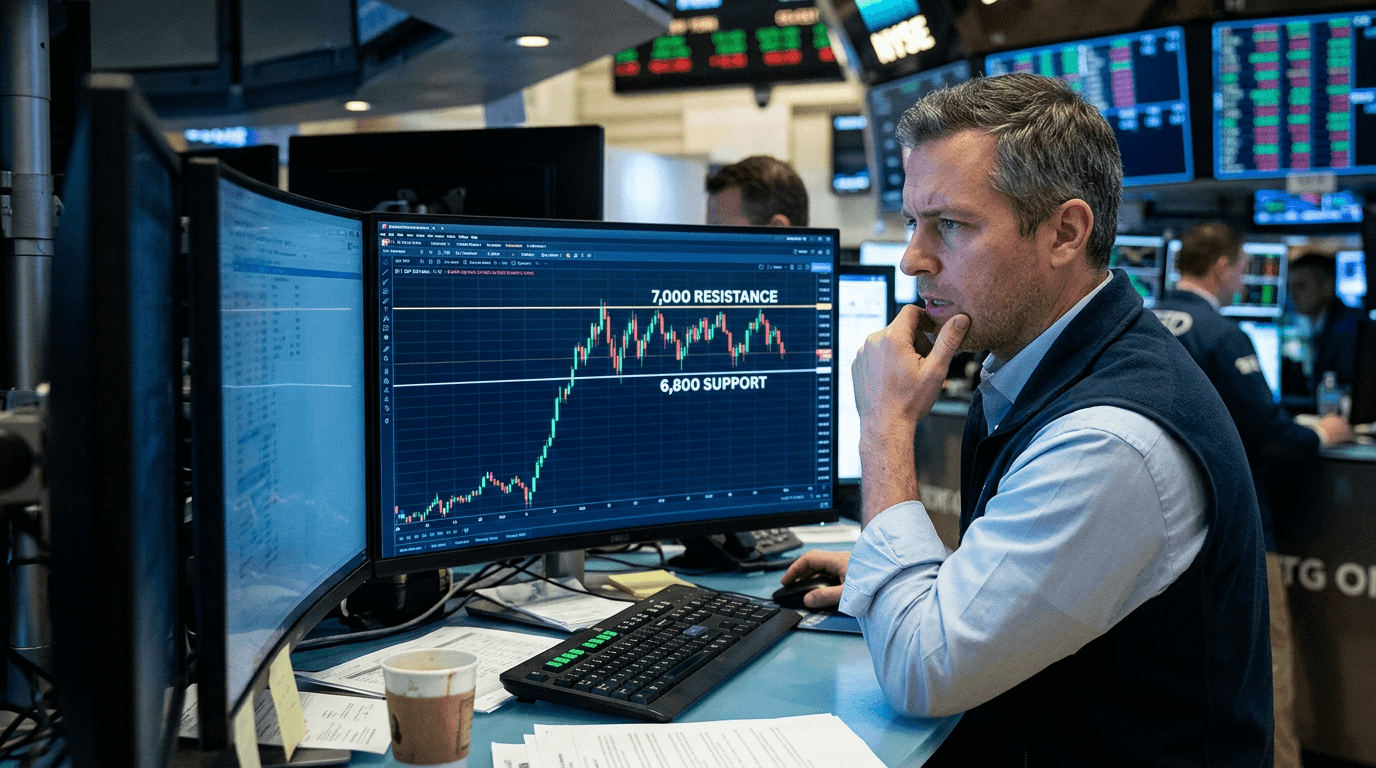
The S&P 500 stands at a critical juncture as it consolidates between 6,800 and 7,000, testing the resolve of bulls and bears alike in what has become the market's most watched trading range of 2026. After closing at 6,946.13 on February 26 with a resilient 0.8% daily gain, the index finds itself just 54 points away from the historic 7,000 psychological milestone that has eluded it for weeks.[2] This consolidation phase is not a sign of weakness but rather a period of digestion following one of the most efficient 1,000-point runs in the history of the S&P 500, a rally that began when the index first crossed 6,000 in November 2024.[2]
For traders and investors, understanding the dynamics of this range is critical. The market is essentially asking a fundamental question: will it break above 7,000 and establish a firmer foundation for continued gains, or will it reverse and trigger the widely anticipated 5-10% correction that technical analysts have been forecasting?[2] The answer to this question will likely determine the character of equity markets through the remainder of 2026.
The Technical Battleground
The current range structure is remarkably well-defined. Resistance stands at approximately 7,000 to 7,050, with the S&P 500 having tested this zone multiple times since late January.[3] The index briefly touched an intraday high of 7,002.28 on January 28, 2026, but failed to sustain the breakout as "sell-the-news" reactions to big tech earnings triggered consolidation.[2] Support sits firmly at 6,780 to 6,820, with deeper structural support visible at 6,600 to 6,650 from late December consolidation patterns.[3] As long as the index holds above 6,780, this remains a constructive consolidation within the broader uptrend rather than a reversal pattern.
The momentum picture reveals why the 7,000 level has proven so sticky. The Relative Strength Index is no longer holding above 50 consistently, suggesting that buyers are losing some control over price action.[3] This shift from expansion to compression is typical during profit-taking phases, but it also sets the stage for a potential spring in either direction. The market's internal dynamics—what it won't do rather than what it will do—offer important clues. Despite a brief tariff shock on February 24 that caused volatility, the market found its footing at the 6,800 support level, demonstrating that the bull market's structural integrity remains intact.[4]
What's Fueling The Consolidation
Three primary forces have shaped this range-bound environment. First, the "second wave" of artificial intelligence investment and a revitalized financial sector continue to provide fundamental support for equities.[2] Second, the implementation of fiscal stimulus measures, including the "One Big Beautiful Bill Act" in mid-2025, has sustained domestic consumption and corporate earnings growth.[2] Third, a technically overbought condition has emerged, prompting necessary profit-taking that prevents the index from running away to the upside too quickly.
The earnings environment remains robust. Fifth consecutive quarter of double-digit earnings growth across S&P 500 components is supporting higher valuations, with forecasts suggesting 15% blended earnings growth for the full year 2026—significantly outpacing historical averages.[2] This is not a market running on speculation; it is running on improving corporate profitability. However, the VIX holding at 17.93 reflects a market that is richly valued even if fundamentally supported.[2] Institutional investors are maintaining expensive downside protection, wary of potential geopolitical shifts or the "gamma walls" of derivatives at the 7,000 strike price that could trigger sudden volatility.
Breakout Scenarios And Probabilities
Three plausible outcomes command the attention of market participants. The bullish continuation scenario, with an estimated 40% probability, sees acceptance above 7,050 triggering continuation toward 7,200 and potentially higher as trend strength returns.[3] This outcome would likely require a strong earnings catalyst, particularly from bellwether stocks like Nvidia whose earnings guidance carries outsized weight in market sentiment.
Sideways consolidation, estimated at 35% probability, envisions the price continuing to rotate between 6,800 and 7,000 while momentum indicators reset.[3] This scenario would allow the market to work off overbought conditions and give late-stage buyers an opportunity to accumulate positions without damaging the broader uptrend.
The corrective pullback scenario, at 25% probability, would see a breakdown below 6,780 triggering a retracement toward 6,600 or lower.[3] Such a move would still qualify as a healthy correction within a larger bullish structure, provided that the 200-day moving average is not threatened and support holds at deeper structural levels.
What Investors Should Monitor
Moving forward, several key developments warrant attention. Any clean daily close above 7,050 would invalidate the current range structure and likely trigger decisive upside action.[3] Conversely, a sustained break below 6,780 would signal that consolidation has given way to corrective pressure. Consistency in AI-related revenue growth and any shifts in Federal Reserve stance on liquidity should be watched closely, as these factors will ultimately determine whether the S&P 500 can establish 7,000 as a firm floor for continued appreciation or whether it must first step back to consolidate further.
The path to 7,000 and beyond will not be a straight line. This consolidation represents a healthy digestion period within a powerful bull market cycle. For traders, it presents clear decision points and defined risk parameters. For longer-term investors, the message is straightforward: the underlying dynamics supporting higher equity valuations remain intact, even as the market works through a necessary technical pause.