
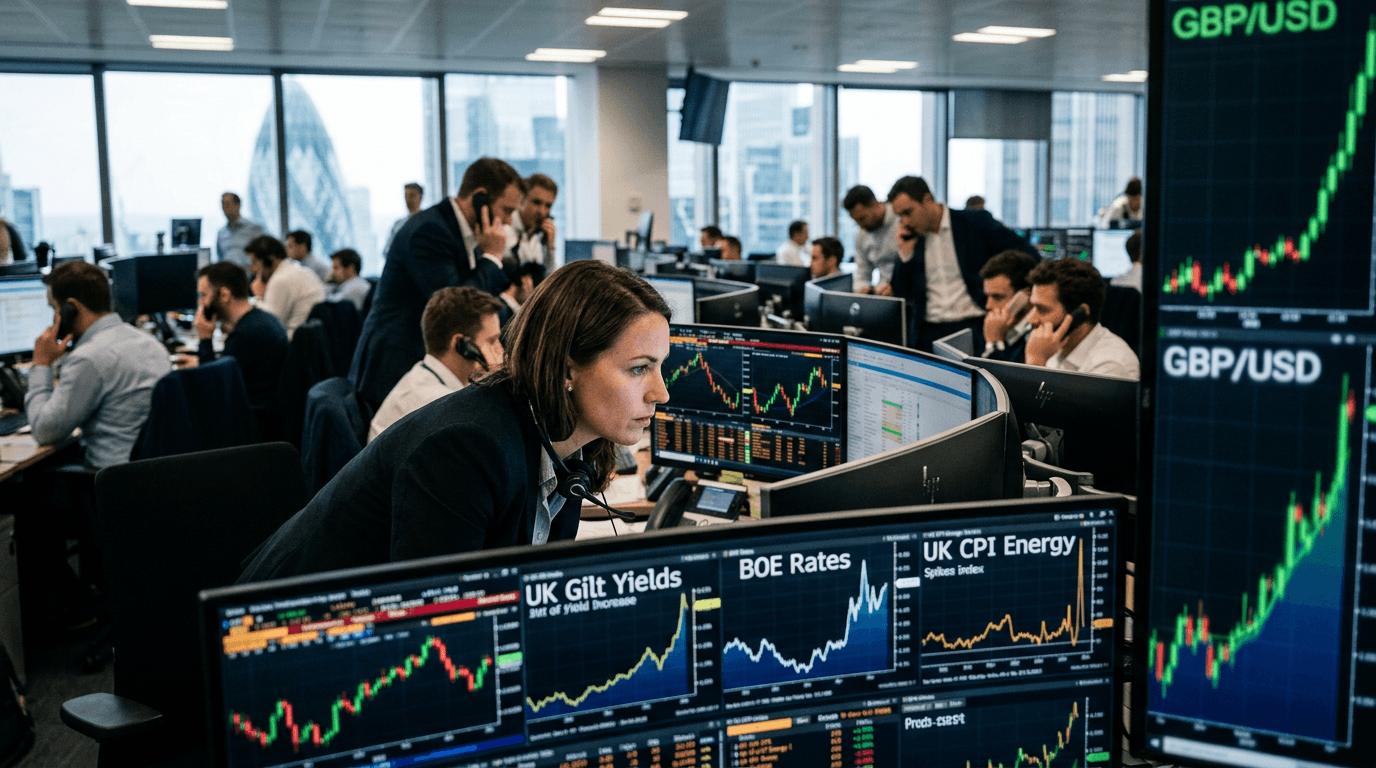
Sterling’s latest climb toward a one‑month high is more than just a currency headline. The move reflects a rapid reassessment of how long the Bank of England (BoE) might need to keep interest rates elevated as an energy‑driven inflation shock ripples through markets, tied to escalating tensions between the U.S., Israel and Iran.[1][2] As traders reprice the BoE’s policy path, risk sentiment has improved in GBP forex pairs and UK rates futures, rewarding investors positioned for a “higher‑for‑longer” rate story.[2][6]
STERLING’S LATEST SURGE
In recent sessions, the pound has traded near a one‑month high against the dollar and around a one‑year peak versus the euro, signalling renewed confidence in UK assets relative to key peers.[1][2][6] Moves of this magnitude are modest in isolation, but the context matters: the rally follows weeks in which markets had been leaning toward earlier and more aggressive BoE rate cuts, reflecting the perception that the inflation battle was largely won.[7][11]
Several factors are supporting sterling simultaneously. Better‑than‑expected UK growth data has reduced the urgency for monetary easing and reinforced the view that the economy can withstand tighter financial conditions for longer.[6] At the same time, investors are gravitating toward currencies backed by more hawkish central bank narratives, with the pound benefiting as traders compare the BoE’s likely trajectory with that of the Federal Reserve and the European Central Bank.[2][7]
For traders, the move in GBP is a classic illustration of how currencies tend to respond to changing interest‑rate expectations. A central bank perceived as staying restrictive for longer generally boosts its currency by offering higher yields on domestic assets and by signalling a stronger stance against inflation, which supports real returns.
Energy Shock And Inflation Expectations
The catalyst for this repricing has been a renewed spike in energy prices, driven by geopolitical tensions in the Middle East and the U.S.-Israeli conflict with Iran.[1][2][5] Energy is a critical component of the UK inflation basket, not only directly through fuel and utility bills, but indirectly via higher production and transportation costs that feed into broader prices.
Bank of England officials have emphasised that elevated and volatile energy prices create one of the “most difficult combinations” for monetary policy, forcing them to balance slowing growth with the risk of inflation re‑accelerating.[9] The BoE has explicitly warned that inflation is likely to rise again later this year as the repercussions of higher energy prices filter through the economy, including potential second‑round effects like wage pressures.[9]
In practical terms, this means that the previous narrative of a smooth glide path back to the 2% inflation target is now under scrutiny. While headline inflation has fallen from its peaks, markets must ask whether this new energy shock is a temporary bump or the start of a sustained period of renewed price pressure.[7][9] Until the answer is clearer, rate‑cut expectations will be more cautious.
Repricing The Bank Of England Path
Going into the latest energy spike, markets were increasingly confident that the BoE would be able to deliver a series of rate cuts over the coming quarters, in line with easing cycles pencilled in for other major central banks.[7][11] The current Bank Rate stands at 3.75%, with inflation running below previous highs but still sensitive to external shocks.[3][11]
As energy prices climbed, traders have sharply reduced the implied probability of near‑term cuts. In similar recent episodes, what had been priced as a near‑certainty of a BoE cut quickly shifted to something closer to a “knife‑edge” 50/50 outcome as energy risks mounted.[8][13] In UK money markets, investors have gone so far as to price out cuts for the remainder of the year in some scenarios, with a small chance of renewed hikes re‑emerging if inflation surprises to the upside.[5][9][13]
This repricing is visible in UK rates futures and gilt yields. Fewer expected cuts translate into higher yields along the curve, particularly in the front‑end where policy expectations are most concentrated. For the BoE, the challenge is to signal enough resolve to keep inflation expectations anchored, without over‑tightening policy into a slowdown that could undermine financial stability.
Crucially, markets now see the BoE as more likely to lag the ECB and potentially the Fed in delivering rate reductions, given the UK’s tight labour market and vulnerability to energy‑related trade shocks.[7] That relative stance is one of the key reasons sterling has outperformed the euro and, to a lesser extent, the dollar.
Market Impact: Fx And Uk Rates
Sterling’s strength is feeding through into broader market behaviour. A firmer pound often weighs on UK export‑heavy equity indices, as overseas earnings translate into fewer domestic currency gains, but it can also support domestic purchasing power and reduce imported inflation over time.[6][12] In the short term, however, the dominant driver remains expectations for the BoE rather than the equity outlook.
In FX space, GBP is benefiting from investors rotating toward currencies associated with credible, hawkish policy frameworks in an uncertain inflation environment.[2] This has helped support risk sentiment in selected carry trades and relative‑value strategies that involve going long sterling versus currencies whose central banks are perceived as closer to an easing cycle.
In UK rates markets, the shift away from imminent cuts has increased volatility. Traders positioned for a smooth decline in yields have had to adjust as front‑end rates move higher on fewer expected cuts, and as the probability distribution of future BoE decisions becomes wider.[5][11][13] This environment rewards those who understand how macro shocks translate into the term structure of interest rates, and penalises strategies that rely on a single deterministic policy path.
Practical Takeaways For Traders And Simulated Investors
For active traders and those practising on simulated finance platforms, several lessons stand out from sterling’s latest move:
- Link macro narratives to tradable instruments. The energy‑inflation‑rates chain connects commodity prices, bond yields and FX pairs such as GBP/USD and EUR/GBP.[2][5] Understanding that chain helps you anticipate where volatility might appear next.
- Focus on relative, not absolute, policy paths. Sterling’s outperformance is as much about the BoE being seen as more hawkish than the ECB or Fed as it is about the level of UK rates in isolation.[2][7] Cross‑currency strategies depend on these relative expectations.
- Track forward‑looking indicators. UK inflation prints, wage data, and BoE communications can quickly change the probability of future cuts or hikes, which is reflected in swaps and futures before it filters into spot FX.[7][8][11]
- Use scenario analysis. Ask how GBP, gilts and UK rates futures might react under different energy price trajectories or inflation surprises. Scenario testing on platforms like E8 Markets allows traders to rehearse responses to shocks without real capital at risk, building intuition for how complex macro stories unfold.
Conclusion: Beyond The Headline Move
Sterling’s climb toward a one‑month high amid an energy price spike shows how quickly market narratives can flip when geopolitics, commodities and central bank policy collide.[1][2][5] What looked like a straightforward transition to lower rates has turned into a more uncertain journey, with traders now betting that the BoE will need to keep policy tighter for longer to guard against renewed inflation pressure.[2][9][11]
For traders, the key is not to fixate on the latest level in GBP/USD or the odds of the next BoE decision in isolation. Instead, it pays to build a framework that connects external shocks like energy price spikes to inflation expectations, central bank reaction functions and cross‑asset pricing. Whether you trade live capital or practice in a simulated environment, this episode underlines that in modern markets, every currency move is ultimately a macro story in motion.