
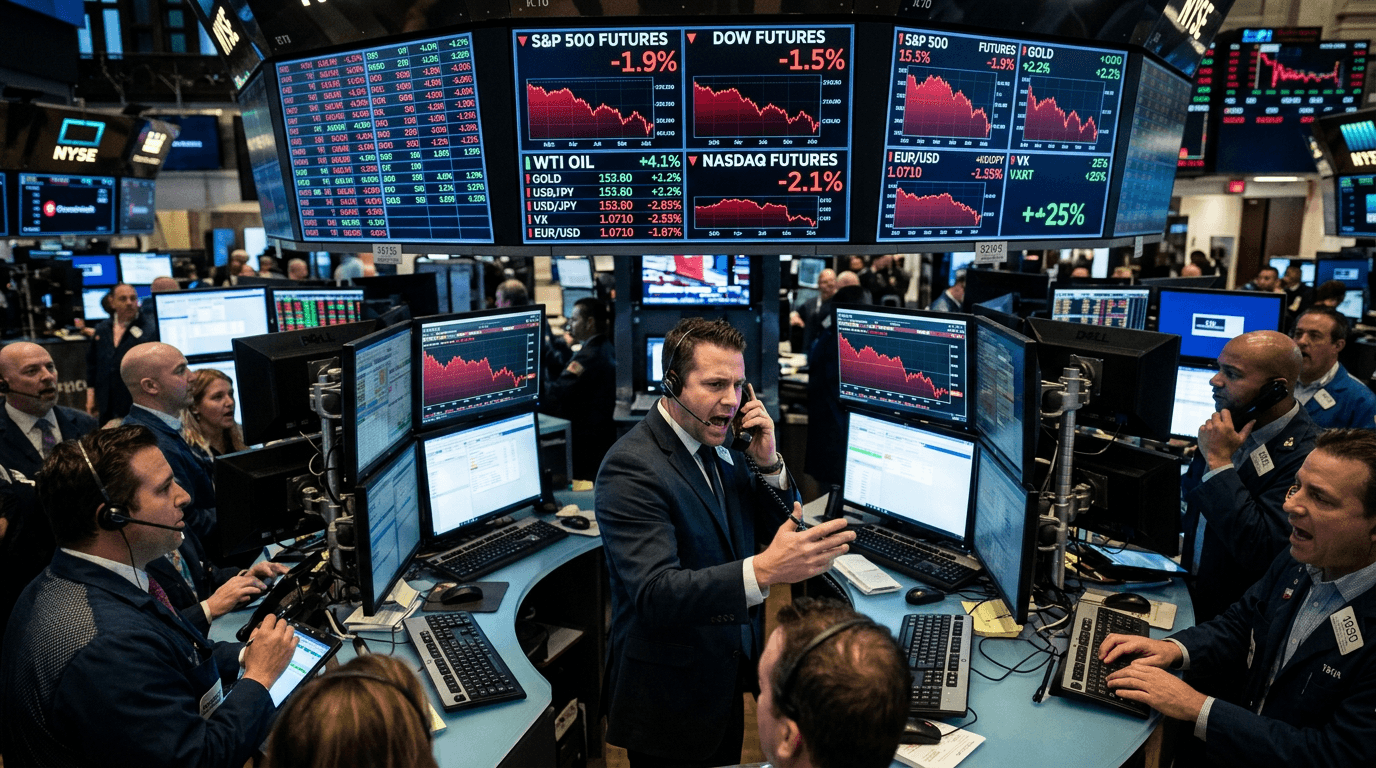
Stock index futures were under pressure as traders absorbed news of an Iranian strike on Israel that threatens to derail fragile ceasefire efforts and ignite a wider conflict. With risk appetite already strained by high rates and sticky inflation, the renewed Middle East tension has pushed investors toward defensive positioning and away from growth-sensitive assets.[7][13]
What The Move In Futures Is Telling Us
When geopolitical headlines hit on a weekend or overnight, index futures are the market’s first real-time stress test. In past escalations between Iran and Israel, S&P 500, Dow, and Nasdaq futures have frequently dropped around 1% or more before the cash market opens, reflecting a rapid reassessment of risk and earnings visibility.[4][9][10] These are not catastrophic moves, but they are meaningful, especially when clustered on top of an already weak week for equities.[2][7]
The logic is straightforward: higher geopolitical risk raises the probability of energy supply disruptions, squeezes corporate margins via higher input costs, and increases uncertainty about global growth. That combination justifies lower valuation multiples, particularly for richly priced segments like tech and consumer discretionary. In prior Iran-related episodes, Nasdaq futures have typically underperformed the Dow, as investors rotate away from high-duration growth stocks and into more defensive or real-asset plays.[4][9]
At the same time, implied volatility usually spikes. During earlier strikes between Israel and Iran, the VIX—Wall Street’s “fear gauge”—has jumped into the low 20s, signaling a shift from complacency to unease, but still short of outright panic.[12] That kind of move is consistent with a market that is repricing risk rather than capitulating.
Why Geopolitical Shocks Hit Risk Sentiment
Geopolitical events matter most when they intersect with key macro channels: energy, trade, and financial conditions. The Iran–Israel theatre touches all three.
First, the Middle East remains a critical node in global oil production and transport. In prior rounds of strikes involving Iran, crude prices have jumped anywhere from 5% to over 10% intraday amid concerns about supply and shipping routes.[4][9][10] Higher oil prices are effectively a tax on consumers and energy-intensive industries, weighing on global demand and margins.
Second, conflict risk can disrupt trade routes, insurance costs, and shipping timelines. Even if physical volumes are not immediately hit, higher perceived risk is enough to tighten financial conditions for energy-importing countries and risk-sensitive sectors such as airlines and logistics. After earlier Iran-related attacks, airline stocks and travel names have consistently underperformed as fuel costs rise and demand expectations soften.[9]
Third, geopolitical uncertainty complicates central bank decision-making. If oil spikes feed back into headline inflation, policymakers have less freedom to cut rates, even as growth risks rise. Markets then must price both higher inflation risk and lower growth—a negative combination for most equities and credit.
The Ripple Effect: Fx, Bonds, Oil, Gold, And Sectors
The reaction rarely stays confined to stock futures. In similar Iran–Israel flare-ups, the moves in currencies, bonds, and commodities have often been just as instructive as the headline hit to equities.[4][9][13][14]
In foreign exchange, investors typically rotate into perceived safe havens such as the U.S. dollar, Japanese yen, and Swiss franc, while trimming exposure to emerging-market currencies and high-yield FX. This pattern reflects a desire to reduce credit and liquidity risk as uncertainty rises.
In bonds, the playbook has become more nuanced. Traditionally, geopolitical shocks drove a clear “flight to quality,” with Treasury yields falling as prices rose. Recently, however, there have been episodes where yields have risen instead, as markets worried that higher oil prices would keep inflation elevated.[9] The message: geopolitics can now be inflationary rather than purely growth-negative, blurring the line between safe-haven and risk asset.
In commodities, oil and gold are usually the primary beneficiaries. Previous attacks involving Iran have pushed crude prices sharply higher almost immediately as traders priced in supply disruptions and risk premiums.[4][9][10] Gold has likewise gained ground, with investors treating it as a hedge against both geopolitical and financial-system stress, helping lift the metal toward or beyond prior record highs.[4][5][14]
Within equities, sector performance often diverges sharply:
Energy and materials: Higher oil and commodity prices support integrated oil majors, oilfield services, and certain miners, making them potential relative winners.[4][9]
Defense and aerospace: Rising conflict risk tends to boost expectations for defense spending, supporting defense contractors and suppliers.
Airlines and travel: These are usual losers as fuel costs rise and discretionary travel demand looks more vulnerable.[9]
Financials and cyclicals: Banks, industrials, and consumer discretionary names can suffer if markets price a hit to growth and confidence.
How Traders Can Navigate Geopolitical Shocks
For active traders and investors, the key is to treat geopolitical shocks as a recurring risk regime rather than a one-off anomaly. They are unpredictable in timing, but their market behavior often rhymes.
First, clarify your time horizon. Short-term price gaps in futures and FX around an Iran–Israel headline can be violent but brief. Past episodes show that markets sometimes stabilize or even reverse once the scale of the attack and the likelihood of further escalation become clearer.[2][14] Longer-term investors may choose to look through the noise if they believe the conflict will remain localized.
Second, understand correlation shifts. During quiet periods, some assets may appear uncorrelated, but in risk-off episodes they suddenly move together. Testing portfolios or strategies against historical stress windows—such as prior Iran- and Middle East–driven selloffs—can highlight hidden concentrations of risk.[4][9][14] Simulated environments are particularly useful here because they allow traders to replay and adapt to shock scenarios without capital at risk.
Third, prioritize risk management over prediction. You do not need to forecast the next strategic move in the Middle East to manage exposure. Position sizing, disciplined stop-loss levels, and scenario planning are more robust than trying to trade every headline. Many professionals approach these events with predefined playbooks: reduce leverage, trim crowded positions, diversify hedges via options, and gradually re-risk only as visibility improves.
Fourth, use cross-asset signals. Movements in oil, gold, FX, and volatility often provide early confirmation of whether a geopolitical shock is intensifying or fading. For instance, if futures are down but oil quickly retraces and gold gives back gains, the market may be leaning toward de-escalation. If instead oil, gold, and volatility all spike together, the risk-off environment is likely more durable.[4][9][13]
Key Takeaways For Modern Market Participants
Today’s drop in stock futures after Iran’s attack on Israel underscores how tightly intertwined geopolitics and markets have become.[7][13] For traders and investors, three practical lessons stand out:
1) Geopolitical risk is now a structural factor, not a tail event. From energy security to shipping lanes, these issues directly affect earnings, inflation, and central bank policy.
2) The first move is rarely the final verdict. Price gaps in futures reflect an initial “fear premium,” but subsequent trading often refines that assessment as more information emerges.[2][14]
3) Preparation beats reaction. Whether you trade live capital or in a simulated environment, rehearsing how your strategies behave during Middle East shocks—across equities, FX, commodities, and rates—can turn chaotic tape into a more manageable, data-driven process.[4][9][13]
By treating moves like today’s not just as news, but as case studies in market mechanics, traders can build more resilient playbooks for the next inevitable geopolitical surprise.