
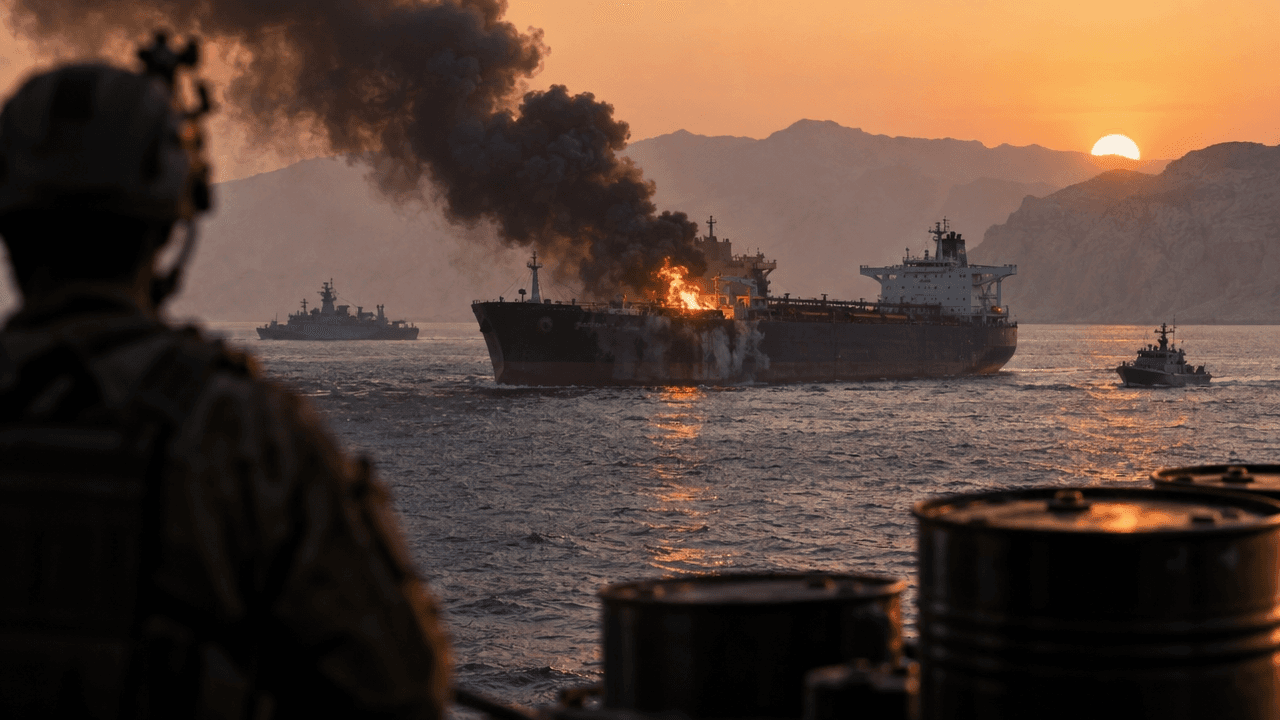
News of a fresh attack on a tanker transiting the Strait of Hormuz has forced global markets to reassess energy risk at one of the world’s most critical shipping chokepoints.[2][12] The incident, which reportedly involved a projectile strike that triggered a fire and crew evacuation, comes on the heels of broader U.S.–Iran hostilities and multiple attacks on vessels in and around the Gulf.[1][2][12] With oil prices already elevated, traders are now debating whether this is a short-lived shock or the start of a structurally higher-risk regime for energy, inflation, and regional assets.[1][3][9]
Global Markets Confront A Critical Chokepoint
Roughly a fifth of globally traded crude and a significant share of refined products move through the Strait of Hormuz, making it a single point of failure for energy markets.[13] Recent weeks have seen a series of mutual strikes by the U.S. and Iran on tankers and naval vessels in and near the strait, as well as attacks on cargo ships in waters off Oman.[1][12][13] Maritime security agencies have reported vessels hit by projectiles, fires onboard, and emergency evacuations, underscoring the operational risk for shipping companies and charterers.[2][13]
This escalation has revived memories of earlier Hormuz crises, when crude benchmarks spiked sharply on fears of supply disruption and potential blockades.[14][15] The difference now is that the energy market is already tight, with spare capacity concentrated in a handful of producers and inventories not far above long-term averages.[3][7] That combination—structural tightness plus geopolitical flashpoints—amplifies the price response to any perceived threat to flows through the strait.
Key takeaway: When a major chokepoint is under stress, markets price not just the incident itself but the probability of further disruption, creating a risk premium that can persist beyond the headlines.
Energy Prices Reprice Geopolitical Risk
Oil benchmarks have reacted swiftly to the latest wave of attacks. Brent crude has repeatedly pushed higher on Middle East supply worries, with moves of 2–3% in a single session becoming more common.[3][4][5][8] In recent trading, Brent has traded around and above the $100 mark, at times jumping toward the $105–108 range as traders price in the possibility of prolonged disruptions.[1][3][4][5][8] U.S. WTI has followed suit, frequently printing above $100 and extending into the low $100s in tandem with Brent’s rally.[3][4][5]
These spikes have not been driven solely by ship attacks. Strikes on Saudi energy infrastructure, the closure of a key Saudi pipeline that bypasses Hormuz, and the postponement of regional diplomatic talks have all compounded supply concerns.[3][6][7][8] Markets are effectively layering multiple tail risks: pipeline outages, tanker attacks, and the risk of direct military escalation affecting production facilities.
For traders, the immediate implication is that oil’s volatility is increasingly event-driven. Intraday moves around headlines, maritime advisories, and official statements can be large, compressing reaction time and increasing slippage risk. Energy-related assets—from oil majors to refinery margins and tanker equities—are now trading as proxies for geopolitical risk, not just fundamentals.
Key takeaway: In a headline-driven tape, risk management around energy trades needs to incorporate event risk, wider stops, and scenario-based position sizing, rather than relying solely on traditional volatility measures.
Inflation Expectations And Central Bank Reaction
Higher energy prices feed directly into inflation expectations through fuel costs, shipping, and input prices across global supply chains.[3][4][5] Recent oil gains have come at a time when many central banks are trying to engineer a soft landing after an earlier inflation cycle, leaving policymakers with less tolerance for renewed price pressures.
While one-off shocks do not automatically change monetary policy, a sustained period of $100+ oil would complicate rate-cut narratives in major economies. Market-based measures of inflation expectations and breakevens tend to move with large oil shocks, particularly when accompanied by supply-side stories such as pipeline closures and tanker disruptions.[3][7] That can shift the curve for government bond yields, as traders reassess terminal rates and the pace of policy easing.
For multi-asset portfolios, this dynamic matters as much as the oil price itself. A move higher in inflation expectations can weigh on growth-sensitive equities and rate-sensitive sectors, even as energy producers benefit. It can also bolster demand for inflation-linked bonds and commodities, prompting rotation within fixed income and real asset allocations.
Key takeaway: Energy shocks are not just a commodities story; they can spill into rates, equities, and FX via inflation expectations, altering relative value and hedging strategies.
Safe-haven Flows And Regional Asset Fallout
Geopolitical tension in the Gulf region typically drives a familiar pattern: flows into perceived safe havens and increased dispersion across regional assets. In recent sessions, episodes of mutual U.S.–Iran strikes and tanker attacks have coincided with higher demand for dollar liquidity, gold, and defensive sectors, even as risk assets digest the evolving narrative.[1][9][11] The pricing of regional risk can vary, with Gulf equities, local bonds, and currencies each reflecting different mixes of oil revenue support and geopolitical discount.
Shipping-related companies and insurers face rising operational and liability risks, while regional energy producers may benefit from higher spot prices but need to manage physical security concerns.[2][12][13] Meanwhile, global investors with exposure to emerging markets and frontier economies in the region must navigate both macro tailwinds from higher oil revenues and micro risks tied to security incidents.
Safe-haven FX such as the U.S. dollar and, in some episodes, the Japanese yen or Swiss franc, often sees bid interest during spikes in Middle East tension, as investors de-risk portfolios and reduce carry exposure. That can increase volatility in EM FX pairs and impact funding costs for leveraged strategies.
Key takeaway: Geopolitical shocks in energy hubs tend to reprice both risk and safety at the same time; understanding cross-asset correlations during stress episodes is crucial for portfolio construction.
Simulated Finance: How Traders Can Practice This Regime
For traders using simulated finance platforms, the current environment offers a rich set of scenarios to practice multi-asset decision-making without capital at risk. Recent Hormuz-related episodes provide case studies in how oil, inflation expectations, safe-haven FX, and regional equities interact when a single chokepoint becomes a source of systemic concern.[1][3][9][13]
Practical exercises might include stress-testing an oil-heavy portfolio against successive 3–5% daily moves in crude, analyzing how different hedges—such as long gold, long dollar, or long inflation-linked bonds—perform across scenarios.[3][4][5][9] Traders can also simulate event-driven strategies: for example, designing rules for cutting risk on confirmed maritime attack headlines, or scaling into positions when diplomatic developments reduce perceived tail risk.[6][8]
Another valuable practice is studying correlation shifts. In calm periods, energy equities, indices, and FX may behave in predictable ways; during crises, relationships can invert or weaken, especially if policy responses or sanctions enter the picture. Simulated environments allow traders to test how their systems handle such regime changes, including slippage, gaps around news, and parameter adjustments.
Key takeaway: Treat the Hormuz crisis not only as breaking news but as an opportunity to refine scenario analysis, correlation awareness, and event-driven playbooks in a low-risk, simulated setting.
Conclusion
The tanker attack in the Strait of Hormuz and the broader pattern of strikes on regional shipping and infrastructure have pushed energy risk back to the center of the global macro narrative.[1][2][3][12] With oil benchmarks repeatedly testing elevated levels, inflation expectations primed to react, and safe-haven flows responding to geopolitical headlines, markets are navigating a complex mix of supply, security, and policy uncertainty.[3][4][5][9]
For traders and investors, the challenge is to distinguish between transient volatility and structural shifts. Chokepoint risk, tight supply, and geopolitical friction can create a sustained premium in energy markets, with implications far beyond the price of a barrel. In a world where macro shocks increasingly emerge from the intersection of politics and logistics, the ability to model and practice these scenarios—whether in live markets or simulated environments—has become a core skill.