
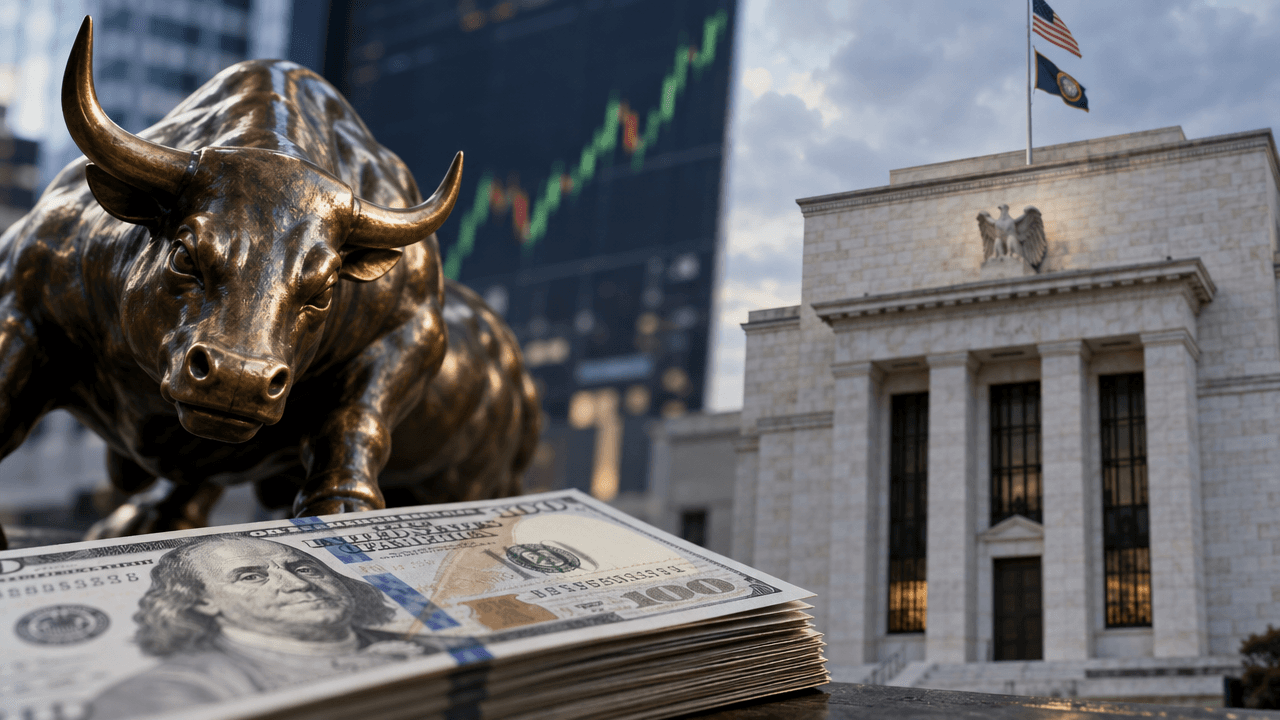
The U.S. economy is sending a complicated message to financial markets: growth is stronger than expected, but inflation remains too persistent for the Federal Reserve to relax. Third-quarter GDP expanded at a 3.4% annualized pace, accelerating from 2.2% in the second quarter and exceeding the roughly 3.1% forecast. At the same time, September personal consumption expenditures inflation rose 3.6% from a year earlier, while core PCE inflation reached 3.1%. [1][2]
This combination of resilient demand and elevated prices is reinforcing expectations that the Fed may need to keep interest rates higher for longer—or raise them again—to prevent inflation from becoming entrenched.
Growth Is Resilient, Not Restricted
The third-quarter GDP report suggests that higher borrowing costs have not yet meaningfully weakened the U.S. economy. Consumer spending, business investment, and government spending helped support the expansion, while stronger investment linked to technology and artificial intelligence also contributed to growth. Imports acted as a drag, but not enough to offset the broader strength of domestic activity. [1][8]
Consumer spending is particularly important for interpreting the report. Household consumption represents a large share of the U.S. economy, and continued spending indicates that consumers still have enough income, savings, or access to credit to maintain demand.
For the Federal Reserve, this strength creates a policy challenge. Rate increases are designed to slow demand, but the latest data suggest that the economy may be able to absorb restrictive policy more easily than previously expected. If businesses continue investing and households continue spending, inflationary pressure may persist even while interest rates remain elevated.
The growth figure is also an annualized rate, meaning it estimates how quickly the economy would expand if the quarterly pace continued for a full year. It does not mean the economy literally grew 3.4% in three months. Nevertheless, it is a meaningful signal that economic momentum remains firm.
INFLATION REMAINS ABOVE THE FED’S COMFORT ZONE
The PCE price index increased 0.5% in September, up from a 0.3% monthly gain in August. On an annual basis, headline PCE inflation accelerated from 3.4% to 3.6%. Core PCE inflation, which excludes food and energy prices, rose to 3.1% from 3.0%. [1][9]
The core measure matters because it can provide a clearer view of underlying inflation trends. Energy prices can move sharply because of geopolitical developments or supply disruptions, while core inflation is more closely connected to wages, services, housing, and persistent demand.
The latest figures remain well above the Federal Reserve’s 2% inflation objective. Although quarterly PCE price growth showed some improvement compared with the second quarter, the monthly acceleration and high year-over-year readings make it difficult for policymakers to declare victory. [2]
For traders, the key issue is not simply whether inflation is falling. It is whether inflation is falling quickly and consistently enough to justify lower interest rates. September’s data suggest that progress may be uneven, increasing the risk that the Fed will maintain a restrictive stance.
Why A Fed Hike Is Back In Focus
Markets had already been preparing for a possible pause in October followed by another rate increase in December. A recent survey found that 76% of respondents expected a December hike, while 93% anticipated that the Fed would hold rates steady at the October meeting. [12]
Strong GDP makes a future hike easier to justify because it reduces concerns that additional tightening would immediately trigger a severe recession. Elevated inflation strengthens the argument further. Together, the reports give policymakers room to focus on price stability rather than responding to an economy that is rapidly deteriorating.
That does not guarantee a rate increase. Monetary policy operates with a delay, and officials must consider employment, financial conditions, credit stress, and the possibility that inflation will slow without additional action. A central bank that raises rates too aggressively could weaken business activity and consumer demand more than intended.
Still, the data shift the balance of risks. Before the reports, investors could argue that the Fed might eventually cut rates as growth cooled. After the reports, the market must assign greater weight to the possibility of another hike or an extended period of high rates.
Market Consequences For Traders
Interest-rate expectations are especially important for currency and bond markets. When traders anticipate higher U.S. rates, Treasury yields can rise and the dollar can receive support because dollar-denominated assets may offer more attractive returns. That helps explain why the dollar remained firm even as broader risk sentiment weakened.
Equity markets face a more complicated environment. Strong growth can support corporate earnings, but higher rates increase discount rates and raise financing costs. Growth-sensitive sectors, highly valued technology companies, and businesses dependent on cheap credit may experience greater volatility.
In SimFi trading, this type of news is useful for studying cross-market relationships. A trader might monitor the U.S. dollar, Treasury yields, equity indices, and commodities rather than focusing on a single chart. The objective is not to predict every price movement. It is to understand how one economic surprise can change expectations across multiple asset classes.
Practical takeaways include
Track both headline and core PCE inflation rather than relying on a single monthly number.
Compare GDP growth with labor-market data to assess whether demand is sustainable.
Watch Treasury yields and dollar strength for clues about changing rate expectations.
Avoid assuming that strong economic data are automatically bullish for stocks.
Use defined risk and smaller position sizes around major data releases, when volatility can increase quickly.
The Bigger Picture
The U.S. economy currently reflects a difficult policy mix: growth is strong enough to tolerate restrictive rates, while inflation is high enough to discourage rapid easing. That combination supports the case for a cautious or hawkish Federal Reserve and keeps the possibility of another rate increase firmly in market discussions.
For traders and investors, the central lesson is that economic strength and market optimism are not always the same thing. Strong GDP can improve earnings expectations, but persistent inflation can push interest rates higher and pressure asset valuations. The most important question in the months ahead will be whether demand finally cools enough to bring inflation down—or whether the economy’s resilience forces the Fed to tighten further.
Until that answer becomes clearer, markets are likely to remain sensitive to every inflation reading, employment report, and comment from Federal Reserve officials.