
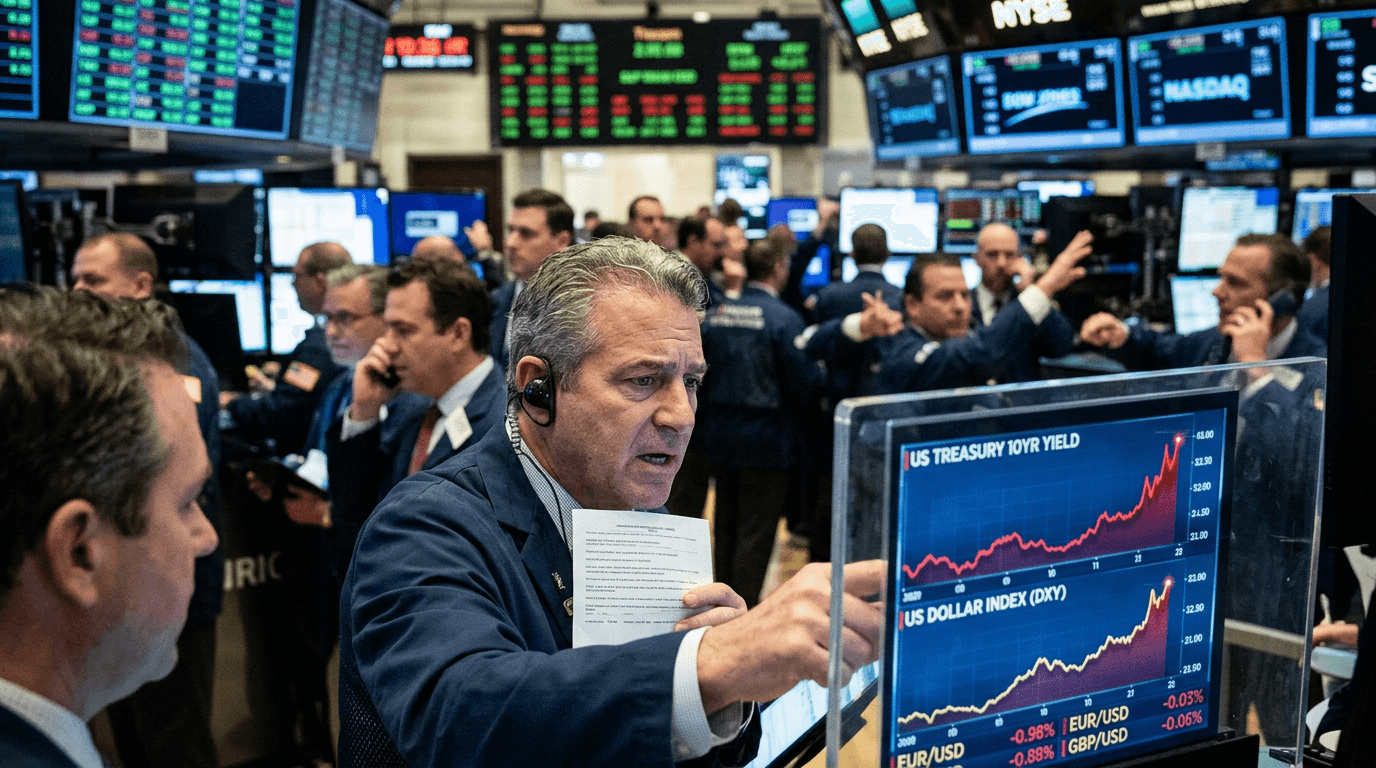
The US dollar is back in the driver’s seat, powered by higher US Treasury yields and a decidedly more hawkish Federal Reserve outlook. As investors reprice the path of US interest rates, the greenback’s yield advantage is widening again, putting renewed pressure on emerging‑market (EM) and commodity‑linked currencies and reshaping global carry and funding dynamics.[2][4][6][9]
Why Higher Treasury Yields Boost The Dollar
At the core of this move is a straightforward mechanism: when US Treasury yields rise, dollar‑denominated assets become more attractive relative to the rest of the world. Higher yields mean investors can earn better returns holding US bonds or cash, which increases demand for the US dollar needed to buy those assets.[4][9][13]
A more hawkish Fed is the catalyst. Markets have shifted from expecting cuts to pricing in a meaningful chance of at least one additional rate hike, taking the “higher for longer” narrative seriously.[2][5][9] Fed officials have emphasized that inflation risks remain and that policy must stay restrictive, prompting traders to push up expectations for the policy rate path.[4][5][11]
That repricing shows up directly in Treasury yields. Short‑dated, rate‑sensitive maturities such as the 2‑year note have climbed as investors adjust to the prospect of tighter policy, while longer‑term yields remain elevated as markets internalize a prolonged period of restrictive financial conditions.[1][9][10][11] As yields rise, the dollar’s yield premium over other major economies—many of which face weaker growth or less room to hike—becomes more compelling.[4][8]
The result: the US dollar index (DXY) has broken out of its earlier consolidation to trade near one‑year highs around the 100–101 region, reversing its previous softness and re‑establishing the greenback as one of the strongest majors on the board.[2][6][7][12]
Pressure On Em And Commodity Fx
When the dollar strengthens on the back of higher yields, the impact tends to be most acute in EM and commodity‑linked currencies. These currencies are often tied to global risk appetite, external financing needs, and cycles in energy and metals.
EM currencies like the Mexican peso and parts of Asia FX have come under renewed pressure as the US dollar’s rise makes it more expensive to service dollar‑denominated debt and prompts some unwinding of carry positions.[2][6] Countries with large external financing requirements or high shares of dollar borrowing are especially vulnerable as the cost of rolling over funding increases when US yields move higher.[4][6]
Commodity‑linked currencies—the Canadian dollar, Australian dollar, and others tied to energy or metals—face a double challenge. Even when commodity prices are relatively supportive, a stronger dollar can blunt their positive impact by tightening global financial conditions and encouraging investors to favor USD assets.[1][3][6] In recent sessions, the Canadian dollar and Mexican peso have weakened as the resurgent greenback and elevated US yields offset support from commodity markets and local fundamentals.[2][7]
For Asia, a stronger dollar often coincides with capital outflows, weaker local currencies, and tougher policy trade‑offs for central banks trying to balance growth and inflation with exchange‑rate stability. That dynamic is re‑emerging as the dollar tests fresh highs and US yields stay elevated.[6][12]
Global Carry, Funding, And Risk Sentiment
The latest phase of dollar strength is not just a currency story; it is also a carry and funding story. A higher‑yielding, stronger USD typically tightens global financial conditions and can act as a headwind for risk assets.[6][7]
Carry trades—where investors borrow in low‑yielding currencies to invest in higher‑yielding ones—become less attractive when the funding currency (often the dollar or yen) rises sharply. As the dollar strengthens and US yields climb, the risk‑adjusted appeal of EM and high‑beta FX carry baskets can deteriorate, prompting position trimming or outright unwinds.[4][6]
On the funding side, a stronger dollar raises the effective cost of dollar funding for global corporates and financial institutions. That can create pockets of stress in offshore USD markets and push some investors to reduce risk in EM debt, high‑yield credit, or equity markets more broadly.[4][6][13] Recent market action has already shown that equities and precious metals tend to come under pressure as the greenback and Treasury yields advance.[5][7]
The broader macro message is clear: a hawkish Fed and rising US yields tend to favor defensive positioning. The dollar often becomes the “first line of defence” for investors navigating sticky inflation, geopolitical tensions, and slower growth abroad, amplifying its safe‑haven role.[3][8]
What Traders Should Watch Next
For traders—whether in spot FX, indices, commodities, or on a SimFi platform—the current environment is a live case study in how macro themes translate into price action.
Key things to monitor include
US data and Fed communication: Inflation prints, labor‑market reports, and Fed speeches will drive expectations for how long policy remains restrictive or whether additional hikes are on the table.[4][9][10] Any upside surprise on inflation or hawkish shift in tone can extend the dollar’s run; softer data or dovish hints could trigger a pullback.
Treasury yield dynamics: The shape of the yield curve matters. A further rise in 2‑year yields would underscore hawkish repricing, while sustained elevation in 10‑year yields would signal tighter long‑term financing conditions.[1][10][11] Sudden yield spikes can produce sharp moves in FX as risk sentiment adjusts.
Technical levels in DXY and key pairs: The dollar index breaking and holding above recent resistance around the 100–101 region is a bullish signal; failure to hold that zone would suggest the rally is tiring.[2][6][12] In EM and commodity FX, watch prior support zones in pairs like USD/MXN, USD/CAD, and AUD/USD for signs of stress or stabilization.[2][6]
Cross‑asset correlations: In strong‑dollar phases, it is common to see pressure on gold, silver, EM equities, and some US equity benchmarks, even as specific sectors (like AI‑linked tech) occasionally decouple.[3][5][7] Tracking these correlations helps traders understand whether the dollar move is part of a broader risk‑off environment.
Practical Takeaways For Simulated And Live Traders
From a practical trading and strategy standpoint, this kind of USD regime offers several lessons.
First, macro matters. Even if you trade technically, ignoring the Fed and yields in a dollar‑driven market is costly. Incorporating a simple macro dashboard—DXY, 2‑year and 10‑year yields, Fed funds futures, and major economic releases—can improve timing and risk management.[2][4][9]
Second, be cautious with crowded carry. High‑yield EM or commodity currencies that performed well during low‑volatility, weaker‑dollar periods can quickly reverse when the greenback regains momentum. Stress‑testing positions against plausible scenarios—such as another 50–100 basis point rise in 2‑year yields or a further 2–3% DXY appreciation—can highlight vulnerabilities before the market does.[4][6][13]
Third, respect correlations but don’t assume they are static. Historically, a stronger dollar has weighed on gold and EM assets, but there are periods when idiosyncratic factors (like AI‑driven tech optimism) partially offset macro headwinds in certain sectors.[3][5][7] Using simulated environments to backtest strategies across different dollar regimes can help traders understand how robust their approaches really are.
Finally, risk management is non‑negotiable. In stronger‑USD phases, volatility can pick up quickly in EM FX, commodities, and indices as funding costs rise and risk appetite swings. Smaller position sizes, wider but well‑defined stops, and diversified exposure across asset classes can help traders navigate these conditions more effectively.
Whether you are trading live capital or honing your edge in a SimFi environment, the current dollar upswing is a valuable reminder: shifts in Fed expectations and Treasury yields do not just move one chart—they reshape the entire global macro landscape.