
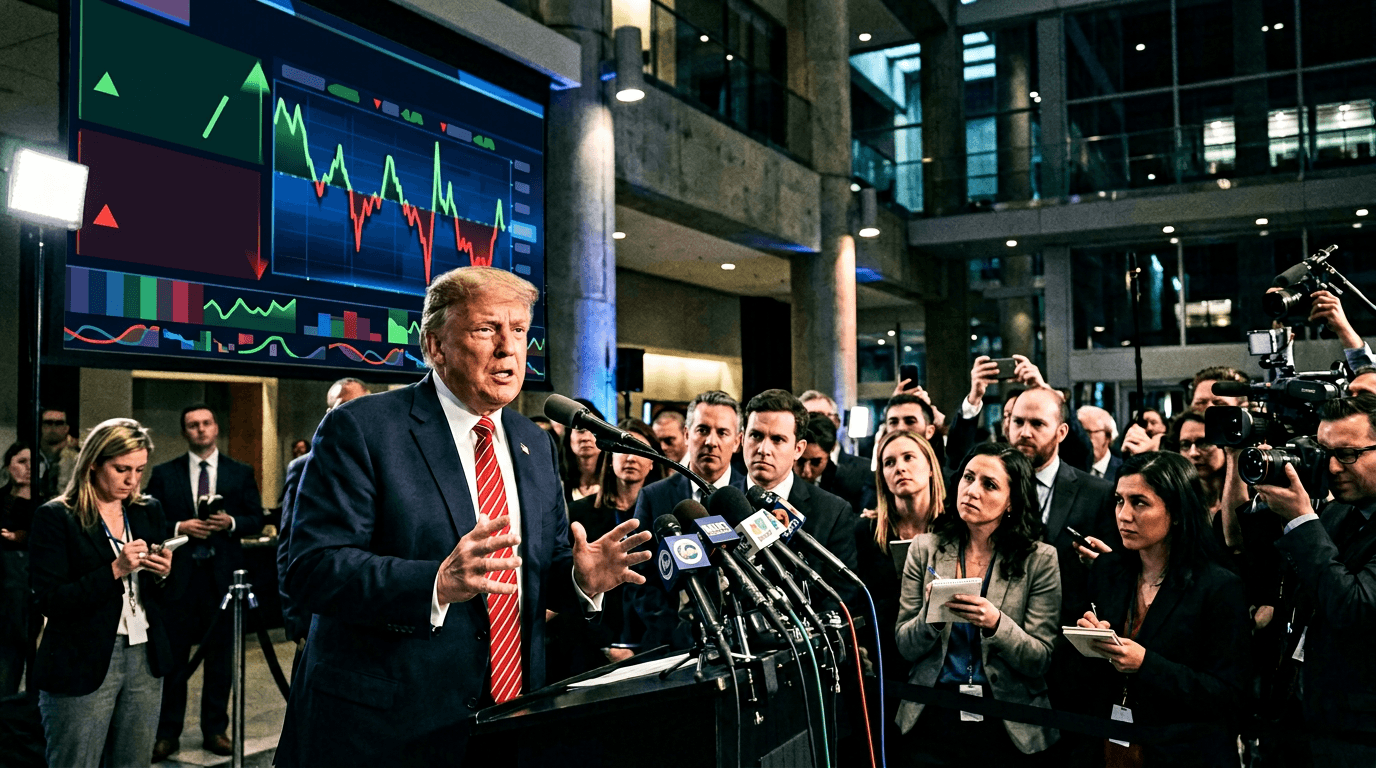
On February 20, 2026, the U.S. Supreme Court issued a landmark 6-3 decision that fundamentally challenged one of the Trump administration's most aggressive economic policies.[1] The Court ruled that President Trump could not use the International Emergency Economic Powers Act (IEEPA) as the legal basis for implementing sweeping tariffs without explicit congressional approval.[1] This ruling struck down billions of dollars worth of tariffs that had been imposed over the previous year, creating immediate ripple effects across financial markets and leaving traders questioning what comes next for global trade policy.
The Supreme Court's Decision: What Changed
The Supreme Court's ruling centered on a constitutional principle that many believed was settled law: only Congress has the power to impose taxes and tariffs.[5] Chief Justice John Roberts, writing for the majority, emphasized that the president's interpretation of IEEPA would grant him the power to "unilaterally impose unbounded tariffs" constrained only by his declaration of an emergency—a power he deemed far too expansive.[2] The Court determined that the word "regulate" in IEEPA does not encompass the authority to impose tariffs, and that the "power to regulate commerce" is "entirely distinct from the right to levy taxes."[3]
The decision was not unanimous. Justice Brett Kavanaugh's dissent notably suggested that the Court's decision would not greatly restrict presidential tariff authority going forward, hinting at alternative legal pathways available to the administration.[4] This observation proved prescient, as events would soon demonstrate.
The Court's ruling also left unresolved a significant practical question: what happens to the estimated $200 billion in tariffs already collected from importers during 2025?[2] Kavanaugh suggested in his dissent that the federal government may be required to refund billions of dollars, though the Court did not mandate this action.[4] This uncertainty has created additional complications for businesses and traders evaluating the true cost of the tariff regime.
Immediate Market Implications
For traders and investors, the Supreme Court decision introduced both clarity and confusion. On one hand, the ruling eliminated the fastest legal tool for imposing broad, country-level tariffs across all trading partners. On the other hand, uncertainty about trade policy persisted because the administration immediately signaled its intention to use alternative legal mechanisms.[1]
The decision has been particularly important for foreign exchange markets. Trade-linked currencies—those of nations heavily dependent on US trade relationships—experienced heightened volatility following the ruling.[5] The underlying uncertainty about whether tariffs would continue, in what form, and for how long, created conditions for significant currency swings. For traders operating in FX markets, this volatility presented both risks and opportunities, particularly in currency pairs involving major US trading partners like Canada, Mexico, and China.
Global FX volatility more broadly increased as market participants grappled with the implications of continued policy uncertainty. When the rules of the game change or become unclear, currency markets tend to reflect that uncertainty through wider bid-ask spreads and more pronounced intraday swings.
The Administration's Swift Response
True to form, President Trump did not accept the Supreme Court's decision as the final word on tariffs. Just hours after the ruling, he announced a new approach relying on Section 122 of the Trade Act of 1974.[1] This provision allows the executive branch to impose temporary tariffs of up to 15 percent for a maximum of 150 days when the United States experiences "large and serious balance-of-payments deficits."[5] Hours after announcing a 10 percent global tariff, Trump raised it to 15 percent—the maximum allowed under this statute.[1]
This maneuver demonstrated the administration's determination to maintain tariffs despite legal setbacks, but it also created a narrower, more temporary framework than the open-ended tariffs previously imposed under IEEPA. The 150-day window means Congress would need to act to extend the tariffs beyond that period, introducing another layer of political uncertainty into the equation.
What This Means For Traders And Investors
The Supreme Court ruling does not end the tariff debate—it redirects it. Traders should recognize several key implications: First, tariff rates are likely to remain elevated overall, keeping upward pressure on prices for consumers and input costs for businesses.[5] Second, policy uncertainty will persist as these temporary measures approach their expiration date and Congress considers whether to extend them. Third, the competitive playing field remains tilted, as large, well-connected firms continue to receive favorable tariff treatment compared to smaller competitors.[5]
For investors, the key takeaway echoes advice from financial experts: ignore headline noise about tariffs and stick to long-term investment plans.[1] While the Supreme Court ruling removes one mechanism for imposing tariffs, it does not eliminate the administration's ability to implement tariff policy through other legal channels. The path forward remains unpredictable, but the volatility it creates may offer opportunities for disciplined traders who understand the underlying dynamics.
The tariff saga continues, but with different rules and greater uncertainty about longevity.