
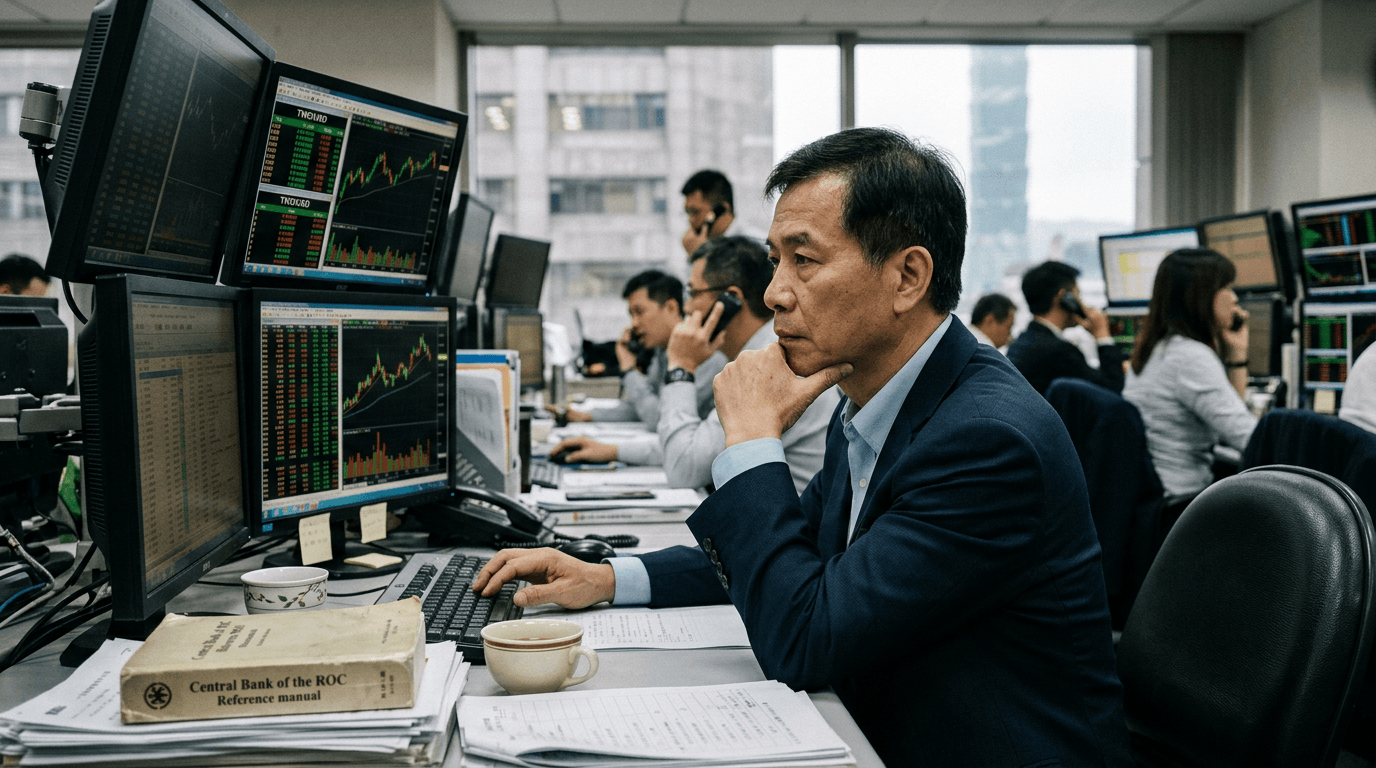
Taiwan’s confirmation that it intervened in the foreign exchange market during June is more than a footnote in the data; it is a clear signal that policymakers are actively defending stability in the Taiwan dollar at a time of choppy global capital flows.[1][5][13] For traders in the Taiwan dollar (TWD) and broader EM Asia FX, this disclosure reshapes expectations around volatility, official reaction functions, and the risk-reward profile of currency strategies tied to Taiwan’s tech-heavy economy.[5][13]
What Happened In June
According to the Central Bank of the Republic of China (CBC), Taiwan’s foreign exchange reserves fell to about US$597.15 billion at the end of June, slipping below the symbolic US$600 billion threshold.[1][2][5][6][14] The roughly US$7.9 billion monthly decline was driven in large part by the central bank’s net selling of foreign currency—primarily U.S. dollars—combined with valuation effects from the depreciation of non‑U.S. reserve currencies.[1][5][6][11][14]
Officials explicitly linked part of this reserves drop to intervention aimed at stabilizing the TWD, confirming that the central bank stepped into the FX market to curb excessive moves and volatility.[1][5][11][13] In practical terms, that meant selling dollars and buying Taiwan dollars when price action was judged disorderly or out of line with underlying fundamentals.[1][6][13] The bank had already been active earlier in the year, reporting net foreign exchange sales of about US$12.6 billion in the first quarter, marking a second consecutive quarter of intervention.[1][2][5][6][11][14]
This pattern underscores that the June operation was not an isolated event. It is part of an ongoing strategy to smooth TWD fluctuations rather than allowing the currency to overshoot under pressure from short‑term capital flows or shifts in global risk sentiment.[1][6][13] For market participants, the confirmation removes ambiguity: the CBC is watching and willing to act when volatility crosses its tolerance band.[10][15][16]
TAIWAN’S INTERVENTION PLAYBOOK
Taiwan’s central bank has long maintained that it respects market-driven exchange rates while reserving the right to intervene when moves become “extreme” or threaten financial stability.[10][15][16] Policy statements consistently emphasize that intervention is aimed at easing volatility, not at engineering a persistent misalignment of the Taiwan dollar’s value.[10][16] This stance helps keep Taiwan aligned with international guidance on FX practices while preserving room to respond to sudden swings.[9][10][19]
Historically, the CBC has stepped in both to limit appreciation and to contain depreciation, depending on the cycle. For instance, previous episodes saw state-linked banks selling TWD to cap sharp gains when the currency strengthened too quickly against the U.S. dollar.[3][7][8] In contrast, recent data show the central bank shifting toward net foreign exchange selling—reducing its dollar holdings—to support the TWD when it comes under pressure.[1][6][13][14]
A report submitted to lawmakers noted that in the prior year the CBC was a net buyer of U.S. dollars to smooth volatility, with purchases equivalent to a modest share of GDP.[17] The move into net selling this year reflects evolving market conditions: more two‑way risk in global FX, heavier sensitivity to technology‑sector capital flows, and heightened geopolitical risk that can periodically weigh on Taiwan assets.[13][18] The June intervention fits squarely within this playbook: reactive, targeted, and focused on dampening short‑term turbulence rather than setting a new long‑term level for the currency.[1][6][10][13]
Market Impact: Twd, Em Asia Fx, And Sentiment
From a trading perspective, the combination of a visible reserves drawdown and explicit confirmation of FX intervention sends a strong signal that the TWD now trades with an embedded policy backstop.[1][5][6][13][14] When a central bank with nearly US$600 billion in reserves shows it is willing to deploy them, the implication is that persistent one‑way speculation against the currency carries higher risk.[1][6][14]
In the near term, traders can expect intraday TWD volatility to be more “managed” around levels that policymakers see as sensitive, especially during thin liquidity or headline-driven swings.[3][7][15][16] Market participants have historically noted late-session moves that appear aligned with official efforts to steer the closing rate, reinforcing the perception that certain price zones attract official attention.[3]
The disclosure also influences regional sentiment. For EM Asia currency futures and cross‑regional FX baskets, Taiwan’s stance contributes to the broader theme of Asian central banks leaning more actively against disorderly market conditions.[5][13] When one large reserve holder signals intervention, others are often assumed to be at least “alert,” which can compress implied volatility across the complex and alter correlations between TWD, Korean won, offshore yuan, and other regional pairs.[18]
For systematic traders, this means volatility regimes can shift abruptly when reserve data or policy communication point to active intervention. Backward‑looking models that ignore official action risk underestimating tail scenarios in EM Asia FX, particularly during periods of global risk-off or rapid repricing of U.S. interest rates.[13][16]
Practical Takeaways For Twd And Simfi Traders
For active TWD traders and SimFi participants, the June intervention offers several actionable lessons:
First, monitor Taiwan’s monthly foreign reserves releases and central bank briefings as key indicators of intervention intensity. A notable drop in reserves—especially when accompanied by comments from FX department officials—often signals recent or ongoing market operations.[1][5][6][11][14] In simulated environments, incorporating these data into scenario design can help recreate realistic policy‑driven market regimes.[13]
Second, avoid building strategies that rely on extended, unopposed trends in the TWD when reserves are high and communication is intervention‑friendly. With the CBC prepared to lean against “excessive” moves, both breakout and carry strategies need tighter risk controls and stress tests around potential policy responses.[10][15][16] In practice, that means using stricter stop‑loss levels near historically sensitive price zones and accounting for the probability of sudden reversals driven by official flows rather than organic market shifts.[3][7]
Third, pay close attention to cross‑asset signals. Taiwan’s currency often responds to swings in global tech equities, semiconductor demand, and geopolitical risk indicators. Intervention does not eliminate these drivers; it reshapes how far and how fast the currency is likely to move when they turn.[13][18] In SimFi platforms, building multi‑asset scenarios that link TWD behavior to equity and rates shocks—while layering in policy reaction functions—can help traders practice navigating complex, real‑world conditions.
Finally, consider how intervention affects liquidity and execution. Central bank operations can momentarily deepen liquidity at targeted levels but may also reduce transparency, as traders hesitate to take aggressive positions against a large official player.[3][16] For strategies that depend on tight spreads or high‑frequency trading, simulated testing under varying liquidity assumptions around expected intervention windows is essential.
Looking Ahead: Policy Signals And Risk Landscape
Taiwan’s June actions reaffirm that its central bank is willing to deploy its substantial reserves to keep the TWD from moving in ways it views as destabilizing.[1][6][13][14] With global markets still adjusting to shifting monetary cycles and geopolitical tensions in the region, further episodes of intervention are possible if capital flows turn more volatile or if speculative positioning becomes outsized.[10][15][16][18]
At the same time, the structure of Taiwan’s reserves and the moderate scale of recent intervention relative to GDP suggest that the June drawdown is a tactical move, not a sign of underlying weakness.[1][6][14][17] For traders, that distinction matters: it frames intervention as a stabilizing force rather than a defensive response to systemic stress.
In this environment, the most resilient trading approaches will be those that treat central bank behavior as an integral, modelled component of the FX landscape. Whether in live markets or simulated finance, understanding how and why Taiwan’s central bank steps into the market—and what its actions imply for TWD and EM Asia FX—is now a prerequisite for serious currency strategy design.