
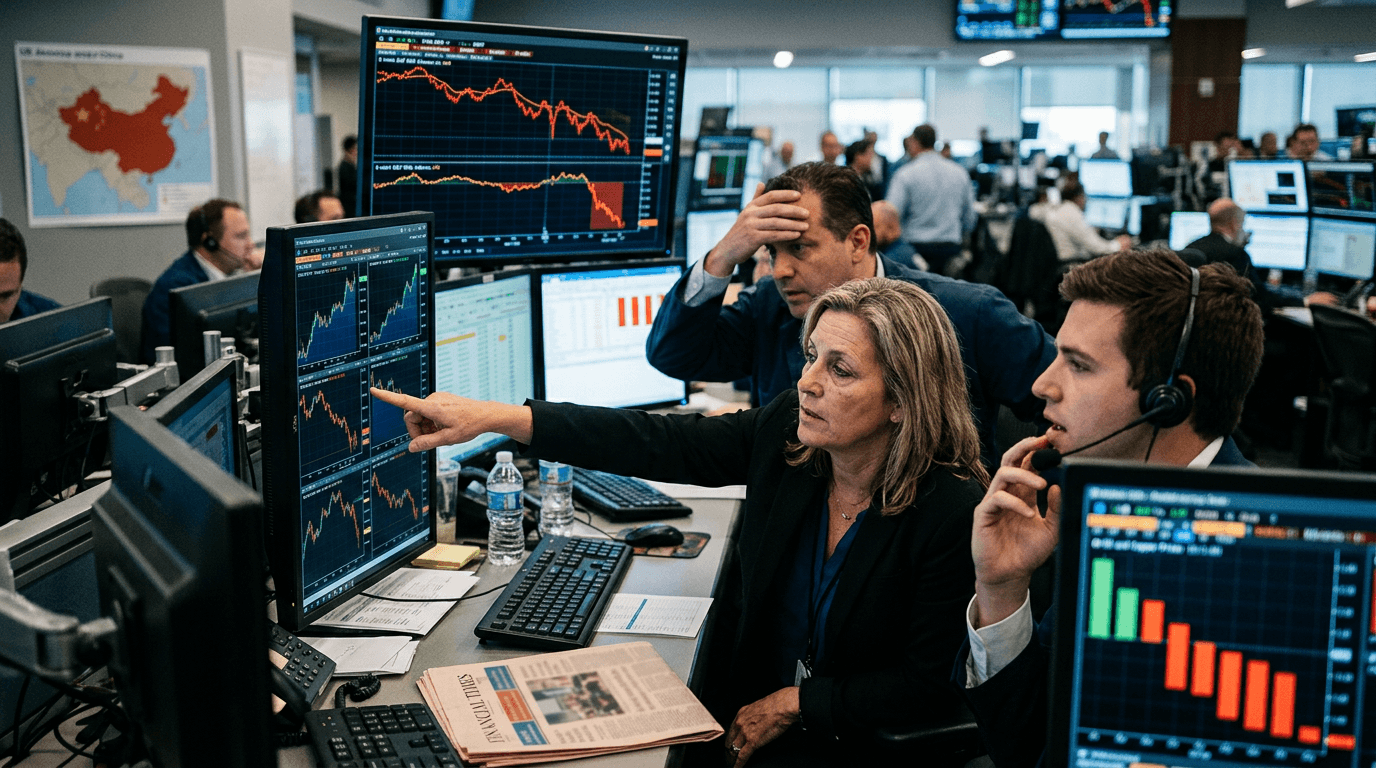
Fresh tariff measures from China on U.S. goods and sharper rhetoric on both sides are keeping investors on edge, reminding markets that the world’s two largest economies remain locked in a strategic economic contest, not a short-term skirmish.[3][2] As headlines flash new duties and possible retaliation, risk sentiment stays fragile, with traders quick to seek safety and reluctant to commit to high-beta, growth-sensitive assets.
Global Backdrop: Why Tariffs Still Matter
The latest escalation comes against a backdrop of already elevated U.S.–China trade barriers, built up over several waves of tariffs in recent years.[3][6] In earlier phases of the conflict, reciprocal tariffs climbed to extraordinarily high levels—up to about 145% on some Chinese goods entering the U.S. and 125% on U.S. goods entering China—before partial rollbacks began.[3]
Policy steps in 2025 lowered some headline tariff rates for both sides, easing inflation pressures and improving the odds of avoiding a recession.[2][6] But analysts stressed that this de-escalation did not represent a return to “normal” trade relations; it only softened the peak of the trade war, leaving a structurally higher level of friction, compliance costs, and uncertainty in place.[2][6]
Those lingering costs matter. Elevated tariffs and export restrictions disrupt supply chains, raise input prices, and make it harder for firms to plan long-term investments with confidence.[2][6] Each fresh round of retaliatory measures reinforces the message that the relationship remains unstable, which is why even modest new tariffs can have an outsized impact on sentiment relative to their pure macroeconomic size.
For traders, that context is key: markets are no longer reacting to tariffs in isolation, but to what they signal about a protracted economic rivalry, potential technology decoupling, and the risk of further policy surprises down the line.[3][2]
How Tariff Escalation Hits Key Asset Classes
Tariff headlines tend to hit multiple corners of the market at once, often through the same channel: a jump in uncertainty and growth anxiety that pushes investors toward perceived safe havens.
In foreign exchange, flare-ups in U.S.–China tensions typically support the U.S. dollar and other haven currencies like the Japanese yen and Swiss franc, while pressuring pro-cyclical and China-sensitive currencies such as the Australian dollar and some emerging market FX in Asia.[7] The Chinese yuan itself often trades as a barometer of trade stress and growth expectations around China and regional supply chains.[7]
Equity index futures usually feel the impact quickly. Global indices dominated by exporters, capital goods, semiconductors, autos, and luxury goods are vulnerable because tariffs directly hit margins and demand in cross-border supply chains.[3][7] Corporate commentary has repeatedly highlighted tariffs, export controls, and retaliatory measures as material risks to earnings, forcing management teams to discuss cost pass-through, sourcing shifts, and potential demand hits on earnings calls.[4] When investors hear that tariffs are crimping margins or delaying capex plans, they tend to demand a higher risk premium, which weighs on equity valuations.[3][4]
Commodities sit at the intersection of trade and growth. Industrial metals and energy contracts are sensitive to any downgrade in global manufacturing and trade volumes that might follow from higher tariffs.[7] At the same time, agricultural products have often been targeted in retaliation, creating uncertainty for farmers, exporters, and related supply chains. This can translate into choppy price action as markets weigh demand risks against possible government support programs or trade diversion to other buyers.[7]
LESSONS FROM PREVIOUS U.S.–CHINA TARIFF WAVES
The market has seen this movie before, and history offers useful lessons. Earlier escalation cycles produced sharp risk-off moves at the start, followed by periods where volatility faded as companies and investors adapted.[3][4]
On the corporate side, firms responded to past tariff hikes by rerouting trade through third countries, seeking exemptions, redesigning supply chains, or absorbing part of the cost in margins.[3][4] Some key tech products have even received temporary tariff exemptions in prior rounds, underscoring how political and industry lobbying can blunt part of the headline impact.[3] Over time, this ability to adjust reduced the pure economic shock from tariffs, even though uncertainty remained elevated.
For markets, the pattern has often been: surprise tariff announcements trigger rapid drawdowns, then partial recoveries as investors realize the long-run damage is limited by such adaptations.[3][5] Recent analysis argues that, because firms and policymakers learned how to sidestep or mitigate tariffs in earlier episodes, new escalation might now cause more short-lived volatility rather than a prolonged bear market—especially compared with the initial shocks in 2025.[5]
However, a crucial takeaway is that even when the direct economic damage is contained, uncertainty and risk premia stay higher than before.[2][6] That translates into more fragile risk sentiment, quicker rotations into safe havens on bad news, and a lower threshold for volatility spikes when new tariffs hit the headlines.
How Traders Can Navigate Fragile Risk Sentiment
In a tariff-driven market, trading discipline and preparation matter as much as the headline itself. A few practical approaches can help:
First, define the “headline complex” you care about. For U.S.–China tariffs, key markers include official announcements from trade and commerce authorities, new lists of targeted products, retaliatory statements from Beijing or Washington, and any hints about exemptions for critical industries like technology, autos, and agriculture.[3][7] These often foreshadow where sector-specific risk will concentrate.
Second, build a cross-asset dashboard that captures how sentiment is evolving in real time. Pairs like USD/CNH, AUD/JPY, major equity index futures, copper, crude oil, and global auto or semiconductor indices offer a quick read on whether markets are in “risk-on” or “risk-off” mode in response to headlines.[3][7] When correlations tighten across these assets during tariff news, it signals that macro sentiment is in the driver’s seat.
Third, adjust risk management for headline volatility. That may mean trading smaller position sizes, using wider but well-defined stops, or expressing views via options rather than outright directional futures or spot positions. Tariff headlines often create fast reversals as clarifications, exemptions, or walk-backs emerge; options structures can help you participate in volatility without being forced out by intraday noise.
For traders practicing in a simulated environment, tariff episodes are an ideal laboratory. They combine macro narrative, cross-asset moves, and the behavioral challenges of trading news that can reverse within hours. Focus on process: predefine your reaction to various scenarios rather than improvising mid-headline.
Looking Ahead: Scenarios For Risk Sentiment
From here, markets will be weighing three broad scenarios.
In an escalation scenario, both sides follow through with broader and higher tariffs, possibly extending measures into sensitive technology, autos, or consumer electronics.[3][7] That would likely reinforce dollar strength and safe-haven demand, pressure global cyclicals, and keep volatility elevated, with investors demanding more compensation to hold risk assets.
In a managed-tension scenario, new tariffs are limited in scope, and both governments signal an intent to avoid an all-out spiral—similar to moments in 2025 when de-escalation steps were taken but the broader rivalry remained intact.[2][6] Markets could settle into a choppy range-bound environment: enough uncertainty to cap valuations, but not enough shock to derail the broader growth narrative.
Finally, in a surprise de-escalation scenario, partial rollbacks or exemptions on the latest measures, perhaps tied to broader negotiations, could deliver a relief rally in global equities and pro-cyclical FX, while trimming some of the safe-haven premium.[2][3] Yet, given that prior tariff reductions have not restored pre-trade-war normality, investors would likely treat any truce as temporary rather than a regime change.[2][6]
For now, the balance of evidence suggests that the U.S.–China economic relationship will remain confrontational, with periodic flare-ups like the latest tariff escalation keeping risk sentiment fragile.[2][3][6] Traders who respect that fragility—by watching the right indicators, managing exposure carefully, and staying flexible across scenarios—will be better positioned to navigate the next headline, whichever direction it breaks.