
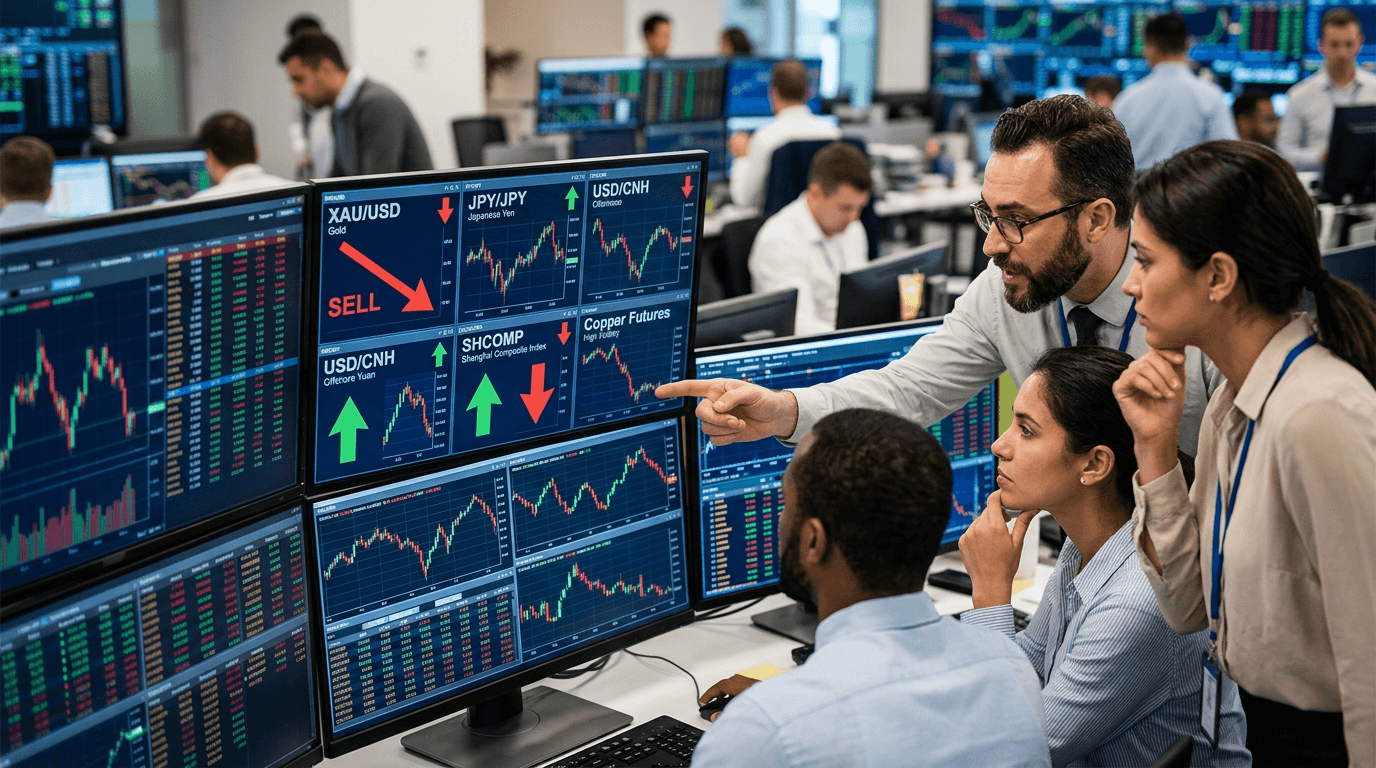
Tariff tensions between the United States and China are back in the spotlight, with fresh US hikes on targeted Chinese imports and rapid retaliatory measures from Beijing pushing duties on some US goods into triple digits. The renewed escalation has revived memories of the 2018–2019 trade war, igniting demand for safe-haven currencies, weighing on Asian equities, and injecting fresh volatility into equity index and metals futures as traders reassess global growth and risk appetite.
What Has Changed In The Latest Tariff Round
The latest moves mark a clear shift from rhetoric back to action: Washington has raised tariffs on selected categories of Chinese exports, and Beijing has responded in kind with steep increases on a range of US products, including some levies now exceeding 100%. This pattern echoes earlier phases of the US–China trade conflict, when tit-for-tat measures pushed effective tariff rates on some bilateral trade flows into triple digits.[3][7]
This escalation matters because it comes after a period of relative calm, when markets had largely priced in a “managed competition” rather than an all-out trade war. Over the past decade, the US–China relationship has evolved from deepening integration to strategic rivalry, as both sides weaponized tariffs to pursue industrial and national security goals.[6][7] Each new round of tariffs raises the risk that tensions spread beyond trade into technology, investment, and financial flows, creating a broader overhang for global markets.
Why Tariff Escalation Spooks Markets
At its core, a trade war is a cycle of retaliatory tariffs and trade barriers between countries, typically launched in an attempt to protect domestic industries or gain negotiating leverage.[5] Tariffs act like taxes on imports: they raise prices for buyers, distort comparative advantage, and encourage firms to reconfigure supply chains. When two of the world’s largest economies are involved, the resulting uncertainty can dampen investment, hiring, and cross-border trade.
The macro impact is not just theoretical. During the last major US–China tariff escalation, the IMF estimated that the then-announced and envisaged tariffs, if extended to all trade between the two economies, would subtract about 0.3 percentage points from global GDP in the short term, with roughly half of the hit coming from weaker business and market confidence.[1] That confidence channel matters hugely for equities and credit, where valuations depend on expectations about future earnings and growth.
Tariffs on intermediate goods—inputs used by domestic firms to produce final products—are especially disruptive. World Bank research on the US–China trade war shows that higher tariffs on Chinese intermediate goods weighed on US downstream exports, output, and employment in industries reliant on those inputs.[4] Instead of cleanly “protecting” domestic producers, tariffs often raise costs along the supply chain, compress margins, and force firms to either accept lower profitability or pass higher prices on to consumers.
Safe-haven Fx, Asian Equities, And Metals Futures
When trade-war headlines hit the tape, markets tend to shift abruptly into risk-off mode. In past flare-ups, stocks, oil, and other risk assets have sold off as investors rushed into perceived safe havens such as government bonds and defensive currencies.[9] Renewed US–China tariff escalation fits that pattern: Asian equity indices, particularly those heavy in exporters and tech hardware, are vulnerable because their earnings are tightly linked to global trade and Chinese demand.
Safe-haven FX typically benefits in this environment. Episodes of elevated trade tension have historically supported currencies like the US dollar, Japanese yen, and Swiss franc while pressuring export-sensitive and emerging Asian currencies. For traders in FX and equity index futures, this means cross-asset correlations can strengthen: equity weakness and spread widening in credit often coincide with stronger safe-haven currencies and flatter yield curves.
Metals futures add another layer of complexity. Gold tends to act as a hedge against macro and geopolitical uncertainty, often attracting inflows when trade wars threaten global growth and policy visibility. By contrast, industrial metals such as copper and aluminum are tightly linked to manufacturing activity and Chinese construction and infrastructure demand. When tariffs escalate, markets face a tug-of-war between weaker growth expectations (bearish for industrial metals) and the possibility of future policy stimulus from China or other major economies (potentially supportive). The result is often heightened volatility across metals futures curves as traders reprice demand and inventory dynamics.
What This Means For Growth, Inflation, And Policy
The economic impact of tariffs is asymmetric and often less effective than advertised. Earlier rounds of US tariffs on Chinese goods reduced bilateral trade volumes but left the overall US trade deficit with China broadly unchanged, in part because trade was diverted rather than eliminated.[1] Studies of the last US–China trade war find that US consumers and firms bore much of the cost through higher prices, while any gains in domestic employment were modest and uneven.[8] On the Chinese side, retaliatory tariffs contributed to pressure on manufacturers and a broader slowdown in industrial activity.[5]
From a macro perspective, tariffs are a classic stagflationary shock: they tend to push import prices higher (inflationary) while weighing on activity and confidence (growth-negative). That combination complicates life for central banks. If trade tensions are persistent and broad-based, they can keep headline inflation stickier even as growth slows, forcing policymakers to balance price stability against employment and financial stability objectives.
For markets, the key question is whether this latest escalation remains targeted and reversible or evolves into a broader, multi-year regime of protectionism. A narrow, politically driven tariff adjustment may cause a sharp but contained market reaction. A sustained, widening trade war between the world’s two largest economies would have deeper implications for earnings, valuations, and the long-term structure of global supply chains.
How Traders Can Navigate Tariff Headlines
For both simulated and live traders, US–China tariff news is a real-time stress test of risk management and macro awareness. The first step is to know which assets are most exposed: export-heavy equity indices in Asia; US and European indices with large global revenue footprints; FX pairs linked to China and global trade (such as CNH crosses, AUD, and certain emerging Asian currencies); and industrial and precious metals futures.
Headline-driven moves can be fast and noisy, so position sizing and trade planning matter more than ever. Traders may consider reducing leverage around high-risk event windows, using wider but clearly defined stops, and avoiding concentrated exposure to a single narrative. Scenario planning—mapping out how different tariff paths could affect growth, inflation, and policy expectations—can help frame directional and relative-value trades across indices, FX, and commodities.
Simulated trading environments are particularly useful in these conditions. They allow traders to practice reacting to sudden volatility spikes, test hedging strategies (for example, using equity index futures to offset single-stock risk or metals futures to hedge industrial exposure), and evaluate how diversified their portfolios really are when correlations jump. By replaying historical trade-war episodes and stress-testing strategies against them, traders can build a more robust toolkit for the live market.
Key Takeaways
First, tariff escalation between the US and China is more than a bilateral spat: when the world’s two largest economies raise barriers, the ripple effects reach global trade, investment, and growth.[1][6]
Second, markets react not only to the direct economic impact of tariffs but also to the uncertainty they generate. Confidence effects can be as important as the tariffs themselves, driving risk-off moves into safe-haven FX and away from export-sensitive equities.[1][9]
Third, the combination of higher import prices and softer growth is challenging for policymakers and investors alike, reinforcing the need to track both inflation and activity data alongside trade headlines.[4][8]
Finally, for traders, tariff news is a reminder that macro and geopolitics can dominate price action. Having a clear framework, disciplined risk management, and a space to test strategies—before committing capital—can be the difference between being whipsawed by volatility and using it as an opportunity.