
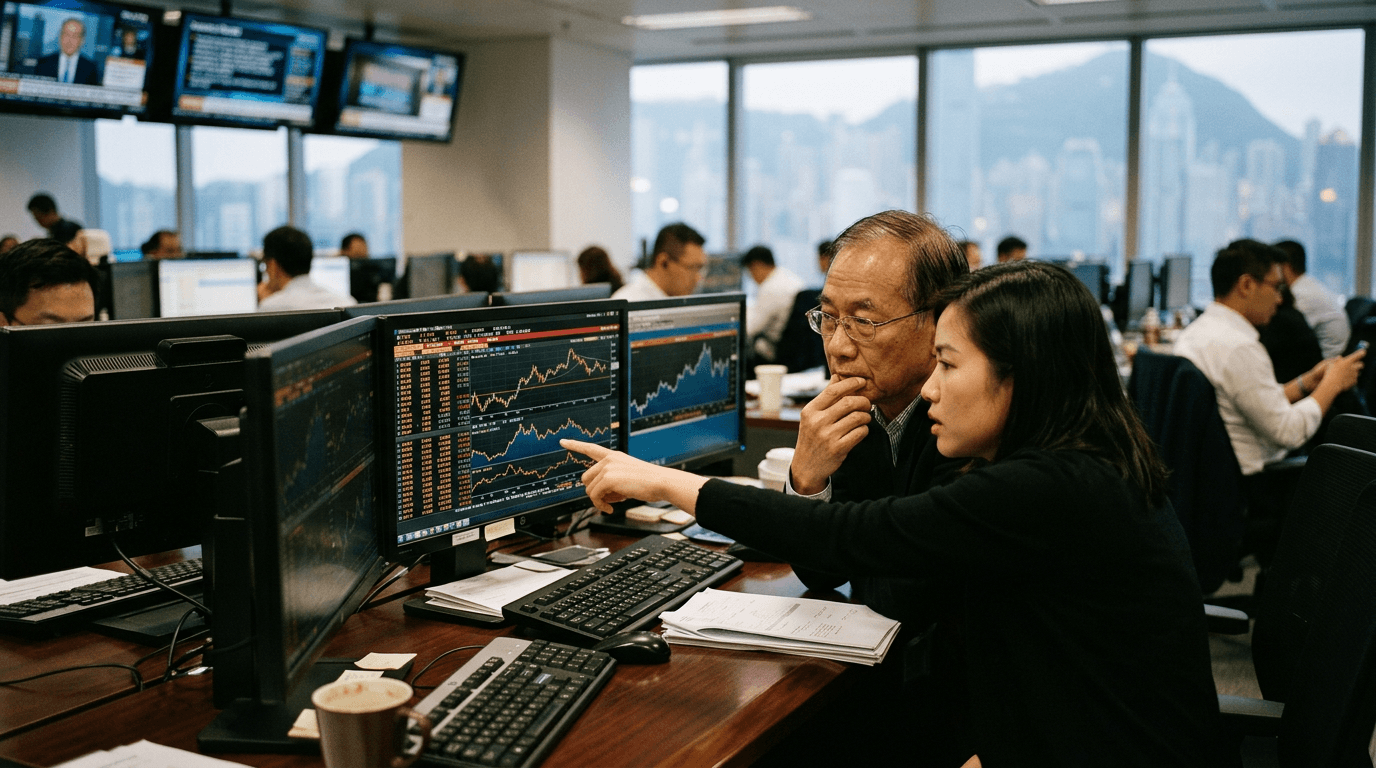
Asian currency markets are caught in an awkward balance: regional FX is trading broadly flat to slightly firmer against a soft US dollar, but underlying volatility is still elevated as traders weigh two big forces that can pull prices in opposite directions—dovish Fed expectations and renewed US‑China tariff risk.[3][5] It is a classic push‑and‑pull environment where directional moves are modest, yet intraday swings and bond market repositioning can be intense.
The Cross-currents Driving Asia Fx
To understand why Asia FX looks “muted,” you have to start with the macro backdrop driving the dollar. Softer US inflation data has reinforced expectations that the Federal Reserve will eventually pivot from a “higher for longer” stance toward rate cuts, even if the timing is uncertain.[3] Lower expected US policy rates reduce the yield advantage of dollar assets, typically weakening the dollar and giving room for Asian currencies to edge higher.
At the same time, markets have learned that the Fed’s reaction function is highly data dependent. Only recently, firm US data and a higher‑for‑longer narrative were enough to push the dollar to multi‑month highs and pressure Asian FX lower.[1] When the data turns, Fed rhetoric often shifts with it, which helps explain why the dollar can quickly go from firm to fragile without a dramatic change in growth fundamentals.
For Asian currencies, this creates a “two‑steps‑forward, one‑step‑back” pattern. On days when US yields fall and the dollar slips, the Korean won, Singapore dollar, Thai baht, and others tend to firm slightly as carry and risk appetite improve. But those gains are capped by lingering concerns over trade policy, Chinese growth, and local inflation pressures, which temper how aggressively investors are willing to buy regional FX or local‑currency bonds.[2][7]
Why Tariff Talk Hits Asia First
Tariff headlines matter disproportionately for Asia because the region is deeply integrated into global manufacturing supply chains and heavily exposed to US and Chinese demand.[2][9] When the US threatens higher tariffs on Chinese or other Asian exports, markets immediately reassess earnings, investment, and growth prospects across the region.[2][7][9] Even before any tariff is implemented, uncertainty alone can tighten financial conditions.
Research on past US tariff waves shows they have consistently been a “storm cloud” over global markets, triggering bouts of volatility not only in equities but also in bonds and FX.[5][9] During earlier tariff escalations, selling pressure spilled into US Treasuries and short‑term dollar funding markets, underscoring that trade policy can reverberate through core global funding channels, not just trade‑sensitive stocks.[5] For Asian policymakers, this complicates the balancing act between supporting growth and maintaining currency stability.
The impact on Asia FX works through several channels:
1) Trade and growth expectations: Higher tariffs on Chinese or Asian goods raise questions about export volumes, corporate margins, and capex plans.[2][7] Weaker expected growth tends to pressure local currencies and push yields higher to compensate for increased risk.
2) Risk sentiment: Tariff escalation usually dampens global risk appetite, encouraging flows into perceived safe havens and away from high‑beta emerging market assets.[5][9] That can weigh on higher‑yielding Asian currencies even if local fundamentals are sound.
3) Policy response: If trade tensions weaken activity, Asian central banks may consider easing or at least refraining from hikes, narrowing yield spreads versus the US and constraining FX upside.
In this context, “tariff jitters” can suppress Asia FX even on days when the dollar is soft, as investors hesitate to extend risk in the region until policy signals stabilize.[2][9]
A Fragile Dollar In A Tariff World
One of the more nuanced aspects of this story is the behavior of the dollar itself. Historically, US tariff announcements have often coincided with dollar strength, consistent with the idea that reduced US demand for imports improves the trade balance and supports the currency.[6] Empirical work on recent tariff rounds finds that the dollar did appreciate around many of those announcements.[6]
But that is not the whole story. There have also been episodes where aggressive tariff moves contributed to selling in US risk assets and the dollar, as investors rotated into other safe havens like the yen, the euro, or gold.[4][5] In those cases, markets seemed more worried about the US losing some of its financial dominance and the long‑run costs to growth than about short‑term trade balance arithmetic.[4][5][6]
Today’s setup looks closer to that second scenario. With markets highly focused on the Fed’s path, trade policy shocks are being filtered through the lens of US rate expectations: if tariffs are seen as raising recession risks or forcing the Fed to cut sooner, they can actually undermine the dollar even as they depress global sentiment.[3][5] That is what “fragile” really means here—the dollar’s direction is increasingly contingent on how the Fed responds, not just on headline tariffs.
At the same time, investors know that effective US tariff rates have already risen sharply from pre‑trade‑war norms, and forward‑looking scenarios suggest the eventual “steady state” could still be in the 10–20% range.[3][8] Markets are no longer reacting to every incremental tariff tweak with panic; some new measures are met with a more guarded or even indifferent response.[8][10] This helps explain why we may see Asia FX mostly range‑bound despite noisy news flow.
What Traders Should Watch Now
For active FX and rates traders, the current environment demands more focus on correlations and catalysts than on simple directional bets.
Key things to watch include
1) Fed communication and US data: Shifts in dot plots, speeches, or inflation and employment prints can rapidly reprice the timing and magnitude of rate cuts, swinging the dollar and US yields.[1][3]
2) Tariff timelines and scope: Markets increasingly care about whether tariffs are broad‑based or targeted, temporary or structural, and how China or other partners respond.[2][5][9] Narrow, time‑limited measures often generate less lasting FX impact than sweeping, open‑ended ones.
3) Chinese growth indicators: Weak Chinese PMIs and deflation pressures have already weighed on the yuan in past episodes, dragging regional FX along with it.[1][7] A tariff shock landing on top of soft Chinese data can amplify downside moves in Asia FX.
4) Local bond markets: Rising volatility in US Treasuries tends to spill over into Asian sovereign curves.[5] Watching how local bonds trade around tariff headlines can offer clues on whether FX is likely to follow or diverge.
In practice, this is a regime where short‑term ranges can be respected until a clear macro catalyst breaks them. Traders who try to force big trend trades without confirmation from rates and volatility markets risk getting chopped up.
Using Simulated Trading To Stress-test Strategies
For many traders, the hardest part of navigating tariff‑and‑Fed cross‑currents is position sizing and risk management, not trade idea generation. Simulated Finance (SimFi) environments offer a powerful way to test how a strategy behaves under different combinations of trade shocks and Fed paths—without putting real capital at risk.
You can, for example, build and compare playbooks for three stylized scenarios drawn from recent experience and research:[3][5][8][10]
1) Dovish Fed, stable tariffs: Dollar drifts weaker, Asia FX grinds higher, carry and relative‑value trades in local bonds perform.
2) Hawkish Fed, escalating tariffs: Dollar firms, Asia FX underperforms, higher‑beta currencies and long‑duration bonds suffer.
3) Growth scare from tariffs, Fed forced to ease: Dollar initially spikes on risk‑off, then softens as rate cuts are priced in; Asia FX may decouple, with exporters under pressure but some high‑carry markets supported by global easing.
Running these types of scenarios in a simulated environment lets you observe not just headline P&L but also drawdowns, margin usage, and slippage around event risk. Over time, that can help refine entries, exits, and hedging tactics so that when the next tariff headline or Fed surprise hits, your reaction is guided by a tested framework rather than emotion.
In a world where Asia FX looks calm on the surface yet is constantly buffeted by shifting expectations for tariffs and the Fed, the edge belongs to traders who understand the underlying macro mechanics and have rehearsed their responses. Whether you trade discretionary macro, systematic strategies, or a blend of both, this is a market that rewards preparation far more than prediction.