
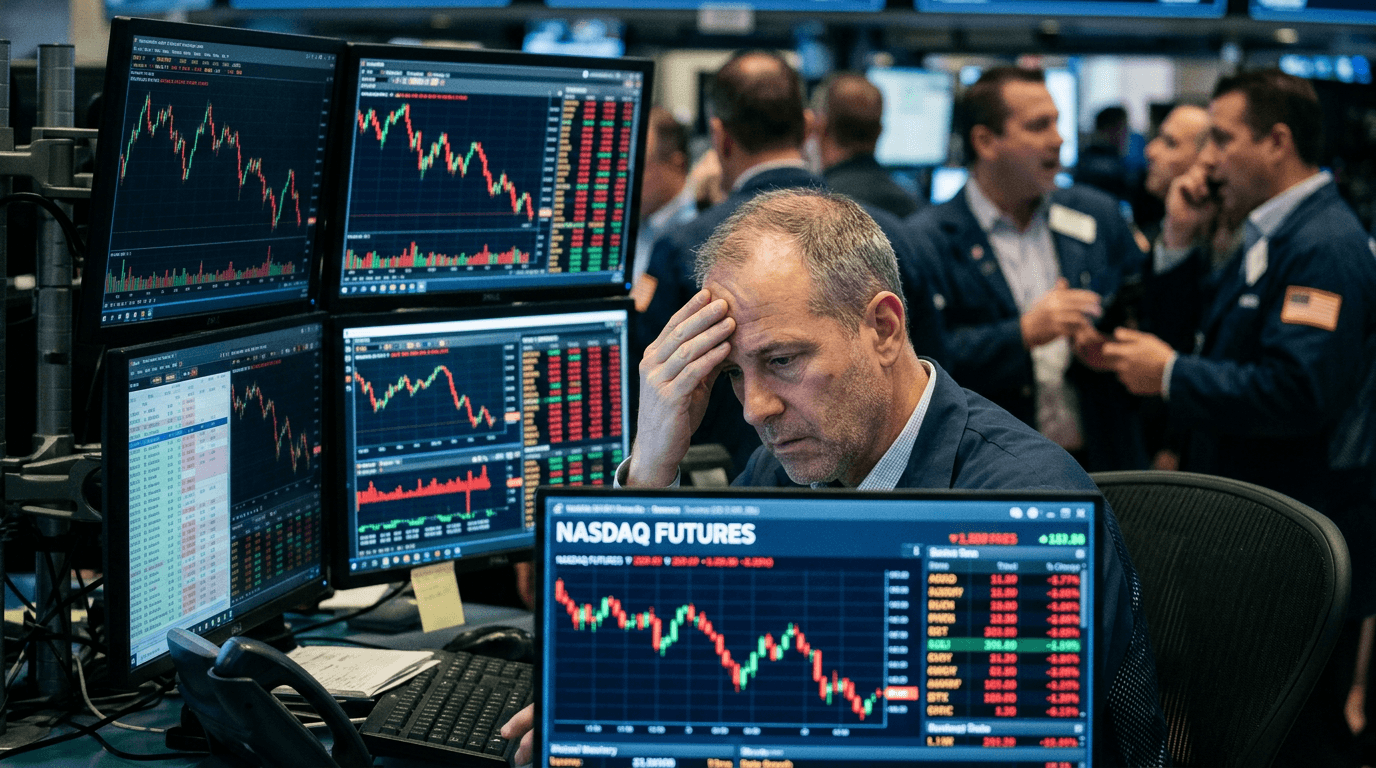
A sharp sell-off in heavyweight technology and chipmaker stocks has once again reminded markets how concentrated today’s equity rally has become, dragging the Nasdaq and S&P 500 lower in the cash session and leaving futures wobbling rather than confidently bouncing back[1][3][9]. The overnight action in index futures has been modestly negative to flat, signaling risk aversion but not outright panic as traders reassess stretched valuations and crowded positioning in AI and semiconductor names[1][3][8]. For both discretionary and systematic traders, this combination of spot weakness and hesitant futures points to a market that is nervous, not capitulating.
WHAT IS DRIVING THE TECH-LED SELL-OFF?
The latest downturn is centered on the same leaders that powered the rally: megacap technology, AI beneficiaries, and semiconductor stocks, with chipmakers and high-multiple growth names bearing the brunt of the selling[1][3][9]. In recent sessions, Nasdaq 100 futures have fallen more than 1% at times, while S&P 500 futures have lagged but still traded meaningfully lower as investors trimmed exposure to the sector that had done the most heavy lifting this year[1][3]. Episodes like a pronounced slump in the S&P 500 tech index, which dropped more than 4% intraday before recovering part of the loss, show how quickly momentum can reverse when positioning is crowded and valuations are rich[9].
Macro catalysts are amplifying the move. Stronger economic data and sticky inflation readings have periodically pushed bond yields higher, reviving concerns that policy rates may stay restrictive for longer and compress valuations for long-duration growth stocks[3][4]. When yields jump or inflation surprises on the upside, investors often rotate toward value, financials, or energy and away from high-PE tech, creating abrupt factor reversals that feel like a sharp, tech-focused shock rather than a broad market event[3][4]. Add in earnings disappointments or cautious guidance from marquee technology names, and you have the ingredients for a concentrated but violent repricing.
WHY FUTURES ARE “WOBBLING” INSTEAD OF CRATERING
The phrase “futures wobble” captures a subtle but important dynamic: after a heavy sell-off in the cash session, index futures are not collapsing; they are drifting slightly lower or stabilizing, reflecting uncertainty about whether the move has run its course[5][8]. In several recent episodes, S&P 500 and Nasdaq futures have opened only marginally lower—sometimes less than 0.2%—even after a sizeable decline in spot indices, suggesting traders are reluctant to extend the sell-off aggressively overnight[8]. At other times, futures have traded down around 1–1.5%, notable but still far short of the kind of capitulation that often accompanies systemic stress[1][3].
For short-term traders, this pattern signals a tug of war between follow-through selling and opportunistic dip-buying. Systematic strategies that respond to volatility and trend may be reducing risk, while discretionary investors weigh whether the tech slump is a buying opportunity or the start of something bigger. When futures fail to bounce decisively after a sharp down day, it often means the market has not yet found a clear equilibrium; price discovery is still ongoing as global participants in Europe and Asia react to the prior US session.
How The Sell-off Spills Into Derivatives And Volatility
Tech-led weakness rarely stays confined to the cash equity market; it quickly ripples through equity index derivatives and volatility products. A sharp move lower in the Nasdaq and S&P 500 tends to push implied volatility higher, steepening the volatility term structure at the front end as traders demand short-dated downside protection. Index options on the Nasdaq 100 and S&P 500 see increased put volume, with more interest in out-of-the-money strikes as investors hedge portfolios tied to index trackers or concentrated tech exposures.
Futures on volatility indices, such as VIX-linked contracts, may move into backwardation if fear rises quickly, signaling elevated demand for near-term hedges relative to longer-dated risk. That shift often accompanies wider bid–ask spreads and heavier trading in volatility exchange-traded products that track or approximate volatility futures. At the same time, the futures–cash basis in equity indices can widen or invert, especially if traders lean heavily on index futures to hedge single-stock tech risk, pressuring near-term futures relative to spot.
Correlation also tends to rise in these episodes. When tech leads the market lower, other sectors initially appear more resilient, but as selling pressure builds, index-level hedging drags a broader basket of stocks down together. This rise in correlation reduces the benefits of diversification and can make portfolio hedging more efficient at the index level—but more challenging for stock pickers who rely on dispersion.
What This Environment Means For Active And Simulated Traders
For active traders, the combination of tech-led weakness, modest but persistent futures softness, and higher implied volatility creates a different playbook than a calm, upward-trending market. Directional trades carry more gap risk, especially around macro data releases, earnings, and policy headlines that can quickly change the interest-rate narrative. Leverage and position sizing become critical; even small overnight moves in futures can translate into large swings on margined positions when volatility is elevated.
For traders using simulated finance environments, this is an ideal backdrop to practice managing risk rather than simply chasing trends. Episodes where futures wobble after a sharp spot move are perfect for testing scenarios such as overnight gaps, failed rebounds, and intraday whipsaws. By experimenting with index futures, options strategies, and volatility-linked products in a simulated setting, traders can explore how different hedges behave when tech risk drives the broader market and volatility regimes shift quickly.
Practical Checklist For The Next Tech-driven Risk-off Move
1. Track leadership and breadth If the same handful of tech and chip names are driving most of the index’s gains and then suddenly start leading to the downside, treat that as a signal that concentration risk is high.
2. Watch futures vs. cash Compare the size of the futures move to the prior cash session. A sharp cash sell-off followed by only a mild futures decline often indicates indecision rather than conviction, which can mean choppy trading ahead.
3. Monitor volatility and skew Rising implied volatility, especially in short-dated puts on the Nasdaq and S&P 500, points to growing demand for protection. Changes in skew can reveal whether traders fear a crash scenario or a more orderly correction.
4. Respect correlation risk Assume that, in a genuine risk-off episode, assets that usually behave differently may start moving together. Adjust portfolio and strategy assumptions to reflect higher cross-asset and cross-sector correlation.
5. Use simulated trading to refine playbooks Before deploying real capital, test “what if” scenarios—such as a further 2–3% intraday drop, a surprise bounce, or a volatility spike—within a simulated environment. Focus on execution, risk limits, and how your strategy behaves under stress rather than on trying to pick the exact bottom.
Conclusion
A tech-led equity sell-off that spills into slightly weaker or unstable Nasdaq and S&P 500 futures is a hallmark of a market in transition: no longer complacent, but not yet in full-blown capitulation. The futures “wobble” signals that investors are reassessing valuations, positioning, and macro risks while still debating whether technology remains the structural leader of this cycle. For traders, the opportunity lies less in calling the next 1% move and more in mastering risk management, understanding how futures and volatility products transmit sentiment, and building robust playbooks that can withstand both the next surge in AI optimism and the next tech-driven air pocket.