
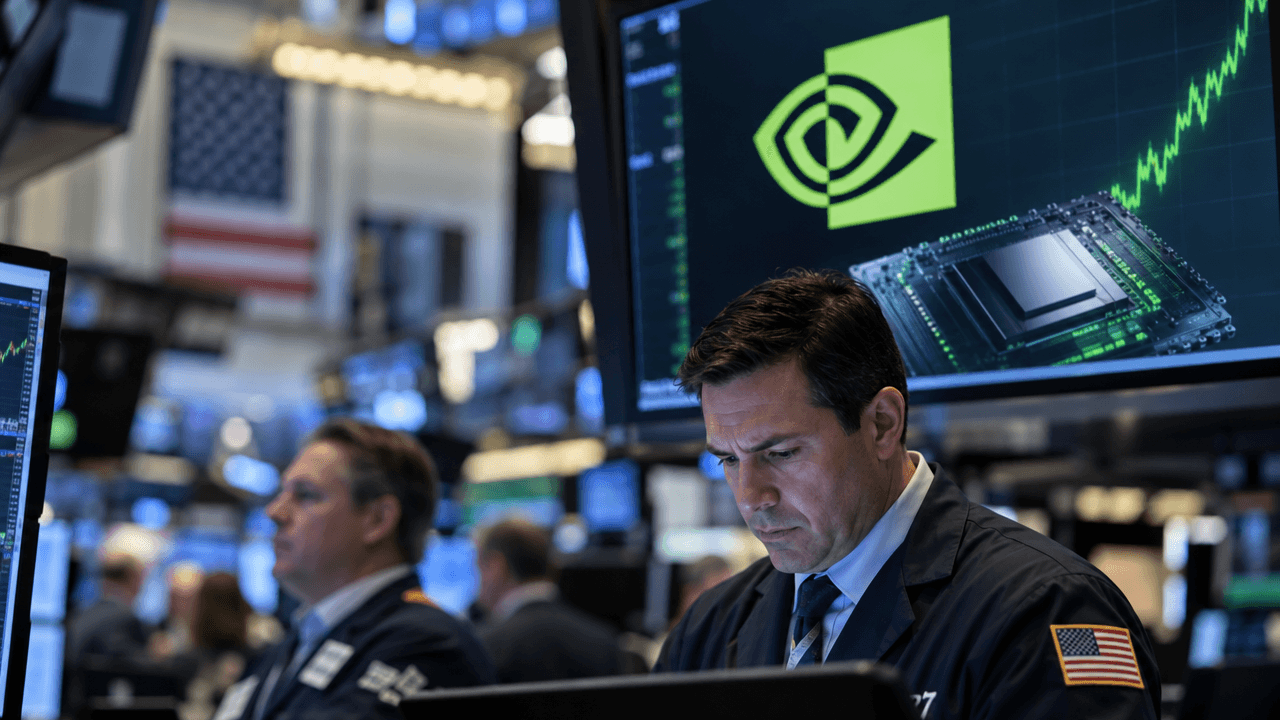
US equity futures are sending a nuanced signal this morning, with technology strength offset by a more cautious tone across the broader market.[1][2] Index futures are trading on either side of unchanged, but chip and AI-related names are firmly in the lead after Nvidia’s latest commentary pointing to a potential doubling of chip sales in 2027.[1][3][10] For traders, it is a classic setup where sector leadership is clear, but index-level conviction is still developing.[1][2]
Market Snapshot
S&P 500 futures continue their post-FOMC reversal, recently extending above the 7,700 level, even as overall moves remain modest.[1][2] Nasdaq-linked futures are again outperforming peers, reflecting the heavy weight of large-cap technology and semiconductor stocks in the tech-heavy index.[9][12][14] Dow futures, by contrast, are more subdued, highlighting the divergence between growth-oriented sectors and more cyclical, value-heavy areas of the market.[9][14]
Chip stocks sit at the center of this move, with Nvidia leading the charge and strength spilling over into other semiconductor names globally.[1][3][9] Overnight, South Korea’s tech giants such as SK Hynix and Samsung Electronics saw notable gains, underlining how Nvidia’s guidance is being interpreted as a broader vote of confidence in the AI hardware cycle.[1] Within the US, technology remains one of the few sectors showing consistent upside, while other sectors have been mixed to slightly negative.[7][9]
For index futures traders, this mixed tape means headline indices can appear flat, even as underlying sector dispersion grows.[8][9] Strong tech performance can pull the S&P 500 and Nasdaq higher, but if financials, industrials, or defensives lag, the net impact on futures can look indecisive.[9][11] Understanding which sectors are truly driving the move is essential for positioning, particularly when leadership is narrow and concentrated in a handful of megacap names.[9][11]
NVIDIA’S COMMENTARY AND THE AI CHIP CYCLE
The catalyst for today’s tech outperformance is Nvidia CEO Jensen Huang’s latest remarks projecting that the company’s chip sales in 2027 could roughly double relative to 2026.[1][3][10] Speaking at a technology gathering in Scotland, Huang framed the outlook in terms of surging AI computing demand and increasingly power-dense data center platforms.[3][10] The company highlighted revenue opportunities from its Vera Rubin platform of around $40 billion per gigawatt, surpassing the $25 billion per gigawatt potential of its current-generation Blackwell architecture.[3]
Nvidia shares reacted positively to the commentary, trading around 2% higher as investors digested the implications of a multi-year AI infrastructure build-out.[3][10] The message is clear: management sees the AI workload curve not only continuing but steepening, with capacity and monetization scaling in tandem.[3] That expectation is feeding directly into higher valuations for chipmakers and AI-linked names, even in an environment where some investors remain cautious on the broader economic outlook.[3][9]
From a macro perspective, guidance of doubling chip sales adds another layer of support to the “AI as a structural growth story” narrative that has dominated markets since the first major AI earnings beats in recent quarters.[7][9][13] Similar episodes in August saw Nvidia’s strong revenue and bullish medium-term outlook power outsized gains in Nasdaq futures and semiconductor indices, even when other sectors lagged.[7][9][13][14] Today’s reaction fits that pattern: tech optimism is powerful enough to move indices, but not yet broad enough to fully override cross-asset concerns.[9][11]
Implications For Us Index Futures
For S&P 500 and Nasdaq futures, Nvidia’s commentary acts as a forward-looking anchor for AI-related earnings assumptions and valuation multiples.[3][9] Futures markets quickly incorporate this kind of guidance, repricing expected growth for the tech complex while leaving more cyclical sectors largely unchanged.[9][11] The result is a “mixed” futures board: modest gains or flat prints at the index level, masking more pronounced rotation beneath the surface.[8][9]
Nasdaq futures are particularly sensitive to semiconductor and mega-cap tech momentum because of their heavy sector concentration.[9][12][14] When a single AI bellwether signals sustained, accelerating demand, it can justify higher earnings expectations for multiple components of the index—from GPU suppliers to memory manufacturers and cloud infrastructure providers.[7][9][13] By contrast, Dow futures, which reflect a more diversified cross-section of the corporate economy, may be less responsive to chip-specific commentary.[9][11]
For traders using index futures, this environment supports a focus on relative value rather than outright direction. Buying Nasdaq futures while hedging with S&P or Dow futures can express a view that AI-linked tech will outperform, even if overall risk appetite stays cautious.[9][11] Conversely, more defensive traders might use strength in tech-heavy futures to add hedges or reduce exposure, anticipating that narrow leadership can leave indices vulnerable if sentiment shifts.[9][11]
What This Means For Risk Appetite
The combination of strong tech and mixed broader futures indicates a market still balancing optimism about structural growth against shorter-term macro uncertainty.[1][2][9] Recent moves in S&P futures above 7,700 suggest that the post-FOMC relief rally is intact, but the lack of broad-based sector participation hints at lingering caution.[1][2][9] Some investors remain wary of interest rate paths, growth momentum, and geopolitical risks, even as they continue to reward companies enabling the AI build-out.[9][11]
Risk appetite, therefore, looks selective rather than indiscriminately risk-on. Capital is flowing readily toward AI infrastructure, semiconductors, and high-margin software, while more traditional cyclicals and defensives struggle to keep pace.[7][9][13] In practice, this means market breadth can narrow, leaving indices more dependent on a small cluster of high-growth names.[9][11] If those leaders stumble—whether due to valuations, regulation, or supply-chain constraints—the impact on futures could be swift and outsized.[9][11]
For traders and risk managers, a key takeaway is that narrative risk is high. A single update from a major AI player can reframe the growth outlook for an entire sector and move global equity markets, as evidenced by the reaction in US and Asian tech stocks to Nvidia’s latest guidance.[1][3][10] Monitoring both company-level commentary and macro data is essential, since the AI story can amplify, but not fully neutralize, broader economic and policy risks.[9][11]
How Traders Can Position In A Simulated Environment
In a SimFi environment like E8 Markets, this kind of tape offers a rich testing ground for strategy development and risk management. Traders can experiment with relative index trades—such as long Nasdaq, short Dow—to capture tech outperformance without taking large directional bets on overall market levels. Scenario analysis around Nvidia’s guidance lets traders stress-test portfolios against a range of AI demand and earnings assumptions.
Sector rotation strategies also become highly relevant. Simulated portfolios can be tilted toward semiconductors and AI hardware while using index futures or options to manage overall beta exposure. This allows traders to isolate the theme they believe will drive returns—AI infrastructure—while controlling for macro volatility that might affect the broader market.
Finally, volatility and risk controls should stay front and center. Concentrated leadership can result in sharp intraday swings, especially if positions crowd into the same names or sectors. Using simulated environments to refine stop-loss placement, position sizing, and cross-asset hedging can help traders build discipline that transfers directly to live markets. The current backdrop—mixed futures, strong tech, and powerful AI narratives—offers an ideal live case study for honing those skills.