
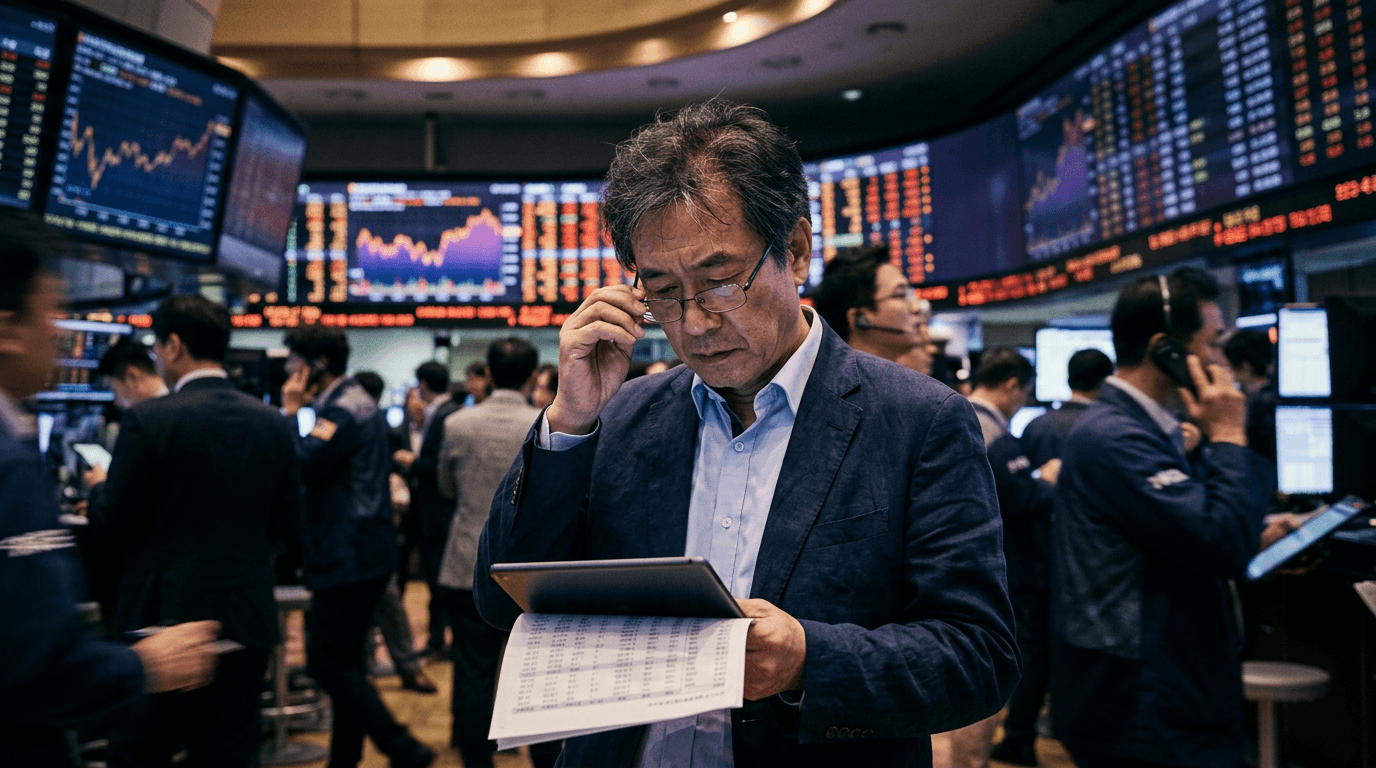
Foreign investors have just pulled a staggering $46.1 billion out of emerging‑market equities in a single month, with South Korea and Taiwan at the epicenter of the exodus[1][9]. The move is rippling through currencies, equity index futures and broader risk sentiment, as global portfolios rotate away from higher‑beta growth stories toward perceived safety[9]. For traders and investors, this is not just a headline; it is a live case study in how capital flows can reshape markets in weeks.
Scale And Speed Of The Emerging-market Exodus
The June outflow stands out not only for its size, but for its concentration in a few key markets[1][9]. Data from the Institute of International Finance (IIF) show that foreign investors withdrew $30.5 billion from South Korean stocks and $18.3 billion from Taiwan equities in June alone, the largest equity outflows for South Korea in more than 25 years[1][9]. Together, these two tech‑heavy markets account for essentially all of the reported $46.1 billion net equity exodus across emerging markets[1][9].
Importantly, June marked the second consecutive month of net portfolio losses for developing economies[1][9]. In May, foreign investors had already pulled a net $26.6 billion from emerging‑market bonds and stocks, driven mainly by $37 billion in equity selling that overshadowed debt inflows[3]. The June data show that what began as an early risk‑off rebalancing in May has escalated into a full‑scale retreat from EM equities, especially in Asia.
The regional breakdown underscores that this is not a blanket rejection of all emerging markets. Emerging Asia recorded around $27 billion in total portfolio outflows in June, while other regions such as Latin America saw relatively more resilient flows, helped by separate local dynamics and commodity exposure[1][2]. For traders, this highlights a critical point: “emerging markets” are not a monolith, and flow dynamics can diverge sharply by region and asset class.
Why South Korea And Taiwan Are At The Center
South Korea and Taiwan have become central to global equity positioning because of their outsized exposure to semiconductors, electronics and broader technology supply chains[1][9]. In the recent AI and industrial capex boom, these markets were major beneficiaries, attracting significant foreign capital into large tech exporters and high‑beta growth names[7]. That same concentration now makes them vulnerable when investors reassess valuations or global risk.
The IIF data attribute the June outflows to a sharp retreat from tech‑heavy equities in these markets[1][9]. Several forces likely played a role:
- Profit‑taking after strong multi‑year performance in semiconductor and AI‑related stocks.
- Concerns about global demand cycles in electronics and hardware.
- Rising volatility in global rates and currencies, which can reduce appetite for leveraged or growth‑heavy exposures.
Because Korea and Taiwan are heavily integrated into global supply chains, their equity markets are particularly sensitive to shifts in global risk appetite and to changes in expectations about technology spending[9][7]. When macro uncertainty rises – whether due to policy, geopolitics, or growth scares – foreign investors often move quickly to lighten exposure in these liquid, tech‑tilted EM markets.
Impact On Currencies, Futures And Risk Sentiment
Equity outflows of this magnitude rarely stay confined to the stock market. The June withdrawals are weighing on EM currencies, where selling of local equities often entails conversion out of local currency back into dollars or other reserve units[9]. This can add pressure to exchange rates, potentially forcing central banks to either tolerate more volatility or lean against it with interventions or rate decisions.
At the same time, emerging‑market equity index futures are pricing in greater volatility and downside risk, reflecting both the recent outflows and the possibility of further risk‑off moves[9]. Futures markets often act as a forward‑looking barometer of institutional sentiment; rising open interest in protective positions or shorter‑dated hedges can signal that participants expect continued turbulence.
Interestingly, the June IIF report also highlights a sharp split between equity and debt flows: while equities saw heavy selling, EM bonds actually attracted $28.3 billion in inflows, leaving overall portfolio flows at a net loss of $17.8 billion[1][2]. This rotation from stocks to bonds suggests that investors are not abandoning emerging markets entirely; they are recalibrating risk by shifting toward comparatively safer fixed‑income exposures, often in markets where yields remain attractive and macro fundamentals are perceived as stable.
For traders, the takeaway is clear: watch both cross‑border flows and cross‑asset rotations. Equity selling coupled with bond buying is a classic sign that investors are trimming growth risk while still seeking yield and diversification.
Short-term Flows Vs Long-term Fundamentals
The recent outflows come at a time when many longer‑term assessments of emerging markets remain constructive. Research from major asset managers indicates that EM equities entered 2026 with renewed momentum, supported by macro tailwinds, evidence of structural profitability improvements, and strengthening investor sentiment[5]. In addition, emerging markets and developing economies are widely expected to outgrow advanced economies, with EM growth projected around 4% versus roughly 1.5% for developed markets in 2026[6].
Some outlooks highlight that EM equities have been delivering higher earnings growth than the MSCI World Index for several years, helped by an industrial “supercycle” spanning AI‑related infrastructure, energy transition, defense and broader industrial capex[7]. Despite this, EM equities still account for only about 10–12% of global benchmarks, leaving room for further institutional allocation over the long run[7].
This tension between short‑term flow stress and long‑term structural strength is central to understanding current markets. Foreign equity outflows can create temporary mispricing, widen risk premia and elevate volatility, even when underlying fundamentals such as demographics, productivity and infrastructure investment remain supportive. For fundamental investors, these episodes often become entry points rather than exit signals, provided country‑level risks are carefully assessed.
Practical Takeaways For Traders And Simulated Investors
For active traders and those practicing in simulated environments, the $46 billion EM equity exodus offers several practical lessons.
First, capital flows matter. Tracking foreign ownership, daily and monthly flow data, and positioning in futures can provide early warnings of regime shifts. When flow momentum turns negative for multiple months, as in May and June, price trends and volatility regimes can change quickly[3][1][9].
Second, concentration risk is real. The outsized impact on South Korea and Taiwan reflects how sector and style concentration – in this case, high‑growth tech – can amplify both gains and losses[1][9]. Building strategies that account for country, sector and factor diversification can help mitigate drawdowns when one theme falls out of favor.
Third, cross‑asset signals are essential. The concurrent move out of equities and into EM bonds suggests that investors are not simply “risk off” on emerging markets, but are recalibrating which risks they are willing to hold[1][2]. Watching spreads, yield curves and currency behavior alongside equities can reveal whether stress is systemic or localized.
Finally, simulated trading environments provide a valuable sandbox for testing responses to such events. Traders can:
- Model scenarios where foreign flows accelerate or reverse.
- Test hedging strategies using index futures and FX overlays.
- Explore relative‑value trades between equity and bond exposures within the same country or region.
By practicing how portfolios behave under rapid flow reversals – without real capital at risk – traders can refine their playbooks for live markets and better understand how emerging markets react to global risk cycles.