
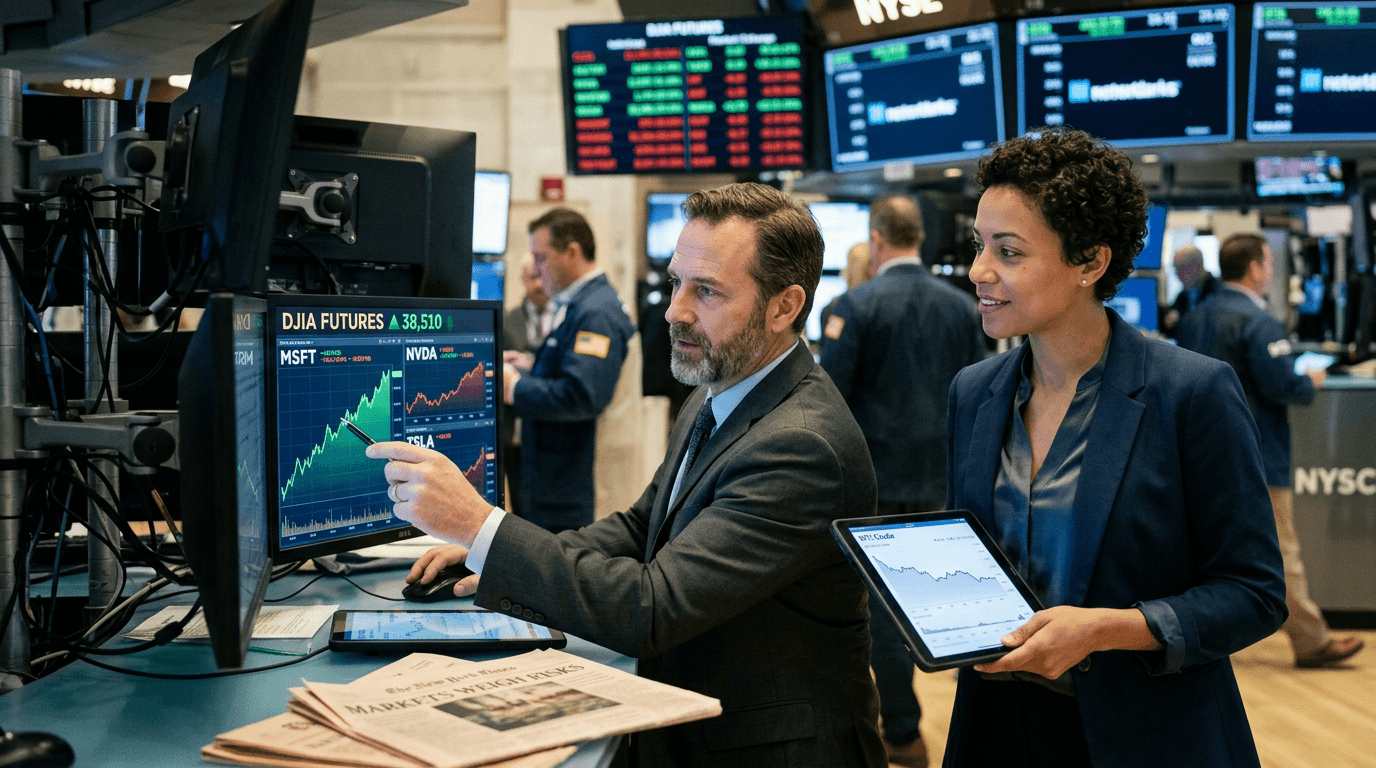
U.S. stock futures are holding close to record territory, with strength in megacap technology names helping offset lingering worries about interest rates and a still-sensitive oil market. As traders digest an extended U.S.–Iran ceasefire and calmer energy prices, risk appetite remains firm, keeping the S&P 500 and Nasdaq futures near their peaks while rotating attention toward what might come next for growth, inflation, and central bank policy.[2][3]
WHAT IS KEEPING FUTURES NEAR RECORD HIGHS?
At a high level, futures are reflecting a tug-of-war between supportive equity fundamentals and macro risks that have not fully gone away. On the supportive side, tech-heavy indices like the Nasdaq 100 have been hitting or challenging record highs, powered by strong earnings, AI-driven investment themes, and ongoing demand for high-margin, asset-light business models.[2][3] This backdrop has helped keep S&P 500 futures elevated, with investors willing to pay up for perceived quality and growth even as they price in higher-for-longer rates.
Earnings have been an important anchor. A strong majority of reporting S&P 500 companies have been beating expectations this season, and aggregate earnings growth is running in the low double digits year over year, reinforcing confidence that corporate profits can absorb modestly higher funding costs.[2] When earnings deliver, futures tend to show resilience: even negative macro headlines often translate into shallow pullbacks rather than deep corrections.
Global risk sentiment has also improved following the extension of the U.S.–Iran ceasefire, which has reduced near-term fears of a sharp disruption in oil supply routes. That has helped stabilize energy prices and, by extension, inflation expectations, giving equity traders a bit more breathing room to focus on growth and earnings rather than pure macro risk.
Tech Strength: Why Megacaps Still Dominate The Story
The core driver of today’s equity tone is still technology. Megacap names and the broader chip and AI ecosystem continue to provide the lion’s share of index-level performance, especially in the Nasdaq and S&P 500.[2][3] In practical terms, this means a handful of very large companies are exerting outsized influence on futures pricing.
Several dynamics are at play
First, tech earnings and guidance have generally been strong. Many hardware, semiconductor, and software firms are riding multi-year themes such as AI infrastructure buildout, cloud migration, and digital transformation, supporting robust revenue growth and healthy margins even as some other sectors face margin pressure.[2]
Second, investors still view leading tech names as “quasi-defensives within growth.” They offer secular growth, fortress balance sheets, and global revenue streams, which can be attractive when uncertainty about rates, inflation, or geopolitics rises. This helps explain why the Nasdaq 100 can push to new highs even when macro data are mixed.[2]
Third, the AI narrative remains a powerful capital magnet. Markets are actively trying to price the long-term earnings potential of AI, and that process tends to favor large incumbents in chips, cloud, and platforms, which in turn keeps index futures well supported.[3]
For traders, the implication is clear: understanding factor concentration risk is critical. Index futures may look strong, but under the surface the rally may be narrow. A portfolio or strategy that is underexposed to tech or AI-linked names can significantly lag the headline indices, while those overexposed may be more vulnerable to an abrupt sentiment reversal.
Oil, Geopolitics, And Rate Fears In The Background
The extended U.S.–Iran ceasefire has reduced immediate tail risks around further escalation, which had been a key concern for oil supply and shipping routes. As tensions have eased, oil prices have pulled back from recent highs, and that has helped alleviate some pressure on inflation expectations.[2][3] In turn, this has taken a bit of urgency out of the “higher for longer” narrative on interest rates, even if central banks are not signaling imminent aggressive cuts.
Still, rate and oil concerns have not disappeared; they have merely been downgraded from front-page crisis to background risk. On the rates side, markets remain highly sensitive to incoming data. Strong labor or inflation prints could quickly revive bets on further tightening or delay expected cuts, pushing yields higher and challenging equity valuations—especially for long-duration growth stocks.
On the oil side, the ceasefire is a relief, not a permanent solution. Any sign of renewed tension or supply disruption could trigger a rapid rebound in crude, feeding back into inflation expectations, rate-path repricing, and risk sentiment. Equity futures would likely respond quickly, with cyclicals and energy outperforming while rate-sensitive sectors, including some parts of tech, could come under pressure.
For traders, the key is to treat the current environment as one where geopolitical and rate risks are “priced but not gone.” That suggests being prepared for volatility spikes around data releases, central bank comments, or news out of key geopolitical hotspots.
How Global Fx And Risk Sentiment Fit Into The Picture
The firm U.S. equity backdrop is spilling over into foreign exchange markets. When stock futures are stable near highs and risk sentiment is positive, so-called risk-sensitive currencies like the Australian dollar, New Zealand dollar, and many emerging-market currencies tend to benefit. Investors are more willing to move capital into higher-yielding or growth-oriented markets when the global risk environment feels more stable.
At the same time, demand for traditional safe-haven assets—such as the U.S. dollar and, to a degree, Treasuries—tends to soften when equities are strong and geopolitical risks appear contained.[2] This can create an interesting feedback loop: a softer dollar can support U.S. multinationals’ earnings in local currency terms, which in turn supports equity valuations, reinforcing the positive tone in futures.
For index traders, monitoring FX and credit spreads can provide useful confirmation signals. A scenario where U.S. futures are strong but credit spreads are widening and EM FX is selling off would suggest a fragile rally. By contrast, today’s setup—strong equities, stable-to-firmer risk FX, and no major stress in credit—aligns more with a constructive, if not euphoric, risk environment.
What Traders Can Do In This Environment
When futures sit near record highs with clear sector leaders and visible macro risks in the background, traders face a distinct set of choices:
- Reassess concentration risk. If your P/L is heavily dependent on megacap tech or AI-linked names, consider whether your exposure matches your risk tolerance. Hedging via index futures or options, or diversifying into quality names in other sectors, can help smooth drawdowns if tech sentiment turns.
- Use levels, not narratives, to manage risk. While the macro story—ceasefire, oil, rates—is important, actual trading decisions benefit from well-defined support and resistance levels in index futures and key single names. Combine the macro context with price action rather than trading headlines alone.
- Watch the macro calendar closely. With rate and oil risks in the background, surprises in economic data (inflation, jobs, growth) or central bank commentary can quickly shift the narrative. Align your position sizing and holding periods with known event risk to avoid being caught offside.
- Practice scenarios in a simulated environment. A SimFi or simulated trading setup can be particularly useful right now. It allows you to test how your strategies behave when, for example, oil suddenly spikes, yields jump 25–50 basis points, or a major tech name misses earnings—without putting real capital at risk. Building and rehearsing playbooks for these scenarios can improve execution when volatility returns.
In essence, today’s futures landscape is defined by the balance between powerful tech-driven momentum and a macro backdrop that is calmer but still conditional. Traders who respect both sides of that equation—staying aligned with the trend while honoring risk—will be better positioned as the next wave of data, earnings, and geopolitical developments hits the tape.