
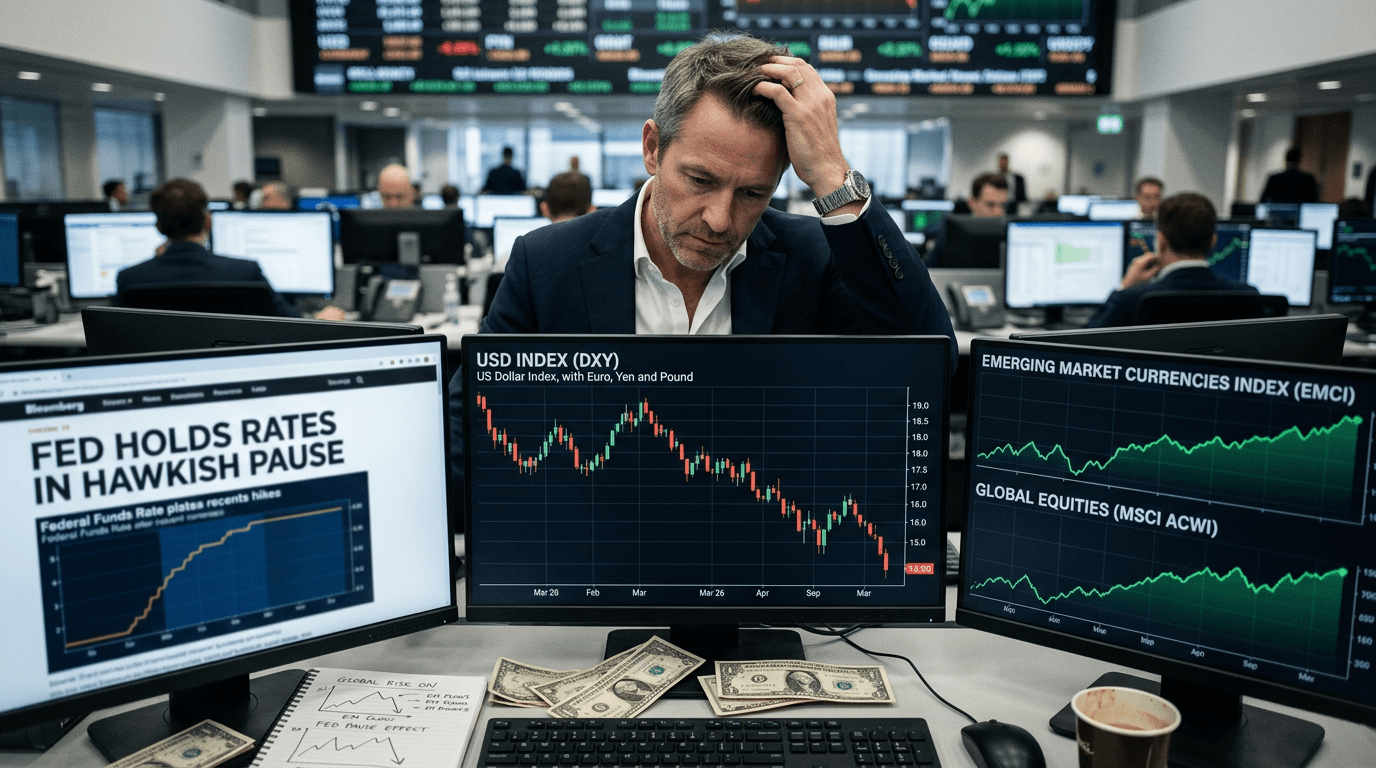
The Curious Case of the Dollar's Decline Amid a Hawkish Fed Pause
In early 2026, the US dollar's trajectory puzzled traders and investors alike. On the surface, the Federal Reserve's decision to maintain a pause on rate cuts could have suggested dollar strength. Yet, recent market behavior tells a different tale. Fed Chair Jerome Powell's announcement of an extended pause in monetary easing was followed by a broad weakening of the dollar against major currencies in Asian and London trading sessions. To unravel this counterintuitive movement, one must delve into the subtleties of market interpretation, global risk sentiment, and the intricate dance between Fed signals and broader economic forces.
Interpreting the Fed's Hawkish Pause
March's Federal Reserve meeting sent a clear signal: rate cuts aren't on the horizon. The federal funds rate was held steady at 3.50-3.75%, continuing the pause initiated in early 2026. Initially, investors had hoped for two rate cuts that year, but shifting expectations before and after the meeting highlighted the Fed's distinctly hawkish stance. Despite market anticipations of several dissents, only one FOMC member supported a rate cut. The more telling sign was the upward revision of the Fed's inflation projections, with the PCE inflation forecast for end-2026 rising from 2.4% to 2.7%. Powell reinforced this hawkish narrative by highlighting upside risks to inflation and the uncertain economic outlook amid geopolitical tensions.
On paper, such a stance should have strengthened the dollar. Traditionally, higher US interest rates attract foreign investment, boosting dollar demand. Yet, the market's response uncovers deeper complexities beneath the surface of Fed policy signaling.
Deciphering Dollar Weakness Despite Hawkish Signals
The contradiction between hawkish Fed messaging and dollar weakness can be attributed to several factors. First, markets may have already priced in the extended pause on rate cuts before the announcement. Derivatives markets had shifted expectations from a June rate-cut timeline to later in the year, implying that the hawkish pause was somewhat anticipated.
Second, despite the overall hawkish tone, dovish dissents introduced uncertainty about the Fed's trajectory. With multiple FOMC members projecting at least one rate cut for 2026, markets faced conflicting signals. This ambiguity can prompt profit-taking among dollar longs betting on a stronger currency during the dollar weakness phase extending through early 2026.
Third, the dollar's broader weakness throughout late 2025 and early 2026 created an environment where even hawkish signals struggled to reverse momentum. The dollar lost 9.5% of its value from January through mid-December 2025, with significant losses in the first half of the year. Such prolonged weakness often precedes consolidation or temporary recoveries, rather than sharp reversals.
The Risk-Off Dynamic and Yen Strength
The yen's strength amid the dollar's weakness indicates a crucial shift in market sentiment: a move toward risk-off positioning. In global financial markets, the Japanese yen typically appreciates during periods of heightened uncertainty, as investors unwind leverage and seek safe-haven assets. The yen's gains alongside dollar weakness suggest that concerns about geopolitical tensions, fiscal sustainability, or other macro risks are overshadowing the appeal of higher US interest rates.
This risk-off environment poses a challenge for the dollar despite the Fed's hawkish stance. When investors grow nervous about growth, they reduce exposure to higher-yielding assets and currencies, favoring the perceived safety of the yen, Swiss franc, and other traditional safe-haven currencies. In such a scenario, even a Fed committed to holding rates steady struggles to support its currency.
Implications for Traders and Investors
For traders navigating this landscape, the key insight is that Fed policy alone does not dictate currency movements. The dollar's weakness following Powell's hawkish pause illustrates that global risk sentiment, technical levels, and market positioning often overshadow purely fundamental interest rate differentials in the short term.
Traders should keep an eye on key indicators: the VIX volatility index as a measure of risk sentiment, global central bank positioning, and critical technical support levels in USD pairs. The current environment suggests that dollar strength may require not just a hawkish Fed, but also a normalization of global risk appetite.
For longer-term investors, the extended dollar weakness trend signals a potential structural shift in global capital flows, possibly driven by capital diversification away from US assets and changes in central bank reserve accumulation patterns. This secular bear market for the dollar could persist even as US rates remain elevated.
Looking Ahead
The coming weeks will determine whether the dollar's weakness is a temporary pullback or the resumption of a longer-term downtrend. Traders should remain vigilant to shifts in Fed communication, global economic data releases, and geopolitical developments that could alter the risk-sentiment equation. The paradox of a hawkish Fed coexisting with dollar weakness may ultimately resolve through clearer global economic trajectories and shifts in international risk perceptions.
News Impact Score: 7