
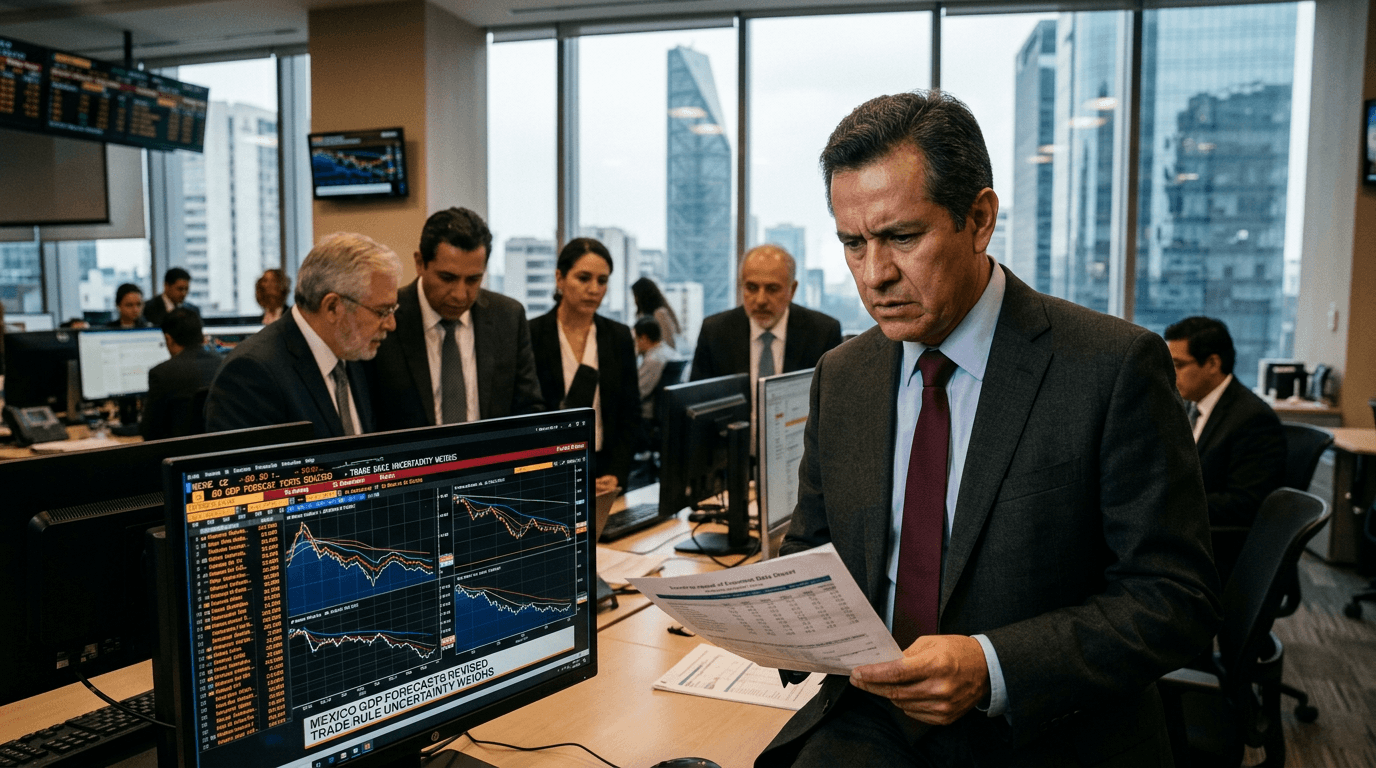
Mexico’s growth outlook is being downgraded again, and this time the driver is clear: uncertainty over trade rules with the United States is starting to bite into investment, confidence, and the Mexican peso’s appeal to global investors.[13] A fresh Reuters poll shows economists now expect the economy to grow more slowly this year and next than they previously projected, underscoring how trade-related risks are reshaping the narrative around one of emerging markets’ most watched stories.[13]
Shifting Growth Expectations
According to a Reuters survey of 32 economists conducted in mid-July, Mexico’s gross domestic product (GDP) is now expected to expand by just 1.1% in 2026 and 1.8% in 2027, both lower than earlier forecasts.[13] The poll explicitly links these downgrades to concerns over trade rules with the United States, which are seen as eroding investment and weighing on the broader outlook.[13]
These revisions are not happening in isolation. Over recent months, a series of multilateral institutions and private forecasters have trimmed their Mexico projections, pointing to a pattern rather than a one-off reassessment. The International Monetary Fund now sees Mexico growing just 1.2% in 2026, down from 1.6% in its April report.[3] The World Bank has also lowered its forecasts, projecting 1.7% growth this year, 1.5% in 2025, and 1.6% in 2026, each about 0.6 percentage points below its previous estimates.[10]
Some recent updates have been even more pessimistic. In a separate report, the World Bank warned of “stagnation” in 2025, cutting its forecast to 0% growth and trimming 2026 to 1.1%, while noting that the current environment is marked by the highest levels of trade uncertainty in a decade.[8] The OECD has similarly cut its 2026 growth outlook from 1.3% to 0.8%, citing economic policy uncertainty, trade tariffs, and fiscal consolidation.[9] Together, these revisions indicate that slower growth is becoming the base case rather than a tail risk.
Trade Rule Uncertainty And Investment
Why are trade rules so central to Mexico’s growth story? The country’s economy is deeply integrated with the United States through the USMCA (United States–Mexico–Canada Agreement), with manufacturing, autos, and cross-border supply chains heavily dependent on predictable access to the U.S. market. When that predictability is called into question, both domestic and foreign investors tend to pause, delay, or re-scale projects.
Economists in the latest Bank of Mexico survey have flagged strained trade relations and industrial contraction as key pressures on the outlook.[7] Private-sector forecasts for 2025 growth have fallen to just 0.41% in that survey—down sharply from earlier expectations above 2% and marking the fourth consecutive downgrade since early 2024.[7] Several major institutions now even pencil in zero growth for 2025, citing weak manufacturing output and a steep 8.7% collapse in construction activity at the start of the year.[7]
International institutions echo this link between trade uncertainty and investment. The World Bank’s Latin America chief economist has attributed lower growth forecasts in part to investor uncertainty, alongside high interest rates and a weaker peso.[10] In its stagnation scenario, the World Bank explicitly notes that sequential contractions in late 2024 and early 2025 have already begun to dent confidence, with GDP falling on a quarter-on-quarter basis and headwinds building.[8]
For businesses operating in Mexico—or allocating capital to Mexican assets—this means the hurdle rate for new investment is rising. Decisions that depended on stable trade rules, especially in export-oriented sectors, are now being revisited. Even in a world of nearshoring interest, where companies want production closer to the U.S., clarity on future rules is becoming the critical variable.
Implications For The Mexican Peso And Em Assets
A softer growth trajectory has immediate implications for the Mexican peso (MXN), sovereign debt, and broader emerging market (EM) assets tied to Mexican risk. The Reuters poll notes that the downgrade is relevant for EM foreign exchange and sovereign debt, with weaker growth prospects likely to weigh on the peso and prompt repricing of growth-sensitive assets and futures linked to Mexico.[13]
The currency already faces a more challenging environment. The World Bank has highlighted a weaker peso and high domestic interest rates as part of the mix behind its more pessimistic outlook.[10] Slower growth can undermine one of the key supports for MXN: the perception that Mexico offers a combination of yield and robust real activity. If growth decelerates while trade uncertainty persists, investors may demand higher risk premia to hold Mexican assets, potentially widening sovereign spreads and increasing volatility in EM FX baskets.
Private forecasters are adjusting to this reality. Bank of America has cut its forecast for Mexico’s 2026 GDP growth to 0.8% from 1.3%, following a sharper-than-expected contraction in the first quarter.[11] Official data show GDP fell 0.8% quarter-on-quarter between January and March, the largest decline since late 2024.[14] Such negative surprises can rapidly shift positioning in currencies and local rates, especially when they confirm a narrative of weakening momentum.
For traders, this backdrop changes the character of the peso from a pure carry play to a more event-driven asset. Headlines about trade negotiations, tariff threats, or USMCA review milestones may now move the currency as much as domestic macro data releases.
What Traders And Investors Should Watch
For market participants—whether trading live capital or using SimFi platforms to test strategies—Mexico’s evolving outlook offers several practical lessons.
First, growth forecasts matter because they shape expectations for policy, currency behavior, and credit risk. Repeated downward revisions from institutions like Banxico, the IMF, the World Bank, and the OECD signal that the balance of risks is skewed toward weaker activity.[3][5][8][9][10] In such environments, traders should be cautious about extrapolating past performance of MXN or Mexican equities without accounting for new macro constraints.
Second, trade news has become a macro catalyst. The Reuters poll explicitly links the latest forecast cuts to trade rule concerns with the United States.[13] This means that tracking developments around USMCA, discussions on rules of origin, and potential sector-specific tariffs is now part of core macro analysis for Mexican risk. Headlines that clarify or worsen the outlook for these rules can affect investment flows, earnings expectations, and risk sentiment in EM FX.
Third, the interaction between growth and monetary policy needs attention. Slower activity and rising uncertainty can push Banxico toward a more accommodative stance, as some private forecasts already anticipate modest rate cuts following weak data.[11] A more dovish central bank can support growth but may also reduce yield appeal, forcing traders to reassess carry strategies versus risk premia.
Longer-term Scenarios For Mexico
Despite the weaker near-term outlook, Mexico still sits at the intersection of several powerful structural themes: nearshoring, energy transition, and demographic stability. The key question is whether trade rule uncertainty proves to be a temporary drag or a lasting structural constraint.
In a benign scenario, ongoing negotiations and reviews yield clearer, stable rules that reassure investors. Under that path, some of today’s delayed projects could restart, allowing growth to recover from the 1–2% range back toward a more robust trajectory as confidence improves and global supply chains continue shifting toward North America.
In a more adverse scenario, however, prolonged uncertainty, higher tariffs, or contentious trade disputes could entrench lower investment and keep GDP growth closer to the modest levels now being forecast for 2025–2027.[8][9][13] For EM investors, this would mean treating Mexico less as a growth leader and more as a low-growth, policy-sensitive market where risk premium and timing become central.
For traders and portfolio managers, the takeaway is clear: Mexico’s story is no longer just about nearshoring and carry. It is increasingly about how quickly policymakers and negotiators can restore clarity on trade rules—and whether investors believe that the resulting framework supports a sustainable growth path. In the meantime, simulated trading and careful scenario analysis can help market participants navigate a landscape where policy headlines and growth revisions are likely to remain key drivers of Mexican asset prices.