
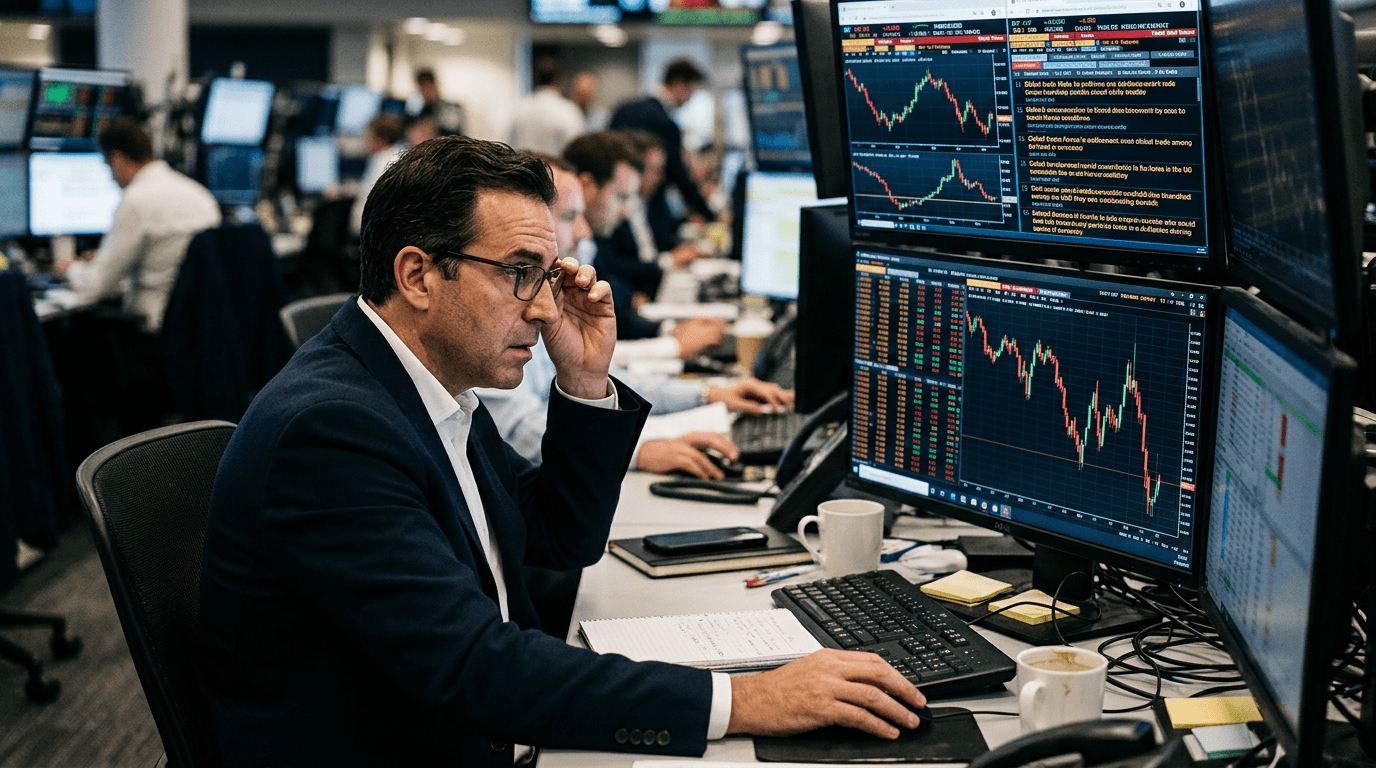
Trade headlines are back in the driver’s seat, and markets are behaving like it. Ongoing tariff talk and trade-policy uncertainty—especially around the US–China relationship—are keeping global risk sentiment fragile, with traders cutting back on aggressive positions and leaning more on safe havens and volatility hedges while they wait for clearer policy signals.[3][1] For active FX and futures traders, this environment is less about predicting the next headline and more about understanding how trade tensions systematically shape flows, sentiment, and price action.
Why Trade Tensions Matter For Risk Sentiment
Tariffs are not just a tax on imports; they are a tax on certainty. When major economies threaten or implement new trade barriers, businesses struggle to plan investment, supply chains are disrupted, and corporate earnings visibility drops.[5][6] That uncertainty tends to weigh on global growth expectations, which in turn suppresses risk appetite in equities, credit, and pro‑cyclical currencies.[1][5]
Historically, episodes of escalating tariffs have coincided with spikes in market volatility and sharp drawdowns in equity benchmarks.[1][4] The risk is not only the immediate economic hit but also the potential for a broader “trade war” that fragments global supply chains and pushes up costs across industries.[6] When traders cannot easily quantify the ultimate economic impact, they compensate by reducing risk and demanding a higher premium to hold volatile assets.
This is why even relatively small policy headlines—an unexpected tariff announcement, a stalled negotiation, a new export restriction—can trigger outsized reactions. The news serves as a signal about the trajectory of globalization: toward more openness, or toward more protectionism.[6] In the current environment, markets are reading the signal as “uncertain,” and that alone is enough to keep risk-taking in check.
Key takeaway: Trade tensions depress risk sentiment not only through actual tariffs, but through the uncertainty they inject into growth, earnings, and policy trajectories.[1][5]
How Tariff Jitters Flow Through Fx And Futures
While equity markets often grab the headlines, the most immediate and nuanced reactions to trade news frequently show up in FX and futures.
In FX, currencies of export‑dependent and emerging economies tend to feel the pressure first when tariff risk rises.[6] A perceived slowdown in global trade can weigh on currencies linked to manufacturing and commodity exports, while relatively safer currencies—like the US dollar, Japanese yen, and Swiss franc—often attract inflows as investors de‑risk.[2][3] The pattern is not perfect, but the logic is consistent: trade‑sensitive currencies price in weaker external demand and capital outflows, while safe havens benefit from a “flight to quality.”
In futures markets, trade headlines influence both index and sector positioning. Equity index futures may see selling pressure when investors anticipate lower earnings and tighter margins due to tariffs.[1][4] Sector futures linked to industrials, autos, and semiconductors can be especially sensitive because their supply chains are deeply global.[6] At the same time, volatility futures and options—such as VIX futures—often see increased demand as traders seek cheap convexity ahead of potential policy surprises.
On the rates side, trade worries can support government bond futures as investors rotate into perceived safety, pushing yields lower.[3] This can flatten yield curves if the market believes trade tensions will drag on growth and eventually push central banks toward easier policy.
Key takeaway: FX and futures markets tend to react first and most cleanly to trade headlines, making them a critical risk‑sentiment dashboard for active traders.[2][3][6]
Safe-haven Flows And Volatility Hedges
When trade tensions rise, market behavior tends to cluster around two themes: safe‑haven flows and volatility demand.
Safe‑haven assets—such as US Treasuries, German Bunds, the Japanese yen, and often gold—usually see inflows as investors unwind high‑beta positions.[2][3] During previous tariff flare‑ups, global stocks have sold off while government bonds and gold have rallied, reflecting a broad de‑risking of portfolios.[1][4] These flows are not only defensive; they can also be opportunistic, as macro traders look to profit from widening growth and policy divergences across regions.
At the same time, volatility becomes valuable. When policy is predictable, traders are comfortable selling volatility to generate income. When policy becomes erratic and headline‑driven, demand shifts toward buying volatility as protection—or as a directional play on future market swings.[3][5] This is especially evident in FX options and equity index options, where implied volatility often rises beyond what recent price action alone would justify.
For intraday and swing traders, this means price moves can become more jagged, with more frequent stop‑outs around data releases, press conferences, and unscheduled headlines. Liquidity can thin out during these moments, amplifying the impact of orders and increasing slippage.
Key takeaway: In a tariff‑driven market, expect stronger flows into safe havens and higher demand for volatility, which can both reshape intraday dynamics and medium‑term trends.[1][3][5]
How Traders Can Navigate A Tariff-driven Tape
You cannot predict every trade headline, but you can design a process that respects the regime you are trading in.
First, tighten your focus on the key policy catalysts. Trade‑related press conferences, tariff deadlines, and major bilateral meetings should be on every trader’s calendar. Treat these events like high‑impact data releases, with position sizing, leverage, and stop placement adjusted accordingly.
Second, adapt your risk management to higher headline risk. This might mean: - Using smaller position sizes around known event risk - Widening stops but reducing leverage to avoid getting whipped out by noise - Considering options or structured hedges to cap downside during uncertain periods
Third, lean on cross‑asset confirmation. If equities are weak on trade worries but safe‑haven currencies and bond yields are not confirming the move, the risk‑off impulse may be temporary. Conversely, when FX, equities, credit, and rates all align in a risk‑off or risk‑on direction, it strengthens the signal and can justify more conviction.
For traders using simulated environments, tariff‑driven markets are a powerful classroom. A SimFi setup allows you to stress‑test strategies across different volatility regimes, study how correlation structures change when trade tensions flare, and refine your event‑risk playbook without putting capital at risk.
Key takeaway: Treat trade tension as a risk regime, not a one‑off headline—then build your calendar, risk sizing, and cross‑asset checks around that regime.
What To Watch Next
Looking ahead, the evolution of trade policy will continue to be a central driver of global risk sentiment. The big questions for markets include: - Will tariff measures broaden into a more systemic shift toward protectionism, or remain targeted and negotiable?[6] - How will multinational companies respond in terms of reshoring, supply‑chain diversification, and capital spending?[5][6] - Do central banks lean more dovish if trade tensions begin to erode growth and business confidence, or do they remain focused on inflation first?[3]
For traders, the key is to track not only the announcements themselves but the second‑order effects: changes in earnings guidance, trade volumes, manufacturing surveys, and corporate investment plans.[1][5] These data points help distinguish between noise and structural change.
As long as tariffs and trade policy remain uncertain, markets are likely to stay cautious, with quick transitions between risk‑on and risk‑off as headlines hit the tape. Those who understand how these dynamics filter through FX, futures, and volatility will be better positioned to navigate the swings with discipline rather than emotion.
Key takeaway: Trade and tariff policy are now core macro variables—build them into your ongoing market framework, not just your newsfeed.