
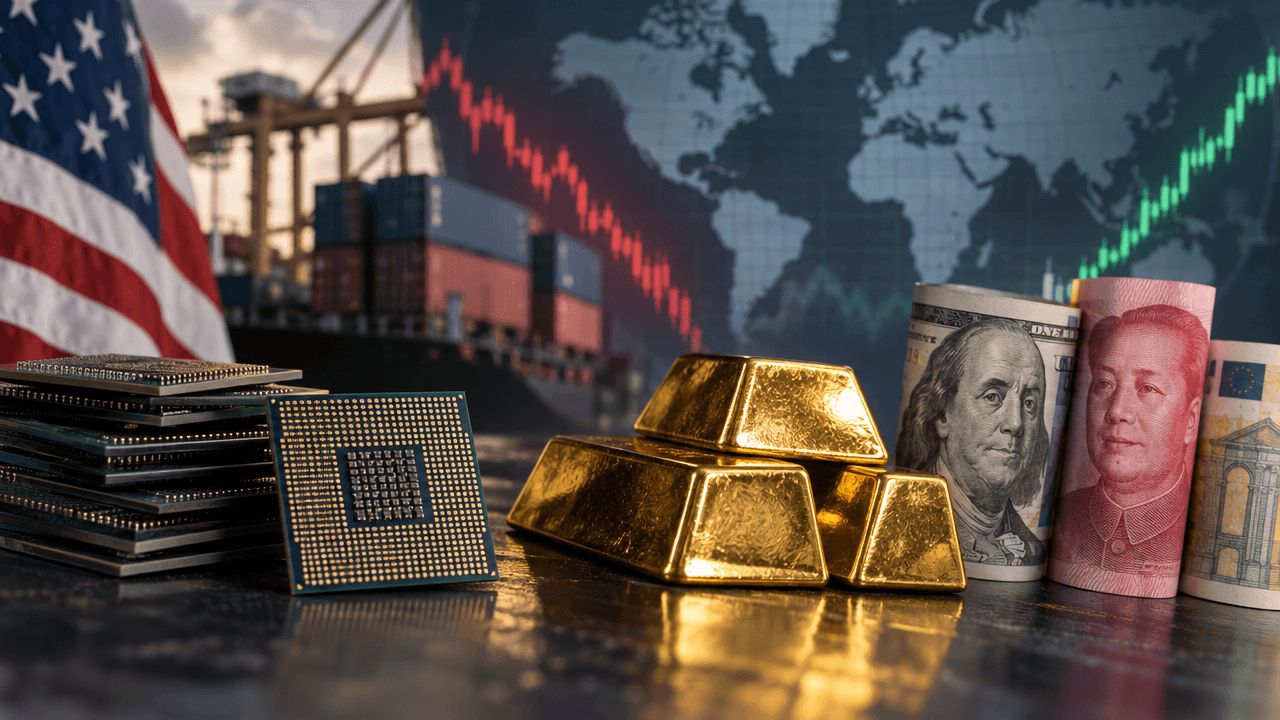
Us-china Trade Tensions Pressure Stocks And Lift Safe Havens
Financial markets are once again being forced to price a more complicated relationship between the world’s two largest economies. New US restrictions on advanced chip sales to China, combined with continuing uncertainty over tariffs, have pressured global equities and increased demand for defensive assets. Technology shares have absorbed much of the immediate damage, while gold has climbed to record levels and the US dollar has weakened in related trading. [1]
The reaction highlights how trade policy can quickly move beyond customs duties. Restrictions on critical technology affect corporate revenues, supply chains, investment plans and national security strategies. For traders, the latest developments offer a useful lesson: geopolitical headlines can change the market’s leadership, volatility and correlations in a matter of hours.
Technology Shares Face A Direct Hit
Semiconductor and artificial-intelligence stocks are particularly sensitive because their valuations depend partly on continued access to large international markets. China is a major customer for many technology companies, while US firms and their allies remain important suppliers of advanced chips, manufacturing equipment and software.
When Washington tightens export controls, investors must reassess how much revenue companies can generate in China and whether restrictions could spread to additional products. Chinese AI and semiconductor shares have already come under pressure as investors consider the possibility of tighter access to advanced US chips. [3] US-listed companies may also face risks if Beijing responds with its own restrictions, procurement limits or regulatory measures.
The uncertainty can affect companies that are not directly named in a new policy. Chip equipment manufacturers, cloud-computing businesses, electronics producers and logistics firms may all be exposed through customers or suppliers. That is why a trade announcement can weigh on a broader technology index rather than only on the companies at the center of the dispute.
For traders, the practical takeaway is to look beyond headline exposure. Review a company’s geographic revenue, supplier concentration, inventory levels and ability to substitute restricted products. A strong earnings history does not eliminate the risk created by a sudden change in market access.
Tariff Uncertainty Raises The Cost Of Risk
Tariffs create uncertainty because markets must estimate not only the size of a possible tax, but also its timing, duration and eventual targets. Businesses may delay capital spending, build precautionary inventories or pass higher costs to customers. Each response can influence margins, inflation expectations and economic growth.
The recent market response was intensified by uncertainty over the future direction of US-China trade policy. Although China has extended the suspension of an additional 24% tariff on some US goods while retaining a 10% rate, the partial relief has not removed the risk of renewed escalation. [5] Investors are therefore treating temporary concessions as a pause rather than a permanent settlement.
Industrial commodities can feel this pressure quickly. Copper and other economically sensitive materials are closely watched as indicators of manufacturing and construction demand. If companies postpone investment or global trade slows, demand expectations may weaken. At the same time, tariffs can raise the cost of physical goods, producing a difficult combination of slower growth and higher prices.
This creates a challenging environment for central banks and equity investors. A weaker economy normally argues for easier policy, but tariff-driven inflation can make policymakers more cautious. Traders should monitor inflation data, purchasing-manager surveys, freight activity and corporate guidance for evidence that policy uncertainty is affecting real economic activity.
Why Gold Is Attracting Buyers
Gold’s rally reflects the classic safe-haven response to political and economic uncertainty. In the reported move, bullion reached a record high near 3,339 dollars per ounce and gained 3.5% during the session. Analysts also raised forecasts as investors sought protection from trade conflict and broader market instability. [1]
Gold can benefit from several forces at once. Investors may buy it when they want to reduce equity risk, when they are concerned about currency stability or when lower confidence in economic policy increases demand for assets without a corporate issuer. A weaker dollar can provide an additional lift because gold is priced in dollars and becomes less expensive for buyers using other currencies.
However, traders should avoid treating a record price as a guaranteed one-way opportunity. Gold can decline if interest rates rise sharply, the dollar strengthens or diplomatic tensions ease. Position size, entry discipline and an awareness of volatility remain essential, especially after a rapid rally.
The Dollar And Asian Currencies
The dollar’s response is equally important because it influences global financing conditions and the value of commodities. Recent related coverage reported a 0.7% decline in the US Dollar Index to its lowest level since April 2022, suggesting that investors were cautious about US assets despite the currency’s traditional safe-haven reputation. [1]
A weaker dollar can support emerging-market assets and dollar-denominated commodities, but it may also increase pressure on countries that rely heavily on imported energy, food or technology. Asian currencies are especially sensitive to the outlook for Chinese demand, regional exports and capital flows. If investors reduce exposure to Asian equities, they may also sell local currencies, increasing volatility.
The market impact will depend on whether the tensions remain limited to selected technologies or spread across broader trade categories. A contained dispute may produce short-lived sector rotation. A wider escalation could create simultaneous pressure on equities, commodities, currencies and corporate investment.
What Traders Should Watch Next
Traders should build a scenario-based framework rather than react to every headline. In a de-escalation scenario, technology shares and Asian currencies could recover, while gold may surrender part of its risk premium. In a prolonged restriction scenario, semiconductor stocks may remain volatile and defensive assets could retain support. In a broad tariff escalation, industrial commodities and cyclical equities could face additional downside.
Key indicators include official tariff announcements, export-license decisions, company guidance, semiconductor orders, the dollar index, gold prices and credit-market conditions. It is also useful to compare price action with trading volume. A sharp decline on heavy volume may indicate broad institutional repositioning, while a smaller move on light volume may reflect temporary headline trading.
The central lesson is that trade tensions are not simply a political story. They influence earnings, supply chains, inflation, currencies and investor psychology at the same time. In the current environment, disciplined risk management matters more than making a confident prediction. Traders who diversify exposure, define invalidation levels and distinguish confirmed policy from speculation will be better prepared for the next market move.