
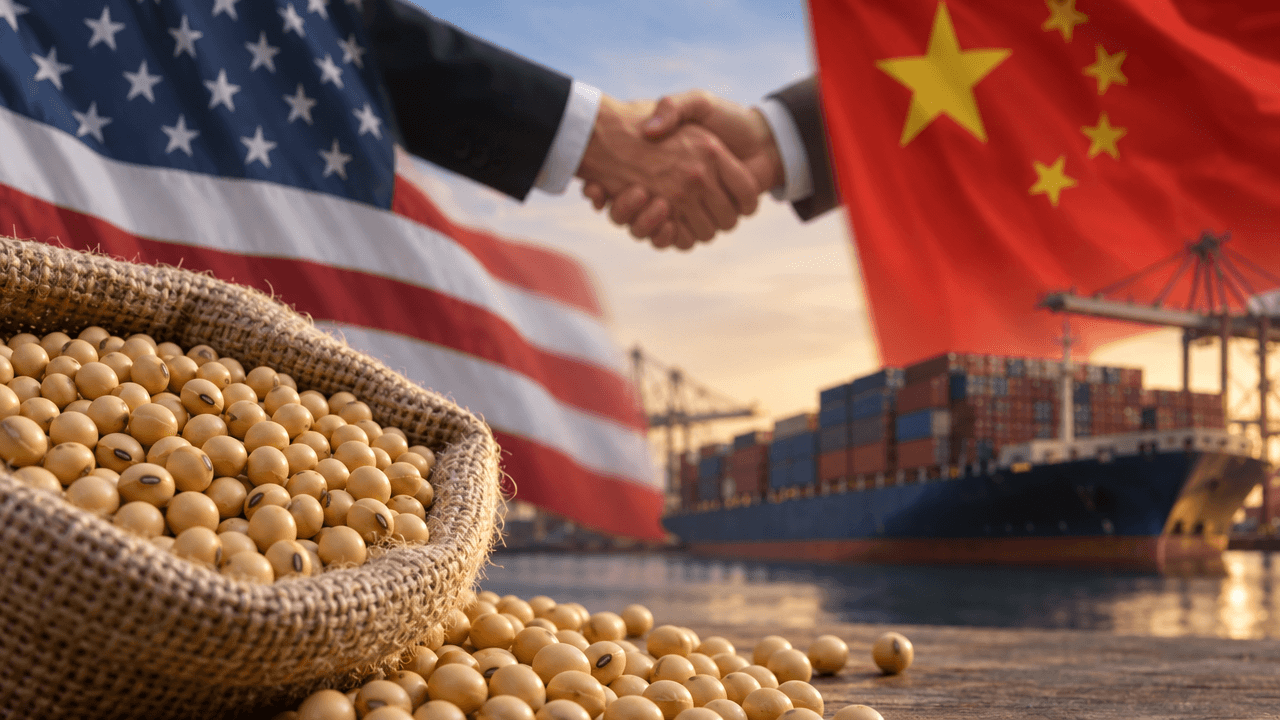
The latest U.S.-China summit delivered a modest win for stability but left agricultural markets wanting more. Washington and Beijing agreed to extend their existing trade truce by two months, pushing the deadline for potential new tariffs out to January 10, 2027, but stopped short of announcing fresh Chinese commitments to buy additional U.S. soybeans. This combination of reduced headline risk and limited new demand has important implications for traders across both real and simulated markets.
Trade Truce: What Exactly Was Extended
The current arrangement, often referred to as the Busan Agreement, had been scheduled to expire on November 10, 2026, before officials confirmed its extension to January 10, 2027[1][5][9]. The truce keeps existing tariff levels in place and pauses new punitive measures while negotiators explore a broader economic deal between the world’s two largest economies[5][10]. Practically, that means exporters and importers avoid a near‑term “tariff cliff,” buying time for supply chains to plan shipments and contracts[9][12]. For markets, this reduces the immediate probability of a shock re-pricing driven by sudden tariff hikes, especially in sectors like agriculture, energy, and industrial metals[9][10]. However, an extension is not a resolution; it merely pushes the decision point into early 2027, keeping a latent volatility event on the calendar[9][13].
Why Soybeans Matter More Than The Headline Suggests
Soybeans sit at the heart of U.S.-China agricultural trade, both as a key feed input for China’s livestock industry and a cornerstone export for American farmers[2][15]. Past deals between the two countries have included specific tonnage targets, such as pledges for China to buy at least 25 million metric tons of U.S. soybeans annually alongside broader commitments for $17 billion in farm goods[2][15]. Heading into this summit, U.S. growers and industry groups were explicitly pushing for additional concrete purchase commitments to support prices and provide demand certainty[2]. Instead, the extension of the truce arrived without any major new soybean purchase announcements, leaving the existing commitments intact but offering no incremental demand boost[2][15]. For the soybean complex, this outcome is “status quo plus time” rather than a genuine step-change in fundamentals.
From a trading perspective, that distinction matters. A large, quantified new buying program from China would be a clear bullish catalyst for U.S. soybean futures, basis levels, and related spreads. In contrast, an extension with no extra tonnage simply preserves current expectations. It reduces downside risk tied to tariffs but does not add upside via new consumption. That nuance helps explain why the news has had a limited positive impact on agricultural futures so far, with traders treating it more as a relief from worst-case scenarios than as a fresh demand story[2].
Market Reaction And What Traders Are Pricing In
Because the truce delays rather than resolves key trade questions, price action in agricultural futures is likely to reflect a balance between short-term relief and medium-term uncertainty. Near term, the removal of an immediate tariff threat typically supports risk assets linked to cross-border flows, including soybeans and other U.S. farm exports, by trimming tail risk around sudden policy shocks[9][10]. That can lead to modest short-covering, reduced implied volatility, and a more orderly term structure in futures curves.
However, with no new Chinese soybean commitments announced, speculative positioning is unlikely to swing aggressively bullish on fundamentals alone. Traders still face the possibility that negotiations could stall before January, that tariffs could snap back if talks sour, or that China could diversify sourcing away from the U.S. over time. In practice, this environment favors more nuanced strategies: spread trading between soybeans and alternative oilseeds, relative value plays across U.S. and Brazilian origins, and option structures that express views on volatility around the January deadline.
For E8 Markets’ SimFi traders, this is a textbook scenario for stress-testing trade ideas. Simulated trading allows users to model how soybean futures, related ETFs, and currency pairs like USD/CNY might behave across different policy paths—extended truce, partial deal, or renewed tariffs—without risking real capital. By comparing P&L outcomes under multiple trade-war scenarios, simulated portfolios can help sharpen decision-making and risk management ahead of actual market moves.
Using Simulated Finance To Navigate Policy Risk
Policy-driven markets can be tricky even for experienced traders because catalysts are binary, timing is uncertain, and information flow is highly political. Simulated Finance platforms such as E8 Markets give traders a controlled environment to build and test rule-based approaches to these situations. For example, a trader could design a playbook that:
1) Reduces position size as key political dates (like January 10) approach and volatility picks up.
2) Uses options in simulation to cap downside while preserving upside if a more favorable trade deal emerges.
3) Diversifies exposure by combining soybean futures with correlated assets such as corn, wheat, or agribusiness equities, then observing how the basket behaves under different trade headlines.
4) Runs scenario backtests where tariffs are reinstated versus fully rolled back, mapping out drawdowns and maximum adverse moves.
By practicing these strategies in a simulated environment first, traders can identify weak points in their logic, refine entry and exit criteria, and understand how macro news interacts with technical signals. That preparation becomes crucial when real-world policy news hits and markets start repricing in minutes rather than days.
Key Takeaways For Traders And Investors
First, the extension of the U.S.-China trade truce to January 10, 2027 is a genuine reduction in near-term risk, but it is not an all-clear signal for global markets[1][5][9]. Second, the absence of new Chinese soybean purchase commitments means the agricultural complex gets stability rather than fresh demand; soybeans may see less downside from tariffs, but they do not receive a strong new upside catalyst[2][15]. Third, traders should treat the January deadline as a key event risk date and plan positioning, hedges, and liquidity needs accordingly.
Finally, simulated trading offers a practical way to transform headline risk into structured, testable strategies. By treating the current truce as one node in a branching scenario tree, traders can use SimFi tools to practice how they would respond to a range of outcomes—from incremental farm purchase deals to renewed tariff escalations. The more thoroughly those scenarios are explored in simulation now, the more confidently traders can act when the next round of U.S.-China trade headlines hits the tape.
In short, this trade truce extension is an important—but not decisive—development. It buys time, calms nerves, and keeps channels open, yet leaves the core soybean demand story largely unchanged. For thoughtful traders, that gap between political stability and fundamental inertia is not a frustration; it is an opportunity to refine strategy, manage risk, and prepare for the next chapter of U.S.-China trade negotiations.