
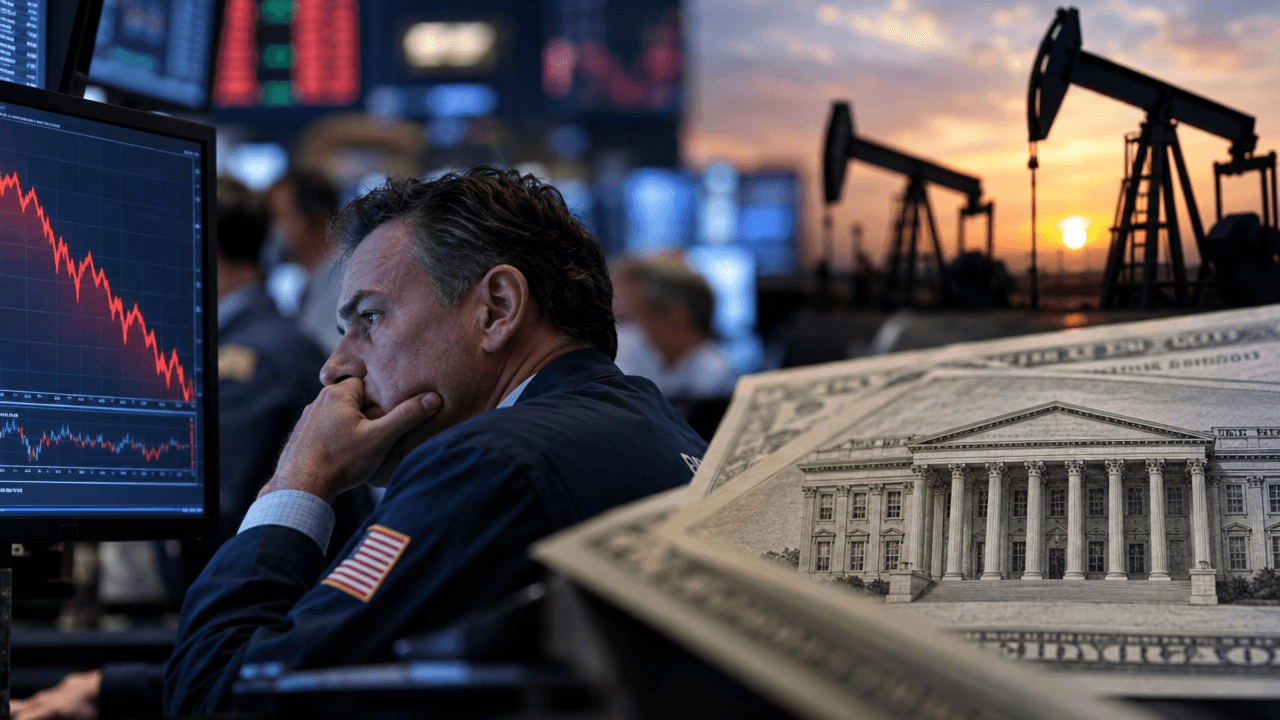
US Treasury yields fell sharply as investors moved toward the perceived safety of government bonds, highlighting how quickly market sentiment can change when stock valuations, inflation risks, and geopolitical uncertainty collide. The benchmark 10-year Treasury yield dropped below 5%, while short-term yields declined by as much as 20 basis points. The move followed a steep technology-stock sell-off and renewed concerns that higher oil prices could intensify inflationary pressure. [2][8]
For traders, the decline is more than a headline about bond prices. It is a signal that investors are reassessing economic growth, Federal Reserve policy, and the durability of the market’s enthusiasm for artificial intelligence. Understanding the mechanics behind the move can help traders interpret similar risk-off events in the future.
Why Treasury Yields Fell
Bond prices and yields move in opposite directions. When investors buy Treasury securities, demand pushes their prices higher and their yields lower. That is what happened as market participants reduced exposure to riskier assets and sought the relative stability of US government debt.
The 10-year yield fell more than 17 basis points to approximately 4.972%, marking its first move below 5% since September 23. It also represented the largest one-day decline in the 10-year yield since March 2023. The two-year yield, which is especially sensitive to expectations for Federal Reserve interest-rate policy, fell more than 16 basis points to roughly 4.659%. [2]
The move across both short- and long-term maturities suggests that investors were responding to several forces at once. The drop in shorter-term yields indicated reduced expectations for future policy tightening, while demand for longer-term bonds reflected concern about growth and a broader preference for safety.
Technology Losses Trigger A Risk-off Rotation
Technology stocks were at the center of the market decline. Investors have become increasingly focused on the enormous capital required to build artificial intelligence infrastructure and whether future earnings will justify that spending. When doubts about expected returns grow, richly valued technology companies can experience sharp losses because their share prices often depend heavily on optimistic forecasts of future growth.
The resulting rotation was straightforward: investors sold portions of their equity holdings and redirected capital toward bonds. This kind of risk-off behavior can occur even when there is no immediate threat to the financial system. Markets only need a change in expectations to produce significant price movements.
The relationship between technology stocks and Treasury yields is also important. Higher yields can reduce the present value of future corporate earnings, placing additional pressure on growth-oriented companies. Conversely, a sharp stock-market decline can increase demand for bonds, pushing yields lower. That creates a feedback loop in which equity weakness and falling yields reinforce one another during periods of heightened uncertainty.
Oil Prices Complicate The Inflation Outlook
The bond rally came despite a significant challenge: rising oil prices. West Texas Intermediate crude futures closed up 2.39% at $99.47 per barrel, adding to concerns that energy costs could keep inflation elevated. [2]
Higher oil prices can affect the economy in several ways. They directly raise costs for fuel, transportation, and energy-intensive businesses. They can also influence consumer expectations and encourage companies to pass higher operating expenses on to customers. If that pressure persists, the Federal Reserve may find it more difficult to reduce interest rates.
This creates a complicated market environment. Oil-driven inflation would normally place upward pressure on bond yields because investors might expect interest rates to remain higher for longer. However, if the same oil surge contributes to weaker consumer spending and slower economic growth, investors may instead buy Treasuries as a defensive asset. The sharp decline in yields suggests that immediate concerns about risk and growth outweighed the inflationary implications of higher energy prices.
What Traders Should Watch Next
The next stage of the market reaction will depend on whether the Treasury rally broadens or reverses. Traders should monitor the 10-year yield around the 5% level, where a sustained break lower could signal that markets are assigning greater weight to slowing growth. A move back above that threshold could indicate renewed inflation concerns, stronger economic expectations, or reduced demand for safe-haven assets.
The two-year yield is equally important. Because it tracks expectations for Federal Reserve policy more closely, further declines could suggest that investors are reducing expectations for additional rate increases. At the same time, a rise in short-term yields alongside falling long-term yields would create a flatter yield curve and could point to increasing concern about policy remaining restrictive.
Equity-market breadth should also be monitored. If losses remain concentrated in speculative technology and artificial intelligence shares, the move may represent a targeted valuation reset. If weakness spreads to banks, industrial companies, retailers, and smaller firms, it would suggest a broader deterioration in economic confidence.
For SimFi traders, this environment offers a valuable practical lesson. Avoid treating a falling yield as automatically bullish or bearish for every asset. Lower yields can support rate-sensitive sectors, but they may also reflect fear about economic conditions. The context matters more than the direction alone.
A disciplined approach involves identifying the catalyst, comparing moves across the yield curve, and observing whether stocks, commodities, and currencies confirm the same narrative. Traders should also define risk before entering positions, since safe-haven rallies can reverse quickly when headlines change.
Conclusion
The sharp fall in US Treasury yields reflects a powerful shift toward safety after technology-stock losses and renewed oil-driven inflation concerns. The 10-year yield’s move below 5% and the large decline in short-term yields show that investors are reassessing both economic growth and the future path of monetary policy.
For markets, the key question is whether this is a temporary defensive rotation or the beginning of a broader repricing of risk. Traders who track bond yields alongside equities, oil, and Federal Reserve expectations will be better positioned to distinguish a short-lived volatility event from a more meaningful change in market direction.