
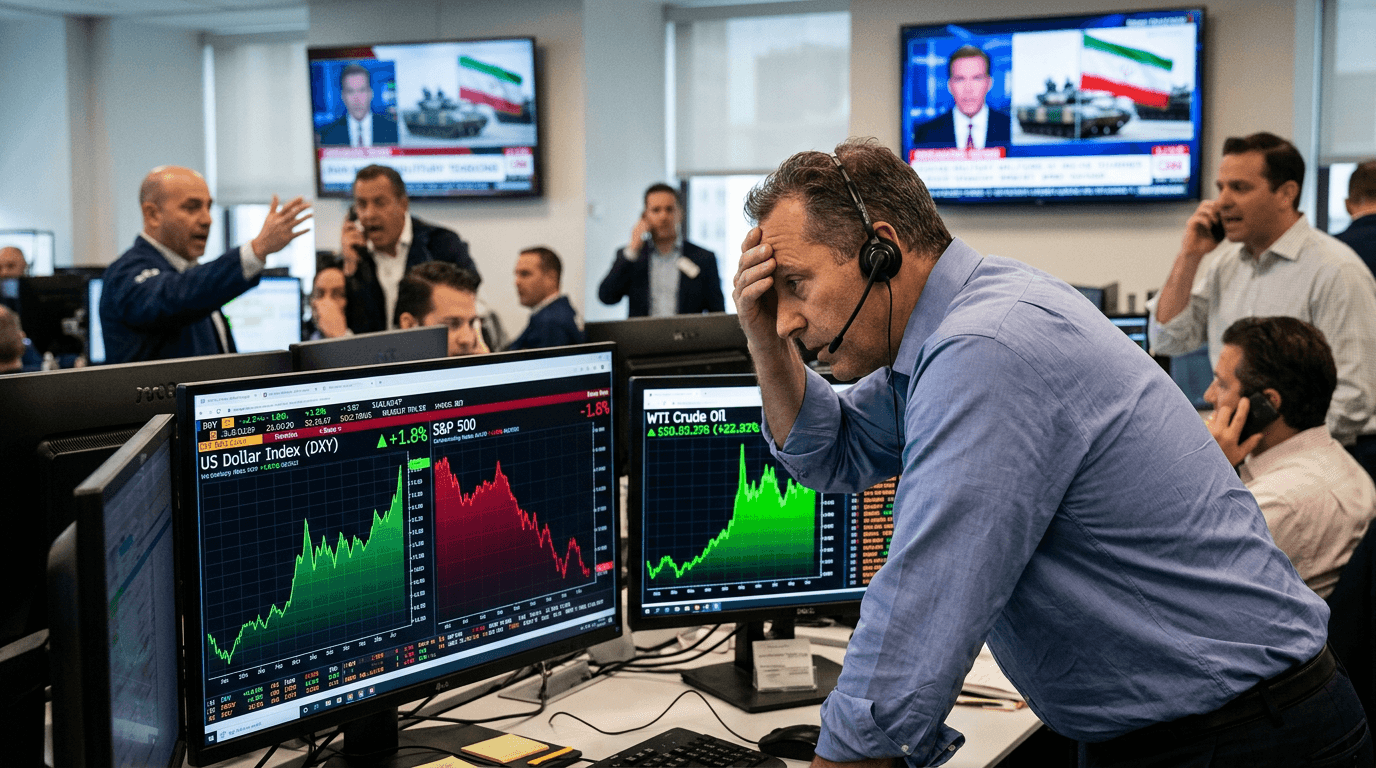
When geopolitical tensions rise, investors often seek refuge in a dependable stronghold: the US dollar. This week, as former President Donald Trump signaled a more assertive military approach toward Iran, the currency and commodity markets provided a textbook demonstration of risk-off trading. The dollar soared, energy prices climbed, and equities faltered, as market participants adjusted their expectations for global stability and economic growth. Understanding this market dynamic is essential for traders navigating an increasingly uncertain landscape dominated by geopolitical factors rather than traditional economic indicators.
The Dollar's Ascent To Safety
The numbers paint a vivid picture. The US Dollar Index surged 1.8% over a 48-hour span following Trump's statements, with the greenback gaining strength against nearly all major currencies. Interestingly, the dollar even outperformed traditional safe-haven currencies like the Swiss franc and Japanese yen, rising 0.6% against the franc and advancing 0.5% against the yen, nearing the psychologically significant 160 level. This widespread dollar strength signals a fundamental shift in market sentiment as investors move away from risk assets toward more secure options.
The mechanism behind this surge is simple yet powerful. During times of geopolitical uncertainty, capital flows toward assets perceived as stable and liquid. As the world's primary reserve currency, the US dollar benefits from this classic flight-to-safety behavior. Beyond sentiment, structural factors enhance the dollar's appeal. The Federal Reserve's current monetary policy stance, the relative strength of the US economy, and the petrodollar system all contribute to the dollar's dominance during crises. Oil transactions predominantly take place in dollars, creating automatic demand during energy market disruptions.
Geopolitical Tensions Reshape Market Landscape
Trump's televised address on Iran significantly altered market expectations. Instead of signaling a path toward de-escalation, the president pledged more aggressive actions against Iran over the next two to three weeks, without offering a concrete timeline for reopening the Strait of Hormuz, a critical waterway through which roughly 20% of the world's oil shipments pass. This messaging dashed investor hopes for a swift resolution to the conflict, triggering immediate repricing across various asset classes.
The geopolitical context is critical. Global intelligence agencies have reported increased military readiness in the region, and Iran has responded with warnings of broader and more destructive retaliation. Market strategists emphasize that the outlook now heavily depends on perceptions of how long the conflict will last and whether escalation will persist. This uncertainty creates an ideal environment for safe-haven demand, as investors grapple with pricing scenarios when the duration and scope of conflict remain unclear.
Market Ripple Effects
The impact reached beyond currency markets. Oil prices soared, with Brent crude futures rising approximately 8% to $109.10 per barrel, driven by concerns about sustained supply disruption through the strategic Strait of Hormuz. Energy markets, closely tied to Middle East stability, responded sensitively to any escalation signals.
Equity markets experienced selling pressure, particularly in Europe and Asia, as investors shifted away from cyclical and growth-oriented positions. Cryptocurrency markets also faced pressure, with Bitcoin falling about 1.7% to just above $67,000 and Ethereum dropping nearly 4% to around $2,058. Notably, defense and cybersecurity sectors attracted inflows, reflecting investor positioning for prolonged tensions.
Central banks now face increasingly complex policy decisions. The European Central Bank, for instance, must balance inflation concerns from higher energy prices against the economic drag of uncertainty and a stronger dollar making exports less competitive. This policy dilemma illustrates how geopolitical events ripple through the global financial system, affecting monetary policy, investment allocation, and growth forecasts.
Implications For Traders
For traders monitoring market technicals, a sustained break above the 105.50 level on the Dollar Index could indicate further bullish momentum for the greenback. Currency strategists suggest that the dollar could "definitely increase further from here against all the major currencies" as markets recognize that global economic growth may slow significantly. This creates potential trading opportunities in currency pairs, particularly those involving the dollar against growth-sensitive currencies like the Australian dollar or emerging market currencies.
However, traders should stay vigilant to mixed signals. Trump's own statements, which suggest that the Iran conflict could conclude within two to three weeks, have introduced volatility and uncertainty into the narrative. Markets remain in price-discovery mode, trying to reconcile aggressive military rhetoric with hints of potential resolution. This uncertainty presents both opportunities and risks for active traders.
Looking Ahead
The current market environment highlights how quickly geopolitical developments can override traditional economic analysis. Instead of being driven by central bank decisions, earnings reports, or economic data, markets are primarily influenced by geopolitical developments and the uncertainty surrounding conflict duration and escalation potential. Investors are likely to remain cautious, favoring defensive assets until clearer signals emerge about the direction of US-Iran tensions.
Traders should closely monitor the Strait of Hormuz, track official statements from US and Iranian officials for signs of de-escalation, and watch for any policy responses from central banks facing the dual pressures of energy inflation and economic uncertainty. The dollar's current strength as a safe-haven asset may persist as long as geopolitical tensions remain elevated, making it a crucial metric for assessing overall market risk sentiment in the weeks ahead.