
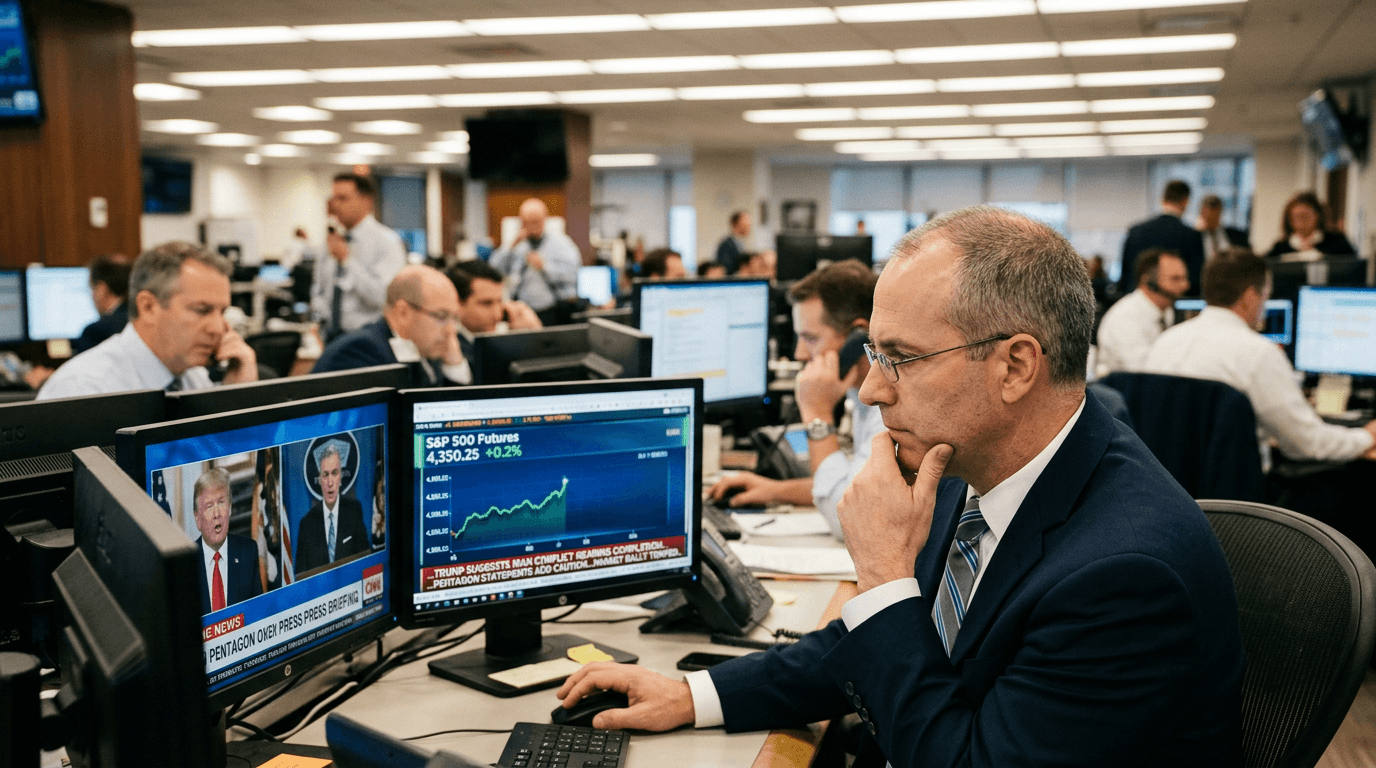
Markets are responding positively to signals that the Iran conflict may be winding down faster than initially anticipated. U.S. index futures posted a modest 0.2% gain on Monday and Tuesday following President Trump's comments suggesting the war is "very complete" and "very far ahead of schedule." This shift in geopolitical risk sentiment highlights how quickly market sentiment can pivot when uncertainty surrounding major conflicts begins to ease, even incrementally.
The backdrop for this market movement is straightforward: when investors perceive reduced geopolitical risk, risk appetite typically improves. Lower expectations for prolonged conflict reduce concerns about energy supply disruptions, military spending escalation, and broader economic instability. Trump's suggestion that American and Israeli forces have already significantly degraded Iran's military capabilities has prompted traders to recalibrate their risk models. The President claimed that Iran's air force, navy, and communications infrastructure have been substantially compromised, with only a "scatter" of missiles remaining.
The Mixed Messaging Dynamic
What makes the current situation particularly interesting from a market perspective is the contradiction embedded in Trump's statements themselves. While he told CBS News the war is "pretty much" complete, he also told Republican lawmakers hours later that "we haven't won enough" and vowed continued military pressure until Iran's leadership is "totally and decisively defeated." This duality creates an unusual market scenario where investors must parse conflicting signals.
The Pentagon further complicated the narrative by posting on social media that "we have only just begun to fight," suggesting military operations may be in earlier stages than the President's public messaging indicated. For traders, this creates ambiguity about the true trajectory of the conflict. Yet markets have chosen to focus on the more optimistic framing, at least in the near term. The modest 0.2% futures gain suggests that investors are pricing in the possibility of earlier-than-expected resolution rather than full conviction in immediate peace.
Timeline Implications And Market Impact
Trump initially estimated the conflict would last four to five weeks. His current messaging that the war is "very far ahead of schedule" implies completion could occur within days or weeks rather than the originally projected timeframe. This acceleration of expectations, even if speculative, provides enough confidence to move markets in a risk-on direction.
The impact on crude oil was particularly notable, with prices sliding following Trump's comments about potentially waiving oil-related sanctions and providing naval escorts in the Strait of Hormuz. This combination of factors signaled to the market that energy supply risks are diminishing. Lower oil prices and reduced geopolitical premiums in energy markets typically support equity valuations, especially for consumer-facing sectors sensitive to fuel costs. Index futures strength reflects this recalibration of energy risk.
Regional And Global Market Divergence
The 0.2% U.S. futures gain stands in contrast to the European Stoxx 50 index falling 0.4%, highlighting how geopolitical developments create divergent impacts across markets. European markets may be experiencing heavier pressure from structural economic concerns or different exposure profiles to Middle Eastern conflict dynamics. Meanwhile, Asia-Pacific markets showed positive momentum on the combination of improved China economic data and reduced geopolitical uncertainty, creating a supportive environment for risk assets.
This geographic divergence underscores an important principle: geopolitical risk doesn't impact all markets uniformly. U.S. equities, particularly large-cap tech and industrial stocks, benefit from both the direct relief of reduced uncertainty and the potential macroeconomic tailwind from lower energy prices. The modest gains in U.S. futures reflect these positive vectors, even if the market is waiting for more concrete developments before dramatically repricing assets.
Investor Takeaways And Forward Outlook
For traders and portfolio managers, the key insight is that geopolitical uncertainty discounts into markets rapidly, and so does its relief. The 0.2% move may seem small in absolute terms, but it represents a meaningful shift in risk sentiment at the global level. Markets that were pricing in prolonged conflict and elevated energy prices are beginning to adjust for a scenario where geopolitical tensions ease more quickly.
However, prudent investors should remain cautious about reading too much into single-day moves or initial policy statements. The contradictions between Trump's various comments, combined with the Pentagon's counter-messaging, suggest meaningful uncertainty remains about the actual conflict trajectory. Markets may be getting ahead of themselves, or they may be correctly interpreting information that proves more reliable than the official mixed signals.
The real test will come from observable developments: are military operations actually slowing? Are diplomatic channels opening? Is energy infrastructure showing signs of stabilization? Until concrete evidence emerges, the current modest market gains should be viewed as a tentative repricing of geopolitical risk rather than a definitive resolution of underlying tensions.