
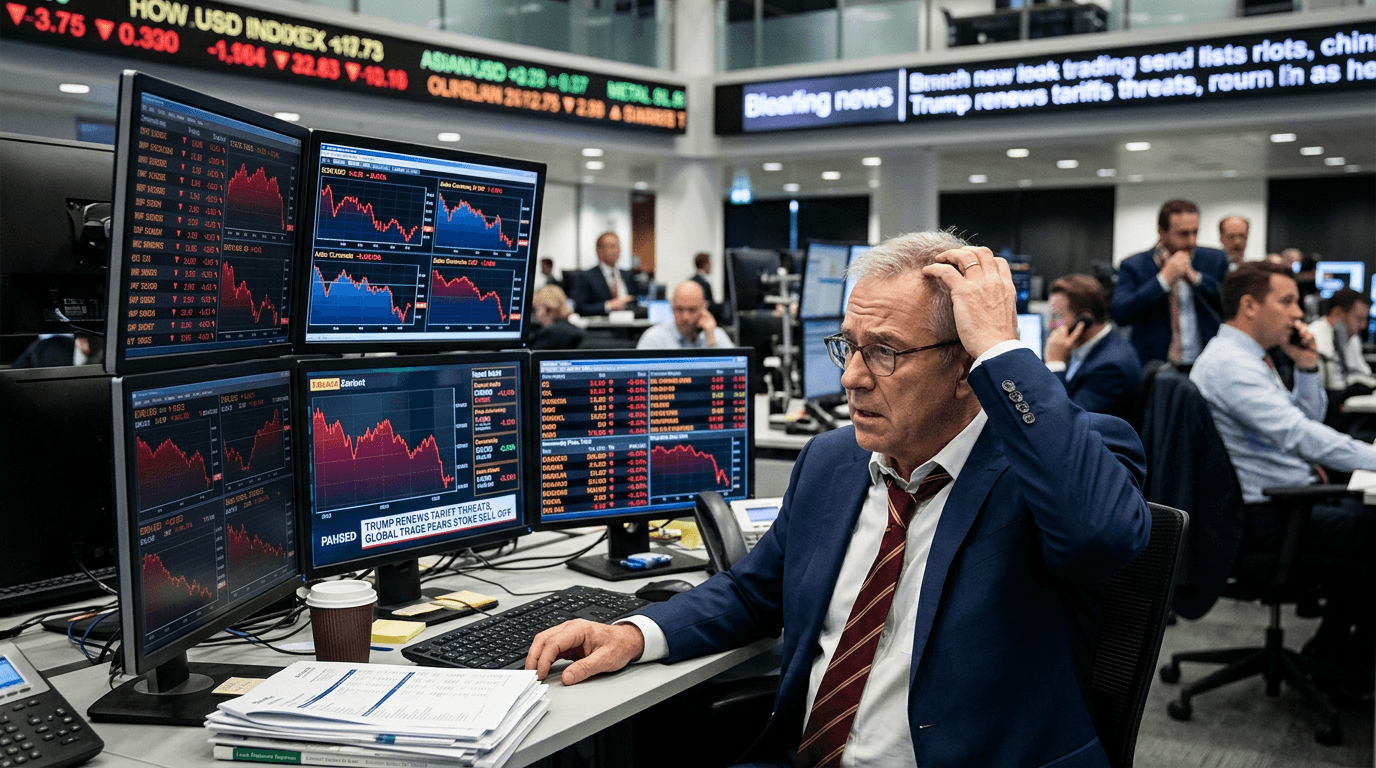
Aggressive tariff talk is back at center stage, and markets are treating it as more than just political noise. Fresh comments from former President Trump have revived the prospect of broad, punitive tariffs on multiple trading partners, renewing concerns that the current fragile trade truce could give way to another full-blown trade war[8][9][12]. For traders, this is a classic macro shock: it hits growth expectations, feeds volatility, and reinforces an already cautious, risk‑off tone across asset classes[6][10][15].
Trade-war Rhetoric Returns
Trump has signaled his willingness to push global tariffs to the legal maximum under Section 122 of the 1974 Trade Act, raising temporary levies from 10% to 15% on imports from all countries[8][9][12]. These comments follow a pattern of escalating tariff threats that have already targeted Canada, Mexico, China and key US allies in Europe over the past two years[4][7][13].
In recent months, the administration has coupled the global 15% tariff framework with more targeted measures, including proposed duties linked to “forced labour” concerns on dozens of economies under Section 301[5][12]. By framing tariffs as a primary policy tool—potentially a partial substitute for income tax—Trump has reinforced the idea that trade barriers could become a semi‑permanent feature of the macro landscape rather than a short‑term negotiating tactic[3][12].
Market Reaction Across Asset Classes
Equity markets have responded predictably: episodes of renewed tariff rhetoric have coincided with sharp equity sell‑offs as investors price in weaker global growth and reduced visibility on corporate earnings[6][10][15]. In past flare‑ups, global stock indices have stumbled, with cyclical sectors such as autos, industrials and materials leading the declines due to their direct exposure to cross‑border supply chains and trade volumes[10][13][15].
In FX, tariff threats tend to push traders toward classic safe havens like the Japanese yen and Swiss franc, while high‑beta currencies and those of export‑sensitive economies underperform[6][13][14]. When markets fear a trade war, capital typically rotates away from trade‑exposed currencies and towards those backed by current‑account surpluses or perceived policy stability, amplifying volatility in major pairs and crosses[6][13][14].
Commodity futures feel the impact via both demand and supply channels. Oil often softens on fears that a trade shock will weigh on global growth and industrial activity[6][15]. At the same time, gold and silver tend to receive a safety bid as investors hedge against policy uncertainty and potential inflationary effects from higher import prices[6][13][15]. For metals tied directly to manufacturing and construction, tariffs can disrupt flows and pricing, but the direction of impact depends on whether a market is more sensitive to demand destruction or supply bottlenecks at any given time[13][15].
Macro Backdrop: Oil, Yields And A Risk-off Tone
The renewed focus on tariffs is arriving in a macro environment where risk appetite is already constrained by elevated bond yields and lingering concerns about energy prices[6][10][15]. Higher yields tighten financial conditions, raising the discount rate on future cash flows and leaving equities more vulnerable to negative growth surprises. When fresh trade‑war headlines hit in this context, they act as an additional shock on top of an already heavy macro load[10][12][15].
Oil’s role is asymmetric. If tariffs cool global growth expectations, oil demand can soften, pushing prices lower and offering some relief to consumers and businesses[6][15]. But sustained trade uncertainty can also delay investment decisions in energy and infrastructure, complicating supply dynamics and keeping volatility high. This cocktail—trade tensions, elevated yields, and choppy energy markets—typically reinforces a “risk‑off” stance: smaller position sizes, tighter risk limits, and greater demand for hedges across portfolios[6][10][15].
What Tariff Risk Means For Active Traders
For discretionary traders, tariff rhetoric is a reminder that macro event risk is as much about policy uncertainty as it is about economic data. Sudden announcements, social‑media posts or press conferences can move markets faster than scheduled releases, particularly when they threaten structural changes to trade relationships[9][11][12]. Being blindsided by such moves can turn a well‑constructed trade into a forced exit if risk is not sized and hedged appropriately.
Systematic traders face a different challenge: tariff shocks can temporarily distort relationships that models rely on, such as the link between growth indicators and equity performance or typical correlations between FX pairs and interest‑rate differentials[13][15]. When policy uncertainty is high, regimes can switch quickly, and historical patterns during calmer periods may not hold. Robust strategies need to incorporate regime‑detection and stress testing around policy‑driven scenarios rather than assuming a stable environment.
Across styles, a few practical takeaways stand out. First, treat major trade statements as potential volatility events and consider reducing leverage ahead of key speeches or announcements. Second, map exposure to trade‑sensitive sectors, currencies and commodities so you understand your implicit bet on tariff outcomes. Third, use options or spread trades to hedge directional risk where appropriate—especially around assets that have historically reacted strongly to trade‑war headlines[6][10][13][15].
Using Simulated Finance To Stress-test Trade-war Scenarios
Simulated Finance platforms like E8 Markets give traders a controlled environment to explore how portfolios might behave under renewed trade‑war pressure without risking real capital. By replaying past tariff episodes—such as earlier rounds of global levies or regional trade conflicts with Canada, Mexico and China—traders can observe how equities, FX and commodities reacted and test strategies against those historical stress periods[4][13][15].
Scenario‑based backtesting is especially valuable in this context. Traders can model paths where global tariffs rise to 15%, certain regions face additional duties, or key trading blocs retaliate with their own measures, then track the impact on P&L, drawdowns and margin usage[8][9][12][13]. This allows for concrete adjustments: rebalancing sector exposure, tweaking FX hedges, or refining entry and exit rules to better handle gap risk and intraday volatility.
SimFi environments also support the development of playbooks for different policy regimes. For example, one playbook might focus on short‑term risk‑off reactions—safe‑haven FX bids, equity sell‑offs and gold strength—while another targets medium‑term opportunities arising from overreactions or eventual policy compromises[6][10][13][15]. By practicing these responses in simulation, traders can move faster and more decisively when similar headlines hit live markets.
Conclusion
Trump’s renewed tariff rhetoric underscores how quickly trade policy can swing from background noise to primary market driver. The combination of potential global levies, targeted measures under long‑dormant legal provisions, and uncertainty about retaliation from trading partners keeps trade‑war risk firmly on the macro radar[5][8][9][12][13]. For traders, the priority is not predicting every political twist but preparing portfolios to withstand policy‑driven volatility. Using tools like scenario analysis and simulated trading, it is possible to turn a noisy, risk‑off environment into a structured set of opportunities—provided risk management stays front and center.