
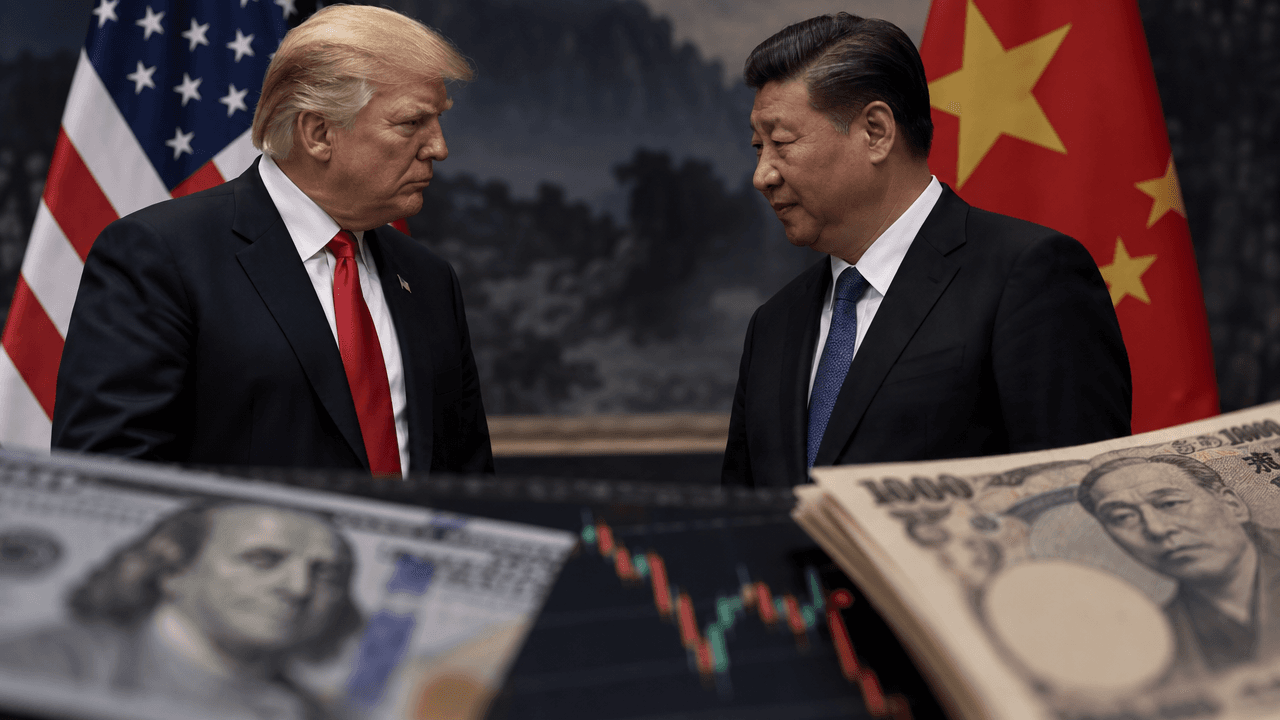
Markets were hoping the latest Trump–Xi summit would reduce uncertainty in the world’s most important bilateral relationship; instead, they got more symbolism than substance and a reminder that geopolitical risk remains firmly on the trading agenda.[7][6][1] At the same time, the Japanese yen has once again shown how quickly it can respond to U.S. political signals, making USD/JPY one of the most headline-sensitive major currency pairs in the current environment.[4][14] For traders on both live and simulated finance platforms, this combination of diplomatic stalemate and political noise is a textbook case of why event risk deserves as much attention as technical levels.
WHAT THE TRUMP–XI SUMMIT REALLY SIGNALS
The Washington summit between President Trump and President Xi was framed as an opportunity to reset the trajectory of U.S.–China relations across trade, technology, and security, but the outcome fell short of any breakthrough on those core issues.[7][6] Readouts from both sides emphasized “strategic guidance” and “constructive stability,” yet concrete deliverables were limited, with talk of extending the existing trade truce rather than striking a new comprehensive deal.[1][11][15] Contentious topics such as AI regulation, Taiwan, and the war in Iran were discussed but left without clear agreements, reinforcing the impression of an uneasy truce rather than a decisive pivot.[7][6][15]
This pattern is consistent with earlier Trump–Xi meetings, which have tended to produce modest economic announcements and rhetorical progress without transforming the underlying strategic competition.[2][9][10] Previous summits in Beijing and other venues likewise ended with statements about successful talks and stronger relationships, while leaving tariffs, technology export controls, and supply-chain dependence largely intact.[9][10][13] For markets, repetition of this cycle signals that the base case remains one of prolonged negotiation and periodic flare-ups, rather than a rapid normalization of U.S.–China economic ties.[2][11][15]
Understanding that context matters because it shapes expectations around growth, trade flows, and risk sentiment. When traders see headlines about “no breakthroughs” after a major summit, they read them as confirmation that uncertainty will persist, and that the probability of future shocks—from sanctions to tariff changes to supply-chain restrictions—remains elevated.[7][3][15] That persistent uncertainty, rather than any single policy tweak, is what often drives demand for safe-haven assets and amplifies sensitivity in currency pairs like USD/JPY.
WHY THE YEN REACTS TO U.S. POLITICAL SIGNALS
The yen’s reaction to recent U.S. political headlines is not a new phenomenon; it reflects the currency’s longstanding role as a safe haven and funding currency in global markets.[8][4] Japan’s large external surplus, deep government bond market, and history of low interest rates have made the yen a go-to asset when investors seek safety or unwind carry trades during periods of heightened risk.[8][5] When political headlines out of Washington hint at instability, policy uncertainty, or future economic friction, global investors often reduce risk and rotate toward safer assets, supporting the yen in the process.[4][14]
Recent price action underscores this sensitivity. USD/JPY has been trading near multi-decade extremes, hovering around the ¥158-per-dollar area at times as strong U.S. data and expectations of further Federal Reserve tightening lifted the dollar.[8][14] Yet the pair has also shown abrupt swings when market narratives shift—from robust growth and higher rates to concerns about geopolitical tensions or policy missteps—underscoring how quickly political signals can change the balance between the dollar and the yen.[4][14] Remarks from U.S. leaders that investors interpret as increasing global risk, even if they do not immediately alter economic fundamentals, can therefore catalyze sharp moves as traders reassess the probability of future shocks.[4][5]
For yen traders, this means watching more than just economic calendars and central bank speeches. Statements from the White House, hints about trade negotiations, commentary on Taiwan or Iran, and even the tone of summit press conferences can feed directly into risk appetite, volatility expectations, and demand for safe-haven currencies.[7][6][13] The Trump–Xi summit’s lack of concrete progress, combined with headline risk around how both sides frame the outcome, is precisely the kind of backdrop where the yen’s political sensitivity tends to show up in intraday USD/JPY moves.
IMPLICATIONS FOR USD/JPY TRADERS
In a market where USD/JPY can pivot on a headline, traders need a structured approach to political and event risk. Price levels near historic extremes amplify the importance of timing, because even small shifts in sentiment can translate into large moves in a highly crowded trade.[8][14] FX desks have noted how quickly USD/JPY can jump when traders revise their expectations for Fed rate hikes or for the trajectory of U.S.–China relations, with recent sessions showing sizable responses to both macro data and political news.[4][5][14]
A practical takeaway is that news flow must be treated as a core input to the trading plan, not a distraction. Event calendars should include summit dates, expected press conferences, and potential policy announcement windows alongside macro data releases and central bank meetings.[7][6] Scenario planning around those events—asking what happens to USD/JPY if talks end with a stalemate versus a surprise deal—helps traders predefine how they will respond rather than reacting emotionally in real time.[3][15] Options markets can also provide clues: elevated implied volatility around key dates often signals that the market expects meaningful headline risk, even if the baseline outcome is “no breakthrough.”[4][14]
Risk management becomes especially important when political narratives are fluid. Tight stops placed too close to the market can be vulnerable to headline-driven spikes, while oversized positions increase the risk of being forced out at the worst possible moment. Many experienced FX traders therefore scale positions around major events, diversify across currency pairs, and use options to hedge tail risks when uncertainty is highest.[4][5] In the current environment, with U.S.–China relations in a prolonged negotiation phase and the yen responsive to every perceived shift in U.S. policy tone, position sizing and diversification are as important as the direction of the trade itself.
Using Simulated Finance To Practice Political-risk Trading
For traders using simulated finance platforms such as E8 Markets, the Trump–Xi summit and the yen’s reaction to political signals offer an ideal case study to practice event-driven trading without real capital at risk. SimFi environments allow traders to build and test playbooks around specific categories of news: leadership summits, tariff announcements, central bank commentary, or geopolitical flare-ups. By replaying periods when USD/JPY moved sharply on U.S. political headlines, traders can see how different strategies—momentum, mean reversion, or options hedging—would have performed under stress.[4][14]
One effective exercise is to construct “if–then” rules for various headline scenarios and test them in simulation. For example: if a summit ends with clear progress and markets interpret it as reducing trade risk, then how should USD/JPY behave, and what signals would justify a long-dollar, short-yen position? If, as in the latest summit, the outcome is a stalemate with no breakthrough, how might risk-off flows and safe-haven demand support the yen, and how should that shape intraday tactics?[7][6][3] By comparing these rules with actual historical price action, traders refine their intuition about how political narratives and FX flows connect.
Simulated trading also helps embed discipline around risk management. Traders can experiment with different stop-loss placements, position sizes, and diversification strategies in a headline-driven environment, learning how often “noise” leads to whipsaws and how frequently genuine regime shifts follow major diplomatic events.[4][5] Over time, that experience builds the confidence to navigate real markets where political and macro forces interact in complex ways, and where the cost of improvised decisions can be high.
Conclusion
The latest Trump–Xi summit underscores a broader message for markets: diplomacy can maintain an uneasy stability without resolving the underlying sources of economic and strategic tension.[7][6][15] That ongoing uncertainty keeps political risk front and center, sustaining the yen’s role as a barometer of global risk appetite and making USD/JPY particularly sensitive to how traders interpret U.S. political signals.[4][14] For both live and simulated traders, the lesson is clear: success in FX trading today requires integrating geopolitical analysis, event calendars, and disciplined risk management into the core of the strategy, not treating them as add-ons. By doing so—and by using platforms like E8 Markets to practice in a SimFi environment—traders can turn headline noise into structured opportunity rather than unmanaged risk.