
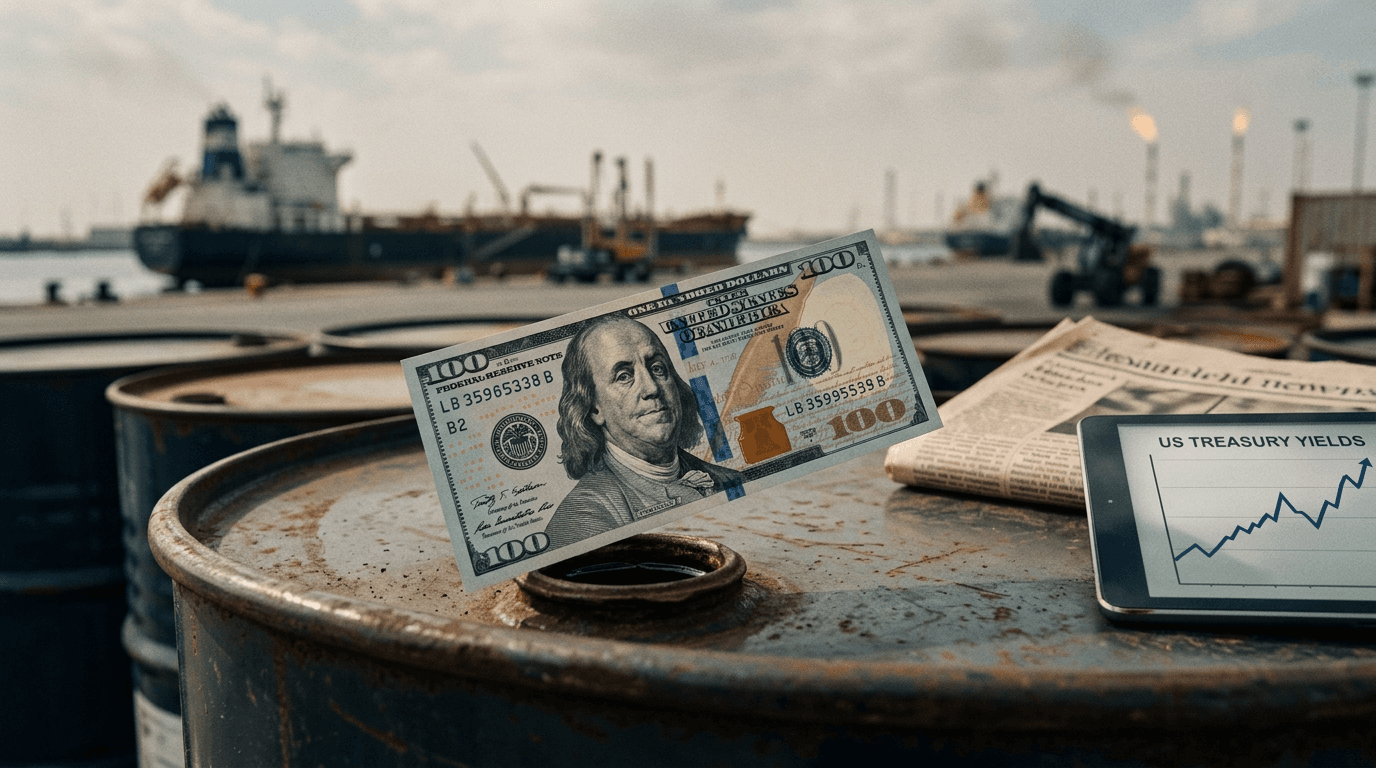
THE GEOPOLITICAL PERFECT STORM
The US dollar's ascent to 2026 highs is fueled by a confluence of geopolitical tensions in the Middle East and structural energy economics, creating a prime environment for safe-haven demand and petrodollar appreciation. What began as a regional conflict has escalated into a global currency phenomenon, challenging bearish dollar predictions and prompting institutional traders to swiftly reverse entrenched short positions. As tanker traffic through the Strait of Hormuz drops by approximately 70%, Brent crude oil prices have soared past $83 per barrel, with effects rippling across major currency pairs and fixed-income markets worldwide.
At the heart of this dollar strength is the classic safe-haven dynamic, amplified by energy market disruptions. Iran's threats to international shipping and military actions targeting merchant vessels have precipitated an immediate supply crisis. Oil traders are factoring in dire scenarios where prolonged regional tensions could drive crude prices toward $100 per barrel, fundamentally reshaping energy inflation and currency dynamics. This isn't mere speculation—WTI has surpassed six-month highs near $78.43, while Brent aggressively climbs to levels not seen since June 2025.
The petrodollar effect plays a critical role here. When oil prices surge, global energy importers face a cash-flow imperative: they need US dollars to buy crude at inflated prices, creating organic demand for the greenback just when sentiment is most fragile. The result has been swift and apparent. The Dollar Index has soared to 2026 highs, breaching key resistance zones and eyeing the 99.50 level with strong momentum. Technical analysts are keenly observing for a push toward 100.00 to 100.50 if market stress escalates.
This rally is particularly notable as it contradicts recent bearish sentiment. Institutions like JP Morgan had prepared for dollar weakness heading into 2026. However, the geopolitical premium has forced a tactical shift. Large fund managers and trading desks are now buying dollars across major currency pairs, unwinding substantial speculative short positions that reached five-year highs just last month.
The Inflation-yields Feedback Loop
Beyond petrodollar mechanics, another powerful force is driving dollar strength: the inflation-yields transmission mechanism. Rising oil prices feed directly into inflation expectations, driving up 10-year Treasury yields as investors seek compensation for diminishing purchasing power. Higher yields enhance the appeal of dollar-denominated assets, creating a self-reinforcing feedback loop that attracts both real money flows and technical positioning.
This dynamic places the Federal Reserve in a challenging position. The central bank had anticipated pausing rate hikes as economic activity slowed through early 2026. However, energy-driven inflation may necessitate a complete recalibration of monetary policy expectations, keeping the Fed's stance restrictive longer than previously assumed. This scenario bolsters dollar strength across multiple dimensions: higher yields attract real money flows, safe-haven flows intensify, and petrodollar demand rises organically. All three forces converge in the same direction.
The euro has become the primary casualty in this repricing. Europe, more reliant on Middle Eastern energy supplies than the US, faces a worsening energy crisis reminiscent of 2022 when the Ukraine conflict sent gas prices soaring. The energy inflation gap is stark: natural gas prices in Europe have surged 39 percent compared to just 3.5 percent in the US. This divergence favors dollar strength and pressures the euro. EUR/USD has fallen toward 1.168 from earlier levels, with continued weakness likely if oil rallies persist.
Positioning And Technical Levels
The technical landscape reveals notable asymmetries in how dollar strength has unfolded. Historical comparisons highlight a key divergence: following the Russia-Ukraine crisis, oil prices rose 32 percent within three months, while the dollar gained 15 percent over the subsequent two months. Currently, Brent crude has surged 56 percent since Iran tensions escalated, yet the greenback has appreciated only 2 percent. This discrepancy suggests the dollar remains undervalued relative to energy price moves and could have significantly more room to appreciate.
In currency pairs, EUR/USD short positions remain appealing with targets toward 1.1615 and 1.159 if oil sustains elevated levels. Conversely, dollar weakness against commodity-linked currencies like the Norwegian krone has been limited, making pairs like USD/NOK less attractive for dollar bulls aiming for further strength.
What Traders Should Watch
Oil prices remain the key barometer for dollar trajectory. If WTI holds above current levels or climbs toward $100, expect continued dollar rallies and equity market pressure. However, if supply disruptions prove temporary and prices revert below $73.50, risk sentiment should recover, and dollar strength may face significant headwinds. The duration of Middle East tensions, Strait of Hormuz accessibility, and any de-escalation developments will ultimately determine whether this energy crisis becomes a structural tailwind or a temporary shock that quickly mean-reverts.
For traders, this environment demands flexibility and scenario planning. Dollar strength appears well-founded on multiple transmission mechanisms, but energy markets remain inherently volatile and geopolitically dependent. Position sizing accordingly and maintaining clear exit strategies remains essential.