
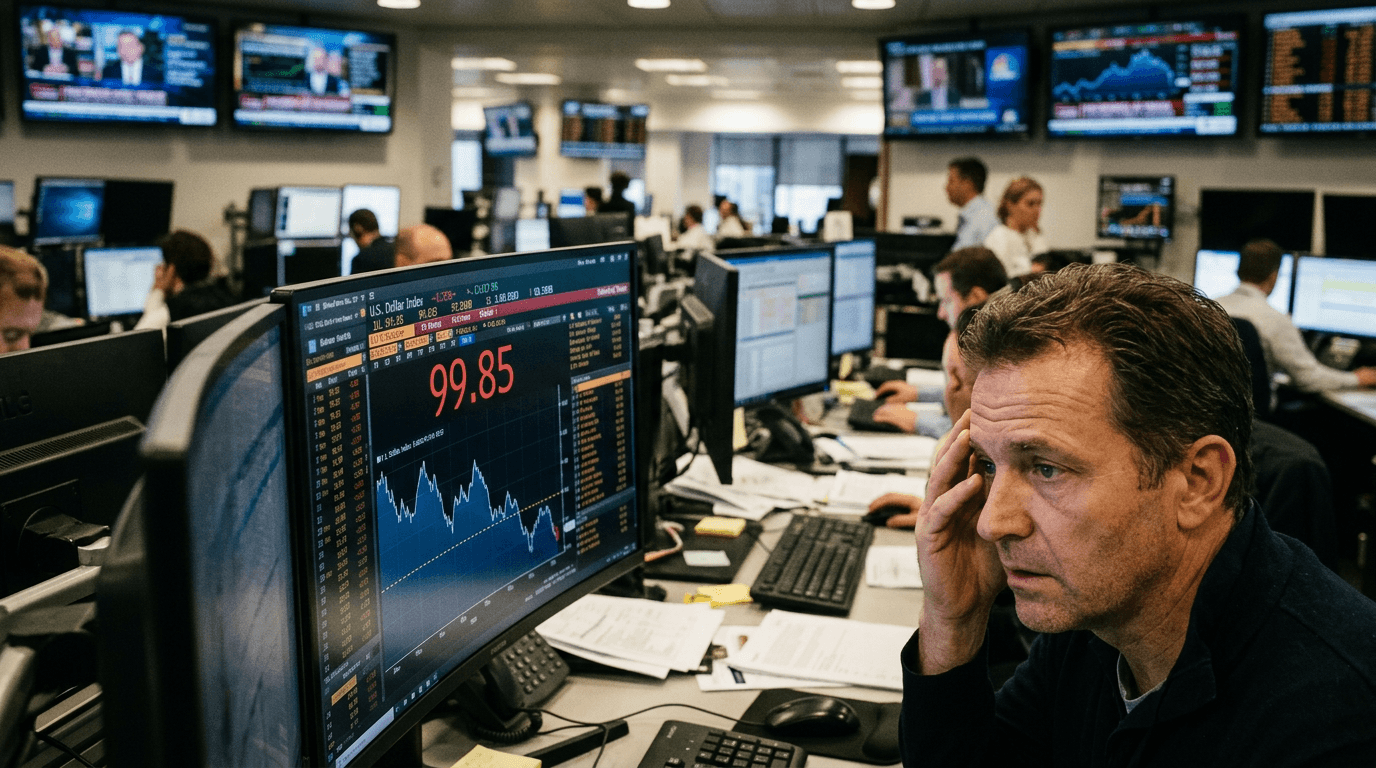
The US Dollar Index has shattered a critical psychological barrier that traders have watched closely for nearly three years. For the first time since July 2023, the DXY has definitively broken below the 100 level, signaling a fundamental shift in how global markets are evaluating US monetary policy, economic resilience, and geopolitical risk. This breakthrough isn't merely a technical adjustment—it reflects mounting concern about US trade policies, recession risks, and the broader implications of tariff tensions with China that have rattled markets in recent weeks.
The Significance Of The 100 Level
The 100 mark on the US Dollar Index represents far more than an arbitrary number. This benchmark measures the dollar's strength against a basket of six major world currencies: the Euro, Japanese Yen, British Pound, Canadian Dollar, Swedish Krona, and Swiss Franc. For over a decade, this level has functioned as a critical support zone and psychological anchor for institutional investors, central banks, and multinational corporations. When an index breaches such a round-number level with substantial trading volume, it typically triggers significant institutional money flows and signals a meaningful shift in currency strategies. The current breakdown is particularly noteworthy because the 100 level marks the dollar trading weaker than its historical average since the index's inception in 1973. A sustained move below this threshold suggests traders are genuinely losing confidence in the dollar's traditional strength narrative.
Tariff Tensions And Policy Uncertainty
The immediate catalyst for the dollar's decline stems from escalating trade tensions with China and uncertainty surrounding US import tariffs. Recent pauses in tariff implementation have raised questions about the administration's commitment to its stated policy objectives, creating volatility in currency and equity markets alike. This policy uncertainty comes at a particularly sensitive time, as traders are reassessing the fundamental strength of the US economy. Rather than providing the dollar with safe-haven demand, the trade uncertainty has actually dampened demand for US assets as investors seek clarity on the economic impact of potential tariffs. Additionally, concerns about recession risks have surfaced as tariff-induced inflation pressures and business uncertainty could weigh on consumer spending and corporate investment. When recession risk rises, investors typically flee to perceived safe havens, but conflicting signals from US policy have muddied the traditional safe-haven trade.
Technical Breakdown And Momentum Indicators
From a technical standpoint, the decline below 100 displays unmistakably bearish characteristics. Charts reveal a clear pattern of lower highs and lower lows, indicating institutional selling pressure rather than casual profit-taking. The most significant signal is the "death cross"—the 50-day moving average has crossed below the 200-day moving average, a classic pattern traditionally associated with sustained downward momentum. Trading volume surged during this breakdown, confirming that this move carries institutional conviction rather than thin-liquidity driven volatility. Key support levels to monitor include 99.70, 98.50, and critically, the 2025 lows near 96.50 to 97.00. If the DXY breaches the 98.50 zone, further losses could accelerate. A break below 97.50 would signal a clearer, longer-term reversal with potentially significant implications for capital flows across asset classes. On the upside, 100.20 to 100.50 represents a potential recovery area, with stronger resistance around 101.60 and 103.
Implications For Forex And Commodities
The weakening dollar has immediate ramifications across multiple asset classes. Currency pairs like EUR/USD have rebounded to higher levels as the Euro strengthens relative to a softening dollar. European investors who had been cautious about dollar-denominated assets are actively reducing exposure, further pressuring the greenback. Commodity traders should carefully monitor that many commodities are priced in dollars, meaning dollar weakness typically provides upside support for commodity prices. This creates a complex trading environment where traditional correlations may be tested. A sustained weak dollar could provide relief to commodity-importing nations while pressuring exporters. Oil prices, precious metals, and agricultural commodities may all find support from continued dollar weakness, even as geopolitical tensions add their own volatility.
What Traders Need To Do Now
For traders and investors, the path forward requires vigilant monitoring of several critical factors. Track the 98.50 support level closely—a breach below this would confirm deeper weakness ahead. Monitor Federal Reserve communications intently for any hints about future rate cuts or policy adjustments. Keep a detailed eye on economic data releases, particularly employment reports and inflation figures. These indicators will ultimately determine whether this breakdown leads to a sustained downtrend or merely a temporary pullback. Evaluate the implications for your currency pair positions and commodity exposure. If you hold dollar-long positions, consider your risk tolerance and whether this breakdown signals the need for portfolio adjustments. Set clear stop-loss levels based on the technical support zones mentioned, and remain flexible as new information emerges regarding trade negotiations and economic data.
The US Dollar Index breaking below 100 represents a pivotal moment in currency markets. This isn't just about the dollar weakening—it's about shifting expectations for US economic growth, policy effectiveness, and the sustainability of the current geopolitical trade environment. Traders who remain positioned on the wrong side of this trend could face significant losses, while those who adapt their strategies may find opportunities in the emerging currency dynamics.
---