
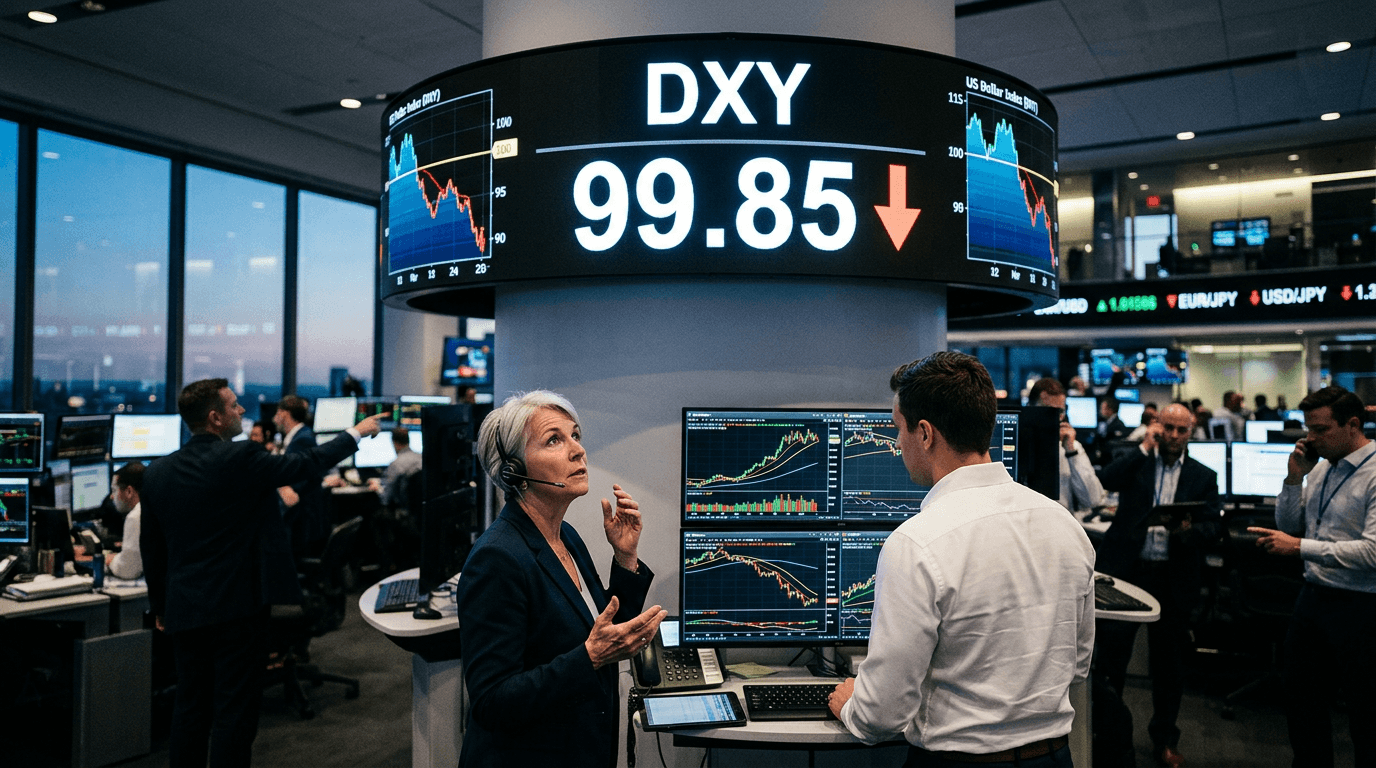
US Dollar Index Dives Below 100: A New Era for Forex Traders
The US Dollar Index (DXY) has plunged beneath the pivotal 100 mark, a threshold that traders have vigilantly observed for over a decade. This descent, the first since July 2023, signifies far more than a mere technical adjustment—it's a profound reconfiguration of currency market dynamics. The drop reflects a waning of the dollar's safe-haven appeal, ongoing tariff uncertainties, and a comprehensive reevaluation of global economic prospects. As institutional investors and central banks recalibrate their currency strategies, the effects ripple through forex markets, impacting everything from EUR/USD rates to broader investment portfolio strategies.
Understanding the significance of the 100 level is crucial for traders maneuvering through current market conditions. The US Dollar Index gauges the greenback's strength against a basket of six major world currencies, with the Euro holding a dominant 57.6% influence, alongside the Japanese Yen, British Pound, Canadian Dollar, Swedish Krona, and Swiss Franc. Since its inception in 1973, a reading below 100 indicates that the dollar is trading weaker than its historical average. For over a decade, the 100 level has served as a vital support and resistance zone, monitored by retail traders, central banks, multinational corporations, and institutional investors worldwide. When the DXY decisively crosses this threshold with significant trading volumes, it typically signals institutional money flowing out of the dollar and a genuine shift in market sentiment rather than a fleeting fluctuation.
Forces Reshaping Dollar Dynamics
Multiple factors have converged to drive the dollar lower, challenging its historical dominance. Tariff tensions and policy uncertainties have spurred volatility beyond traditional currency fundamentals, creating a storm of selling pressure. Concurrently, robust economic data from regions like the Eurozone has steadily eroded the dollar's traditional safe-haven appeal. With global risk appetite improving, investors find fewer reasons to seek refuge in US assets, naturally diminishing demand for dollars. This shift away from the dollar's recent strength, previously buoyed by geopolitical tensions and perceived stability, marks a significant departure. The combination of weakening fundamental support and deteriorating technical structures has finally breached the 100 level.
Technical Breakdown and Support Levels
From a technical standpoint, the dollar faces rising challenges beyond the 100 level breach. The 50-day and 200-day moving averages have crossed into a death cross formation, a classic bearish signal indicating sustained selling pressure. Intraday chart analysis reveals a sharp drop followed by modest recovery, highlighting the heightened volatility and uncertainty gripping traders. Key support levels now hover near 98.50, a zone untested since early 2023. If the DXY breaches this critical support, losses could extend further, potentially testing the 2025 lows near 96.50 to 97.00. On the upside, 99.50 is a critical zone under scrutiny. The 100.20 to 100.50 range is particularly crucial; if the dollar sustains above this level, it might rise towards 101.60. However, given current momentum indicators and the breach of major technical structures, the risk of further downside remains elevated despite any attempted recovery bounces.
Implications for Forex Traders and Investors
The DXY's fall below 100 has immediate repercussions for major currency pairs. EUR/USD and GBP/USD pairs have capitalized on dollar weakness, presenting attractive opportunities for traders anticipating continued euro and sterling strength. The breach opens new technical scenarios and trading ranges that were not viable when the dollar remained above 100. For investors and traders, this environment demands increased attention to both technical levels and fundamental catalysts. Economic data releases, particularly inflation and employment figures, could swiftly reverse the dollar's weakness, pushing it back above 100. Conversely, data supporting expectations of slower growth or earlier Federal Reserve rate cuts could drive the dollar to even lower levels, testing support zones that held firm during previous weakness episodes.
Navigating the Path Ahead
The US Dollar Index's dive below 100 represents a complex narrative intertwining technical breakdowns with a fundamental shift in currency market drivers. While chart patterns suggest continued vulnerability for the dollar, its ultimate direction will hinge on the resurgence of traditional catalysts like relative interest rates and global risk sentiment. Traders should remain vigilant regarding forthcoming economic releases and Federal Reserve communications, as these catalysts could quickly reshape the dollar's trajectory. The current environment presents both risks and opportunities; positioning must account for the possibility of further weakness testing lower support zones as well as the potential for stabilization and recovery if fundamental factors shift suddenly. Navigating this market successfully requires balancing technical awareness with fundamental analysis while maintaining flexibility to adapt to rapidly evolving geopolitical and economic conditions.
NEWS IMPACT SCORE: 7