
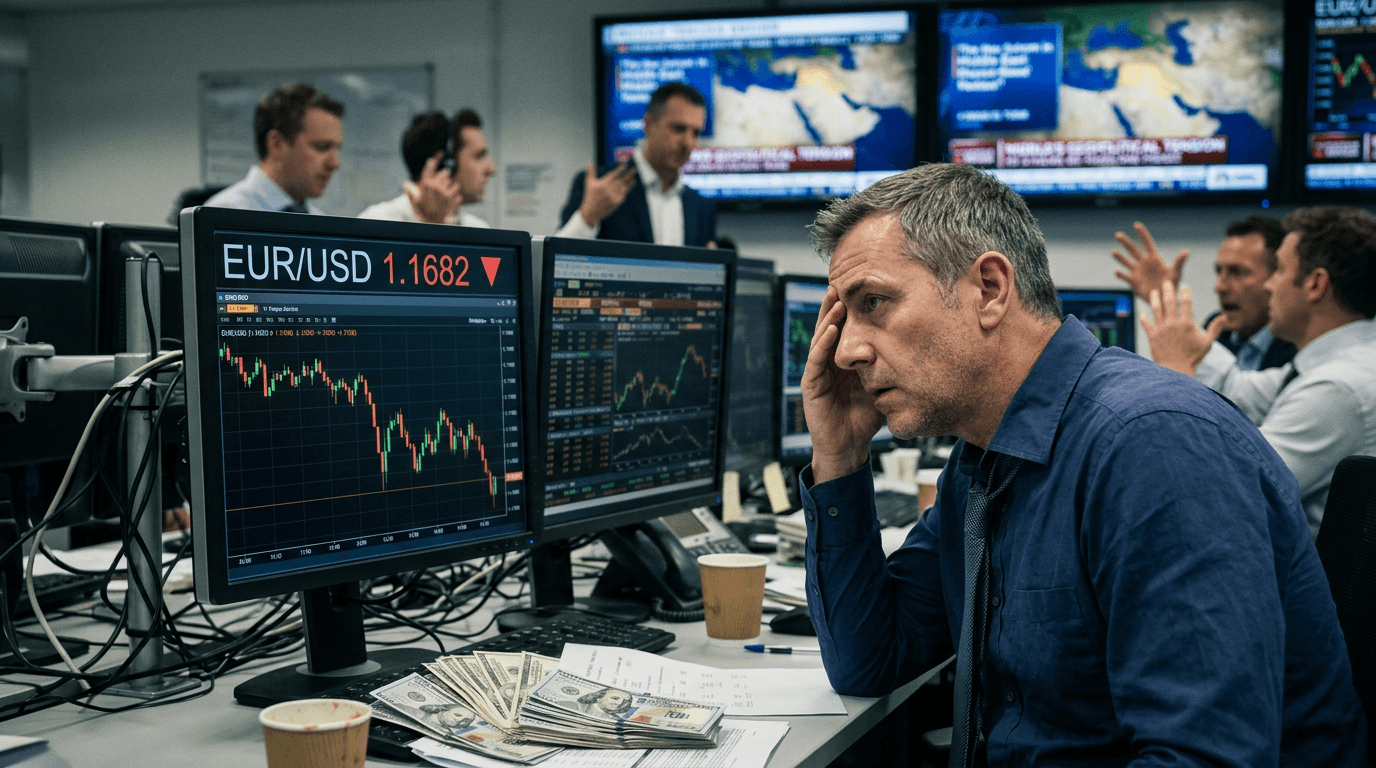
Geopolitical tensions in the Middle East have triggered a significant rally in the US dollar, pushing the EUR/USD pair to multi-month lows as investors scramble to shift capital into safe-haven assets. Following military strikes on Iran by the United States and Israel over the weekend, currency markets experienced sharp movements that reflect the classic risk-off sentiment that emerges during periods of global uncertainty. The Dollar Index surged 0.8% to 98.38, its highest level in over five weeks, while EUR/USD plummeted 0.9% to 1.1707, signaling a major reversal in currency dynamics that traders need to understand.
The Geopolitical Shock And Market Reaction
The escalation in the Middle East represents a significant departure from the relatively contained regional conflicts we've seen in recent years. The strikes that killed Iranian Supreme Leader Ali Khamenei, combined with subsequent Iranian retaliation across multiple countries including Israel, the UAE, Qatar, Bahrain, and Kuwait, have created an environment of heightened uncertainty. President Trump's statement that military operations would continue "for as long as necessary" underscores the risk of prolonged conflict, a factor that has weighed heavily on investor sentiment.
When geopolitical risks emerge suddenly, markets typically experience what analysts call a "shock and adjustment" period. Initial reactions tend to be extreme as traders react to headline news without complete information. However, what we're observing in this case is not just panic selling across all asset classes. Instead, we're witnessing a more nuanced market response where capital is flowing strategically toward assets perceived as safer stores of value.
Safe-haven Demand Driving Dollar Strength
The surge in the US dollar reflects a fundamental truth about financial markets: during periods of uncertainty, investors prioritize safety over yield. The dollar's status as the world's reserve currency makes it the default destination for flight-to-safety flows. This dynamic was evident in the sharp appreciation of the dollar against virtually all major currency pairs, though the impact on EUR/USD has been particularly pronounced.
David Morrison, senior market analyst at Trade Nation, noted that "the U.S. dollar remains the go-to safe-haven currency for investors," reinforcing the idea that reports of dollar weakness due to de-dollarization may have been premature. This is a critical insight for traders who have been betting on dollar weakness in recent months. A major geopolitical event can quickly reverse structural trends that appeared to be well-established.
The flight to dollar safety has extended to other traditional safe-haven assets as well. Gold prices climbed 1.8% on the day, reflecting investor anxiety about the broader implications of Middle East escalation. However, the dollar's outperformance relative to other safe-haven assets demonstrates its unique position in the global financial system.
ENERGY PRICES AND THE EUR/USD BREAKDOWN
One critical factor driving the EUR/USD decline is the spike in crude oil prices. Brent crude surged 13% in early Asian trading, briefly topping 82 dollars per barrel before settling at lower levels. While some feared oil could spike to 100 dollars, current projections suggest this would require an extended disruption of Middle Eastern oil flows, such as a closure of the Strait of Hormuz.
For Europe, rising energy prices present a particular challenge. The region's relative dependence on imported oil and natural gas means that higher energy costs directly impact economic growth and inflation expectations. Analysts at ING indicated that EUR/USD could face significant downside pressure, with potential levels around 1.1575 to 1.1650, with outside risk moving toward 1.1575 to 1.1600. The energy shock creates a dilemma for European policymakers who are trying to support economic growth while managing inflation pressures.
In contrast, the United States is much better positioned to weather an oil price spike, importing only about 7% of its crude needs from the Middle East. This structural advantage for the US economy relative to Europe and Asia further supports dollar strength during a period of elevated energy prices.
Broader Implications And The Inflation-growth Tradeoff
The Middle East conflict has created a stagflation scenario that presents a genuine policy dilemma for the Federal Reserve. Higher oil prices typically stoke inflation concerns, which argues against rate cuts. However, the uncertainty surrounding geopolitical developments could slow economic growth, which typically supports rate cuts. This creates a challenging environment where the Fed risks reigniting inflation by cutting too soon or further damaging growth by holding rates too high.
The impact on other currency pairs reflects these dynamics. The Japanese yen fell against the dollar as traders priced in a more cautious Bank of Japan, reducing expectations for near-term rate hikes. Meanwhile, the Swiss franc surged to its strongest level against the euro in more than a decade, reflecting its status as another safe-haven currency.
What This Means For Traders
For traders and investors, this episode offers several lessons. First, geopolitical events can quickly reverse established market trends. Second, safe-haven flows remain real and powerful forces that can override structural narratives about currency weakness. Third, asset price correlations shift during crisis periods, and traditional diversification strategies may not provide expected protection. Finally, the direction of major currency pairs like EUR/USD will depend heavily on how the Middle East situation evolves, making it essential to monitor developments closely and adjust positions accordingly.