
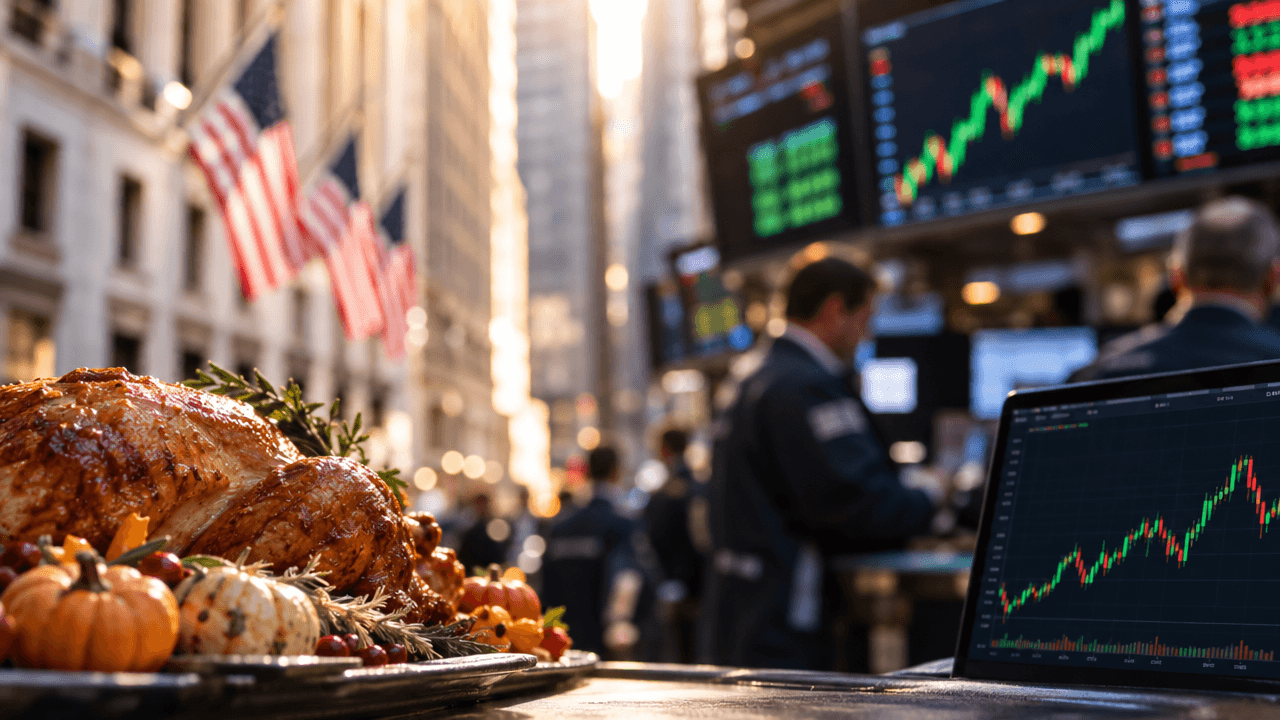
U.S. equity futures are pointing to a stronger Wall Street reopening after the Thanksgiving holiday, with investors returning to the market in a notably optimistic mood. Dow futures were recently up about 1.2%, while S&P 500 futures gained approximately 1.8%. The move suggests renewed appetite for risk, but the holiday-shortened session could also make price swings sharper than usual. [8][10]
A positive futures signal does not guarantee a sustained rally. Futures reflect expectations before the cash market opens, and those expectations can change quickly as traders respond to volume, headlines, economic data, and institutional order flow. For traders using simulated finance accounts, Friday offers a useful case study in how market conditions—not just direction—can influence execution and risk.
What The Futures Move Is Signaling
The gains across the major index futures point to broad-based buying rather than strength confined to one market segment. The Dow’s rise suggests improved sentiment toward large, established companies, while the stronger performance in S&P 500 and Nasdaq-linked contracts indicates that technology and growth stocks are helping lead the rebound.
Other reports showed Nasdaq 100 futures gaining close to 3% at one point, with S&P 500 futures up around 2% and Dow futures higher by roughly 1.3%. [9] These figures can move before the opening bell, especially when liquidity is limited, but they illustrate the market’s initial preference for buying stocks that had recently come under pressure.
The immediate question is whether the opening gains attract follow-through buying or become an opportunity for traders to take profits. A strong open followed by weakening breadth may indicate that the rally is losing momentum. Conversely, if advancing stocks remain broad and index futures hold near their premarket highs, sentiment may be improving more decisively.
Why Ai Stocks Remain Central
Artificial intelligence-related shares continue to dominate the market narrative. Investors are weighing two competing ideas: the long-term potential of AI-driven earnings growth and concerns about elevated valuations, capital spending, and whether recent expectations have become too aggressive.
Recent trading has been particularly volatile as market participants reassess the cost of developing AI infrastructure and the eventual return on those investments. Reuters reported that AI-linked stocks had been moving sharply in both directions as investors considered more attractive valuations alongside concerns about heavy technology spending. [6]
That tension creates opportunities and risks. A beaten-down technology stock may rebound quickly when sentiment improves, but a high-beta share can also reverse just as rapidly if the broader market weakens. Traders should avoid treating a futures rally as proof that every AI-related company has regained a durable uptrend.
A more disciplined approach is to separate market exposure from company-specific exposure. In a simulated trading environment, this could mean comparing a position in an index future or broad exchange-traded fund with a concentrated position in a volatile AI stock. The comparison can reveal how much of a trade’s result came from overall market direction and how much came from individual-stock risk.
Holiday Liquidity Can Magnify Moves
U.S. markets were closed for Thanksgiving on Thursday and are scheduled to operate for only a half-day on Friday, with regular stock trading ending at 1 p.m. Eastern Time. [13] Shortened sessions often produce lighter participation, particularly from institutional traders and investors who remain away from their desks.
Lower volume can have two important effects. First, relatively small orders may move prices more than they would during a normal session. Second, technical levels may be breached temporarily without representing a meaningful change in market conviction. A rapid move through support or resistance is therefore more difficult to interpret when fewer participants are active.
Traders should also be cautious about using normal-session assumptions for stops and position sizing. A stop placed too close to the entry price may be triggered by a brief liquidity-driven fluctuation. At the same time, widening a stop without reducing position size can increase the potential loss. The most consistent solution is to determine the maximum acceptable dollar risk first and calculate the position size from that figure.
The Jobs Report Is The Next Test
The market’s attention will soon shift from holiday positioning to the November employment report. The U.S. Bureau of Labor Statistics is scheduled to release the data on Friday, December 4, at 8:30 a.m. Eastern Time. [2][3]
Employment data can influence several markets at once. A stronger-than-expected report may support stocks if it reinforces confidence in economic growth, but it can also pressure growth shares if investors believe stronger labor conditions could keep interest rates higher for longer. A weaker report may increase expectations for easier monetary policy while raising concerns about economic momentum.
This creates a scenario in which the same headline can produce different reactions depending on market positioning. If traders are already expecting a weak report, a merely soft result may not generate much buying. If expectations are optimistic, a small disappointment could lead to a sharp reversal.
For SimFi traders, the practical lesson is to prepare for multiple outcomes rather than predict one number. Mark important index levels, identify the economic release time, reduce unnecessary leverage, and decide in advance how much volatility the strategy can tolerate.
Practical Takeaways For Traders
First, treat the futures rally as an opening indication, not a guarantee of a full-session advance. Confirm whether market breadth, volume, and price action support the initial move.
Second, monitor AI-related shares without assuming that sector strength is uniform. Leadership can rotate quickly between semiconductor companies, software firms, cloud providers, and broader technology names.
Third, respect the risks of a shortened holiday session. Wider spreads, sudden reversals, and temporary price dislocations can make otherwise reasonable strategies perform poorly.
Finally, keep the December jobs report on the trading calendar. The report may become a larger catalyst than Friday’s reopening, particularly if it changes expectations for economic growth or interest rates.
Conclusion
The higher futures point to a constructive reopening after Thanksgiving, but the signal should be interpreted with discipline. Strong gains in Dow, S&P 500, and Nasdaq-linked contracts show that buyers are returning, while the rebound in AI shares suggests risk appetite has not disappeared.
Still, light holiday participation can exaggerate both gains and losses. The most effective response is not to chase the opening move, but to study confirmation, manage exposure, and prepare for the next major catalyst. In simulated finance, that process provides a valuable way to test decisions under realistic market conditions without allowing a single volatile session to define a trading plan.